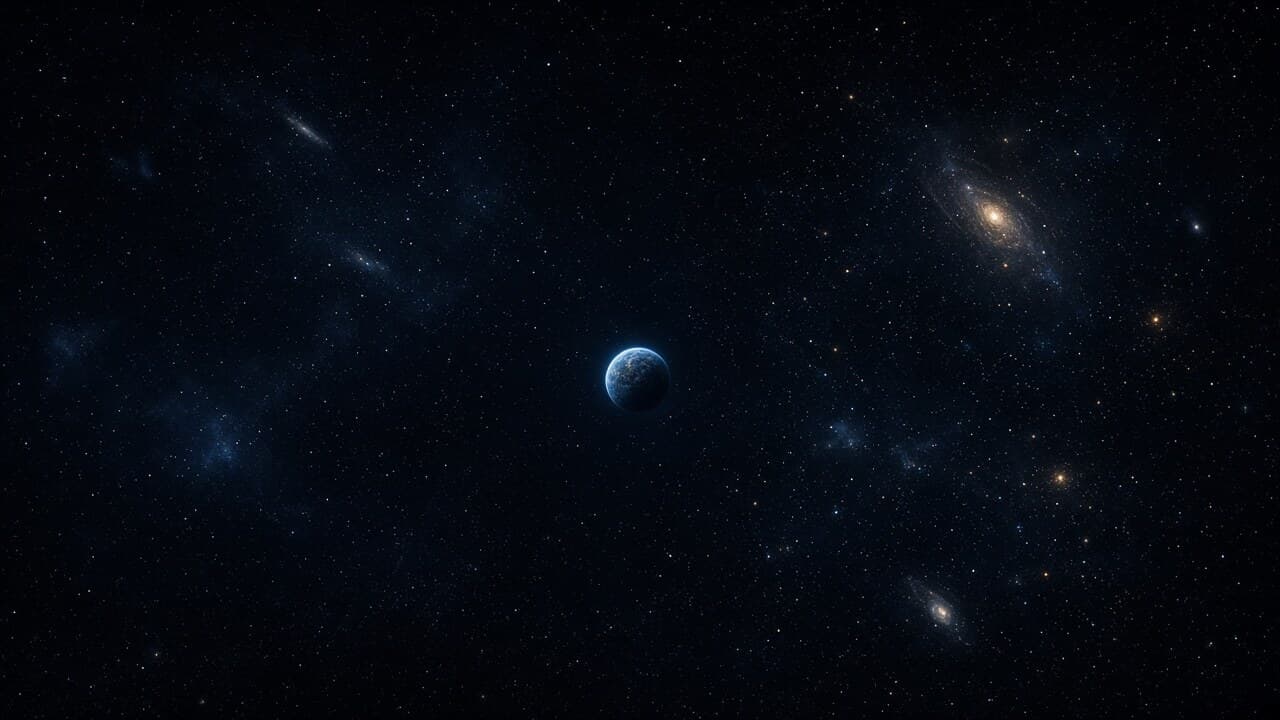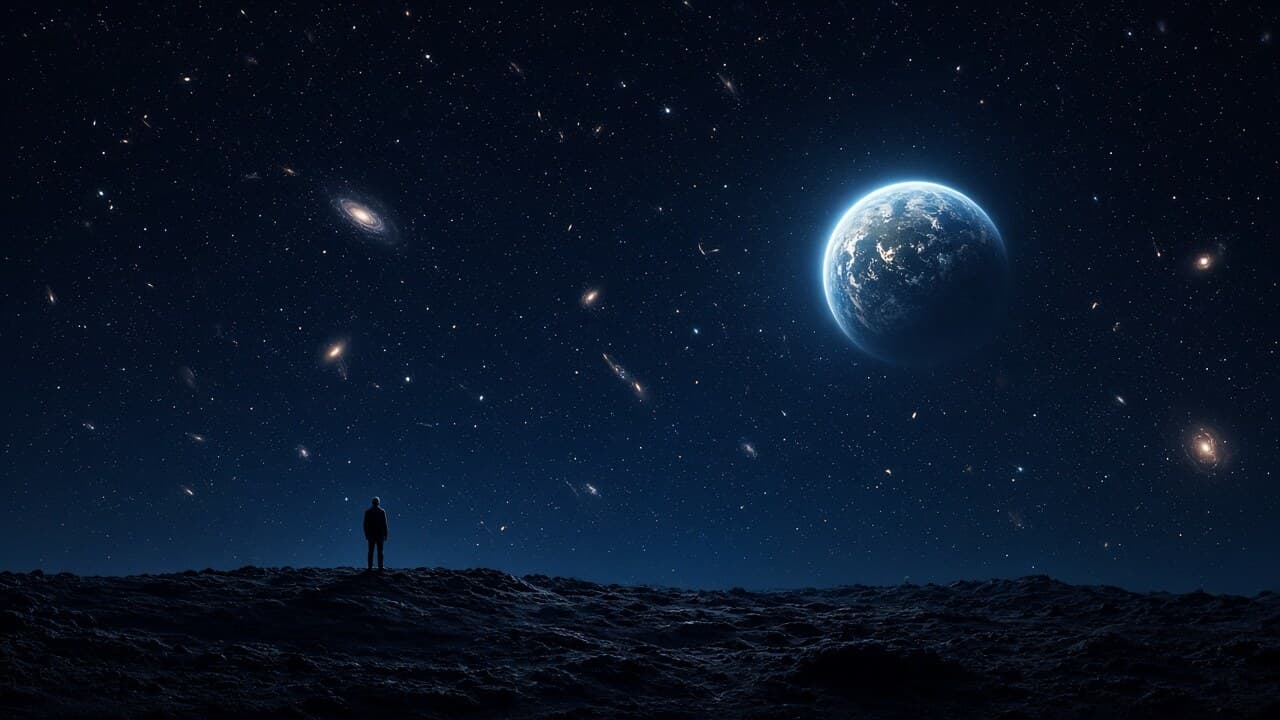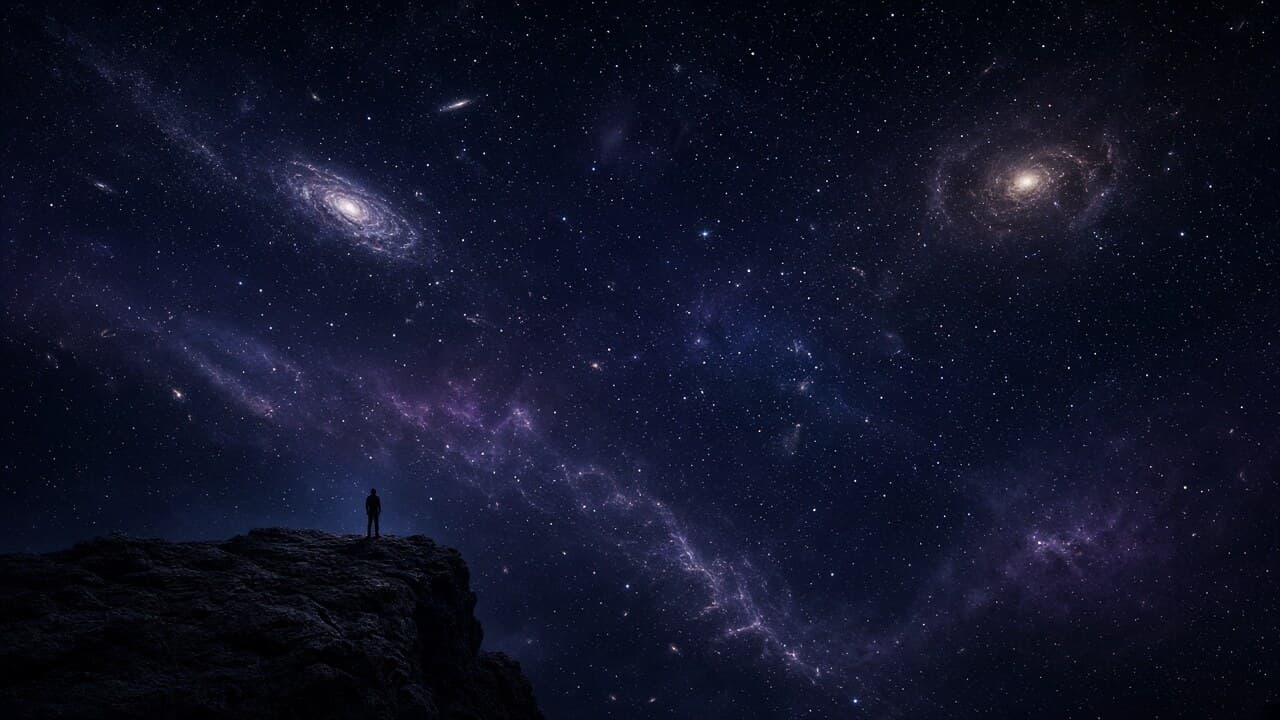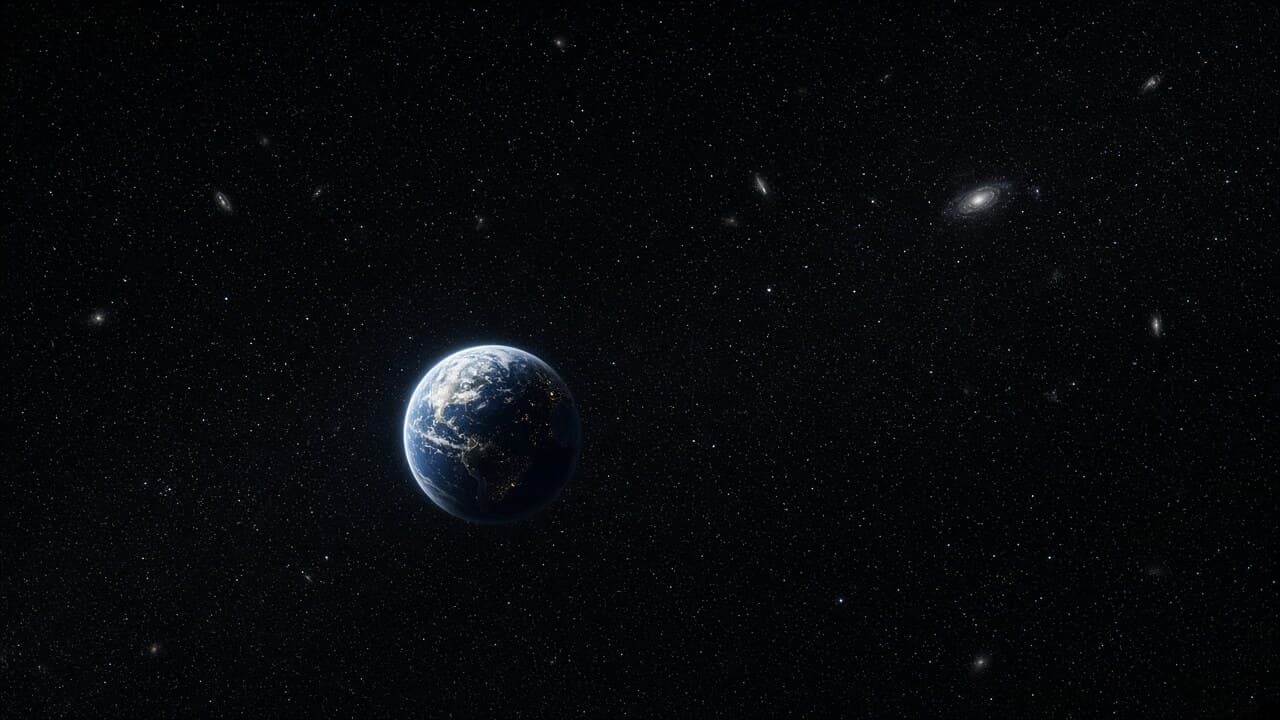
Imagine looking up at the night sky and realising that every star may be the centre of its own planetary system. Some planets could have oceans, atmospheres and conditions suitable for life. Some worlds may have existed billions of years before Earth. So why, after all this time, does the universe appear so silent?
Somewhere in the enormous cosmic landscape, life could have emerged long before Earth existed. Perhaps it evolved into intelligent beings, developed technology and eventually looked towards the stars.
And yet, when humanity listens to the universe, we hear almost nothing. No confirmed alien message. No verified extraterrestrial spacecraft. No unmistakable technological signal from another star.
In 1950, physicist Enrico Fermi reportedly raised a version of this question during a conversation with colleagues at Los Alamos National Laboratory. His question was simple: “Where is everybody?”
That question became associated with one of astronomy's most famous puzzles: the Fermi Paradox. Its possible answers range from the surprisingly ordinary to the deeply unsettling.
This article goes beyond the basic paradox and examines the explanations that make the silence feel most unsettling—from the Great Filter and Rare Earth ideas to the Zoo Hypothesis, Dark Forest scenarios and the limits of our searches. For a broader overview of the paradox itself, see our earlier guide to the Fermi Paradox.
The observable universe is approximately 13.8 billion years old. Our Milky Way galaxy contains hundreds of billions of stars, and it is only one galaxy among an immense number in the observable universe.
In 1995, astronomers confirmed a planet orbiting a Sun-like star outside our Solar System. Since then, thousands of exoplanets have been discovered. By November 2026, the NASA Exoplanet Archive listed more than 6,400 confirmed exoplanets. The count changes as new discoveries are confirmed.
Astronomers often discuss the habitable zone: the region around a star where a planet could, under suitable atmospheric conditions, have liquid water on its surface.
Earth remains the only world where life has been confirmed. The discovery of thousands of other planets has expanded the search, but it has not yet answered whether life exists elsewhere.
The Fermi Paradox is named after physicist Enrico Fermi, who reportedly asked “Where is everybody?” during a 1950 conversation at Los Alamos. The exact details come from later recollections rather than a published paper by Fermi himself. The broader argument was developed further by other scientists in the decades that followed.
- Our galaxy contains an enormous number of stars.
- Many stars have planetary systems.
- Some planets may have environments suitable for life.
- The galaxy is billions of years old.
- Civilisations that emerged much earlier than humanity could have had enormous amounts of time to develop advanced technology.
Some theoretical models suggest that a wave of interstellar expansion could cross the Milky Way in tens of millions to perhaps around 100 million years, depending heavily on spacecraft speed, settlement rates and assumptions about a civilisation's behaviour.
That is short compared with the age of the galaxy. But the argument assumes that civilisations want to expand, can sustain such projects and leave detectable traces. None of those assumptions is guaranteed.
Where is everybody?
In 1961, astronomer Frank Drake introduced a mathematical framework to organise the discussion about extraterrestrial intelligence. It became known as the Drake Equation. Rather than providing a definite answer, it breaks the question into smaller variables.
Astronomy has improved our understanding of some early terms, especially the prevalence of planets. But we still have only one confirmed example of life: Earth. We do not know how often life begins, how often intelligence develops or how long technological civilisations remain detectable.
Change those assumptions and the result changes dramatically. The Drake Equation is not a machine that calculates the number of aliens. It is a framework for identifying what we still need to learn.
Imagine the journey from lifeless matter to an advanced civilisation as a staircase. Life must emerge, become complex, develop intelligence and eventually create technology capable of communicating or travelling between stars. What if one of those steps is extraordinarily difficult?
This is the central idea behind the Great Filter. Economist Robin Hanson developed the concept in his 1998 essay, asking whether an extremely unlikely barrier exists between lifeless matter and a civilisation capable of spreading through the galaxy.
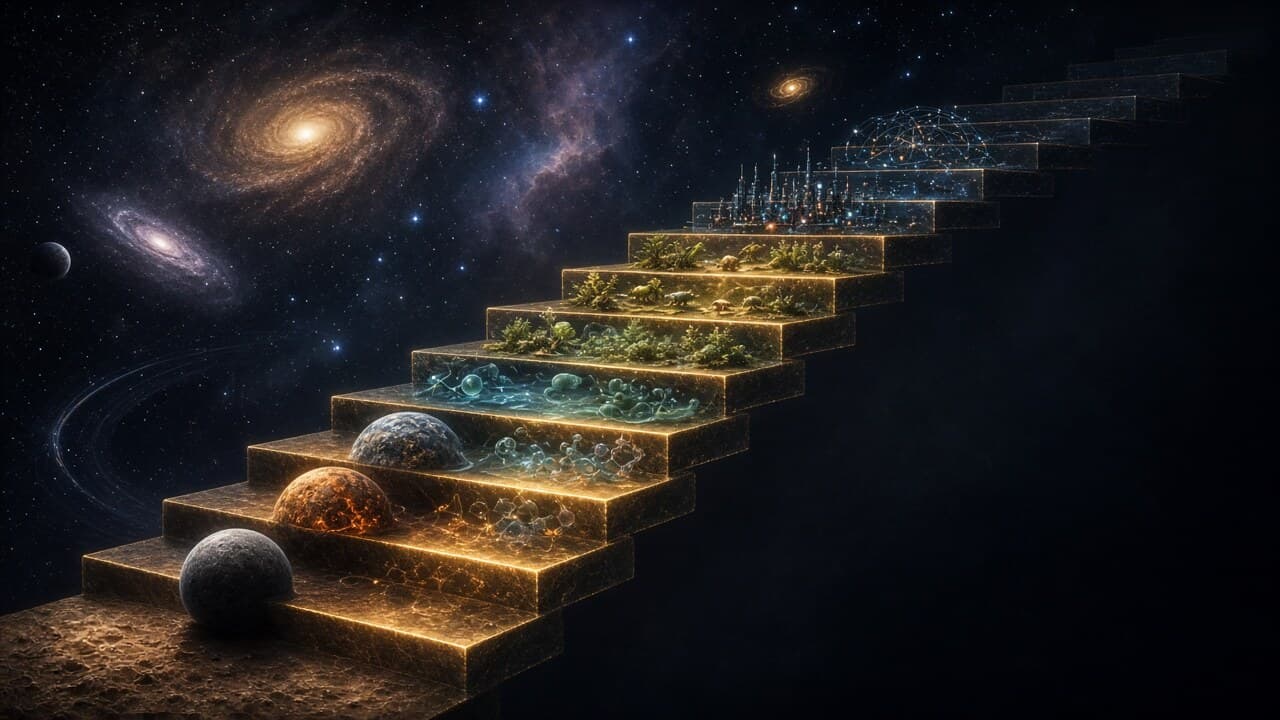
Perhaps the emergence of life is incredibly rare. Maybe the transition from simple life to complex cells almost never happens, or the development of technological intelligence requires an unusual chain of events. If so, humanity may already have passed the Great Filter.
That would mean intelligent civilisations are rare because the universe rarely produces them in the first place. We would be unusual, but not necessarily doomed.
Perhaps intelligent civilisations frequently emerge, develop advanced technologies and eventually reach a stage where their own capabilities become dangerous. They might destabilise their environment, create technologies they cannot safely control or experience another civilisation-ending catastrophe.
The idea nevertheless raises a serious question about our own future: can a technological civilisation become powerful enough to destroy itself before it becomes wise enough to survive?
What if intelligent civilisations are out there, know Earth exists and have deliberately decided not to contact us? Astronomer John A. Ball proposed the Zoo Hypothesis in 1973.
Imagine a nature reserve. Animals live inside it, unaware that humans are observing them. The humans do not interfere because they want the animals to develop naturally. The hypothesis imagines Earth as something similar: an advanced civilisation might observe humanity while avoiding direct contact.
There is no confirmed evidence that an extraterrestrial civilisation is observing Earth. A 2024 Nature Astronomy perspective by Ian Crawford and Dirk Schulze-Makuch explored the Zoo Hypothesis as one possible response to the apparent absence of technological civilisations. It did not demonstrate that the hypothesis is true.
The Dark Forest Hypothesis imagines the universe as a dark forest. Every civilisation is like a hunter moving quietly through the trees. Nobody knows who else is nearby or whether another civilisation is friendly or hostile. Revealing your location could expose you to danger.
The analogy became widely known through Liu Cixin's science-fiction novel The Dark Forest, part of the Remembrance of Earth's Past trilogy. It has also been discussed as a speculative strategic explanation for the Fermi Paradox.
- Civilisations must see one another as potential threats.
- They must be uncertain about one another's intentions and capabilities.
- They must have the ability to attack across interstellar distances.
- They must believe that pre-emptive destruction is safer than communication or cooperation.
We have no evidence that alien societies follow these rules. Interstellar distances also make attacks difficult and slow. The Dark Forest is a thought experiment, not a confirmed description of the galaxy.
Maybe the universe is full of planets, but very few develop complex life. The Rare Earth Hypothesis, popularised by Peter Ward and Donald Brownlee, argues that Earth may have benefited from an unusual combination of conditions.
- Long-term access to liquid water.
- A climate that remained suitable over geological timescales.
- A suitable atmosphere and planetary chemistry.
- Geological processes that may help regulate the carbon cycle.
- A stable source of energy from the Sun.
- A planetary history that allowed life to develop and persist.
No single factor guarantees life, and scientists still debate which conditions are essential, optional or replaceable. Evolution also has no predetermined goal of producing technological intelligence. On Earth, life existed for billions of years before humans appeared.
Perhaps microbial life is common, but technological intelligence is rare. That could explain why a universe containing life might still have very few civilisations capable of communicating with Earth.
What if a dangerous stage of technological evolution begins when a civilisation creates machines that become more capable than their creators can reliably control? Artificial intelligence is advancing across science, communication, medicine, engineering and many other fields.
A sufficiently capable civilisation might use AI to solve difficult problems and explore space. It might also become dependent on systems it does not fully understand or struggle with conflicts over who controls powerful technology.
There is no evidence that AI inevitably destroys its creators, or that extraterrestrial civilisations have encountered such a barrier. The useful question is whether a civilisation can develop increasingly powerful tools while retaining meaningful control over their use.
The nearest star system to the Sun, Alpha Centauri, is about 4.37 light-years away. Light itself takes more than four years to travel between us and that system. A signal from a civilisation thousands of light-years away could take thousands of years to arrive.
Distance also creates a timing problem. Imagine one civilisation broadcasts radio signals for 200 years, then disappears or changes its communication technology. Another civilisation develops radio 50,000 years later. Both existed, but their detectable communication periods never overlapped.
A galaxy could have hosted many civilisations throughout its history without having many detectable civilisations at the same time. We may simply be arriving at the wrong moment.
When people say scientists have searched the universe and found nothing, it can sound as though every star has been examined. That is not true. SETI uses radio telescopes and other instruments to look for possible signs of technology beyond Earth.
- Narrow-band radio signals.
- Repeating or unusual electromagnetic patterns.
- Optical laser pulses.
- Unusual infrared emissions.
- Possible atmospheric signs of industrial activity on distant planets.
A signal might be too weak, use a frequency we have not examined, be directed elsewhere or be transmitted only briefly. A civilisation might not use radio technology at all.
A technosignature is an observable feature that could indicate the presence of technology. An advanced civilisation using enormous amounts of energy might release waste heat, potentially creating unusual infrared signatures. Researchers have explored possible large-scale structures around stars, sometimes discussed in connection with Dyson spheres.
So far, there is no confirmed detection of extraterrestrial technology. That does not mean the search has proved nobody exists. It means we have not found convincing evidence yet.
We often imagine extraterrestrial intelligence as biological beings with cities, spacecraft and radio transmitters. But intelligence could develop in forms very different from our own. A civilisation might communicate through methods we have not imagined, or eventually become largely machine-based.
Our search methods are shaped by our technological history. We began with radio because humans developed radio. We study atmospheric chemistry because we understand some of the processes associated with life on Earth.
An unfamiliar civilisation could be difficult to recognise. But this possibility should not become an excuse to explain away every absence of evidence. A useful hypothesis must eventually make predictions that observations can test.
| Possible explanation | What it suggests |
|---|---|
| Rare Earth | Complex life or intelligence may be extremely uncommon. |
| Great Filter | One or more stages of evolution or civilisation are extraordinarily difficult. |
| Zoo Hypothesis | Advanced civilisations may deliberately avoid contacting us. |
| Dark Forest | Civilisations may remain silent because they fear potential threats. |
| Technological transition | Civilisations may change into forms we do not recognise. |
| Vast distances | Signals and visitors may be too far away or difficult to detect. |
| Short communication windows | Civilisations may not exist at the same time as detectable neighbours. |
The most important distinction is between the possibility that the hardest step is behind us and the possibility that it is still ahead. Perhaps life or intelligence is extraordinarily rare. Alternatively, perhaps technological civilisations frequently emerge but rarely survive their own development.
We do not know which possibility is correct. The Great Filter is a framework for thinking about why we do not see the evidence we might expect under certain assumptions, not an established scientific law.
What if humanity is not late to the cosmic conversation? What if we are early? The universe is approximately 13.8 billion years old, but stars and planetary systems have different lifetimes. Many low-mass red dwarf stars can remain stable for vastly longer than the Sun.
Perhaps technological intelligence is rare. Perhaps the conditions needed to create it are more difficult than we currently understand. Perhaps humanity is among the first civilisations to develop technology capable of searching beyond its own planet.
We cannot establish that we are early from the evidence available today. It is one possibility among many. It would be equally premature to conclude that nobody is out there simply because our first searches have not found anyone.
The honest answer is that we do not yet know how common life is. That uncertainty is not a weakness of science. It is the reason the search matters.
The universe may not be empty. We may simply be arriving at the wrong moment—or asking the wrong questions.
For billions of years, stars have formed, planets have emerged and galaxies have evolved. On at least one small planet, life developed, became increasingly complex and eventually produced a species that learned to look beyond its atmosphere.
We built radio telescopes, launched space observatories, discovered thousands of planets around distant stars and searched for signals. And still, we have no confirmed evidence of extraterrestrial intelligence.
Perhaps intelligent life is incredibly rare. Perhaps civilisations do not survive long enough to communicate. Perhaps the distances between stars are simply too great. Perhaps we are looking for something that does not resemble us.
The Fermi Paradox is not proof that aliens exist, that they are hiding or that humanity is approaching its own destruction. It is a reminder of how much we still do not know.
We have not searched everywhere, in every way, for long enough to declare that we are alone. The universe is enormous. The silence is real. But the answer is still waiting to be discovered.
Continue with the Fermi Paradox overview, what if Earth were alone, and why humans believe in aliens.
Cosmic Silence FAQ
What is the Fermi Paradox?
Who first asked, “Where is everybody?”
What is the Great Filter theory?
Are aliens hiding from humanity?
What is the Dark Forest Hypothesis?
How many planets have scientists discovered outside our Solar System?
Does being in the habitable zone mean a planet has life?
Have scientists detected an alien signal?
Could artificial intelligence be the Great Filter?
Are humans alone in the universe?
What this framework clarifies — and what remains open
What works
- The Fermi Paradox provides a useful framework for exploring the search for extraterrestrial intelligence.
- The Drake Equation separates a huge question into smaller research questions.
- Exoplanet discoveries have made the search for potentially habitable worlds more concrete.
- SETI and technosignature research provide testable ways to investigate possible technological life.
What doesn't
- The key biological and civilisation-related variables remain deeply uncertain.
- The absence of a detected signal does not prove that extraterrestrial life does not exist.
- Many proposed explanations, including the Zoo and Dark Forest hypotheses, are difficult to test.
- Popular versions of the paradox sometimes assume that all civilisations want to expand or communicate, which may not be true.