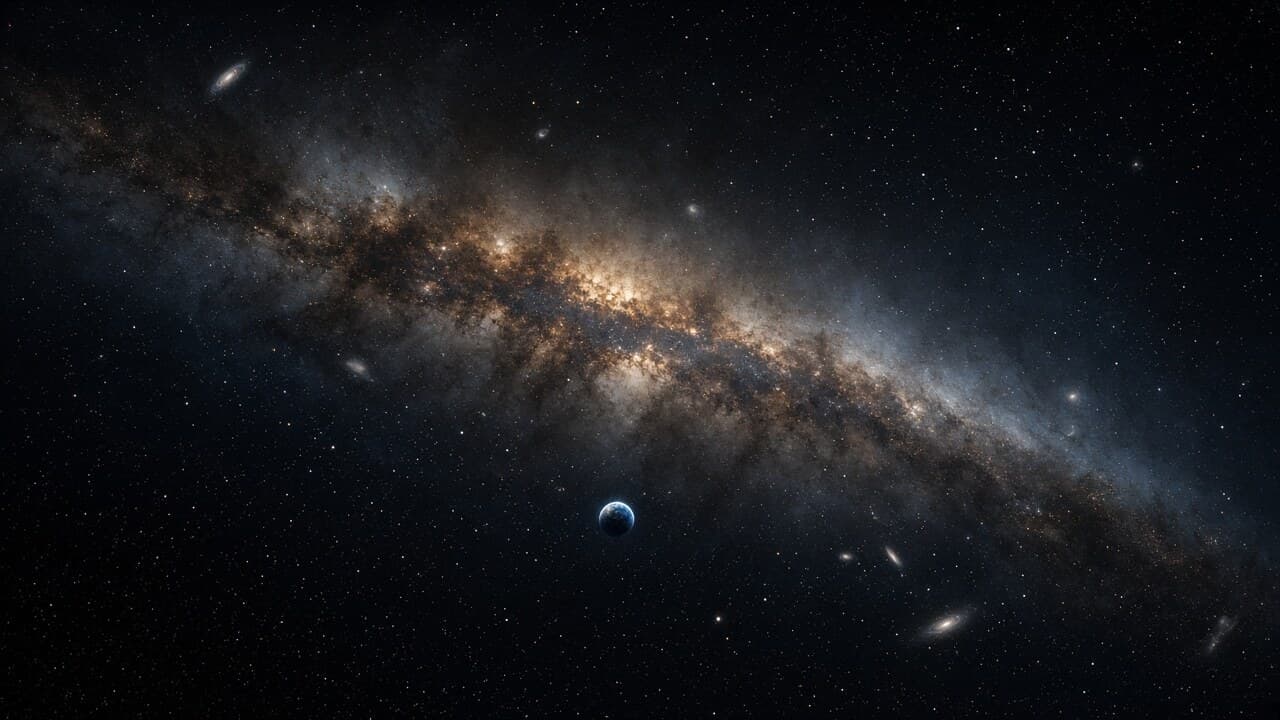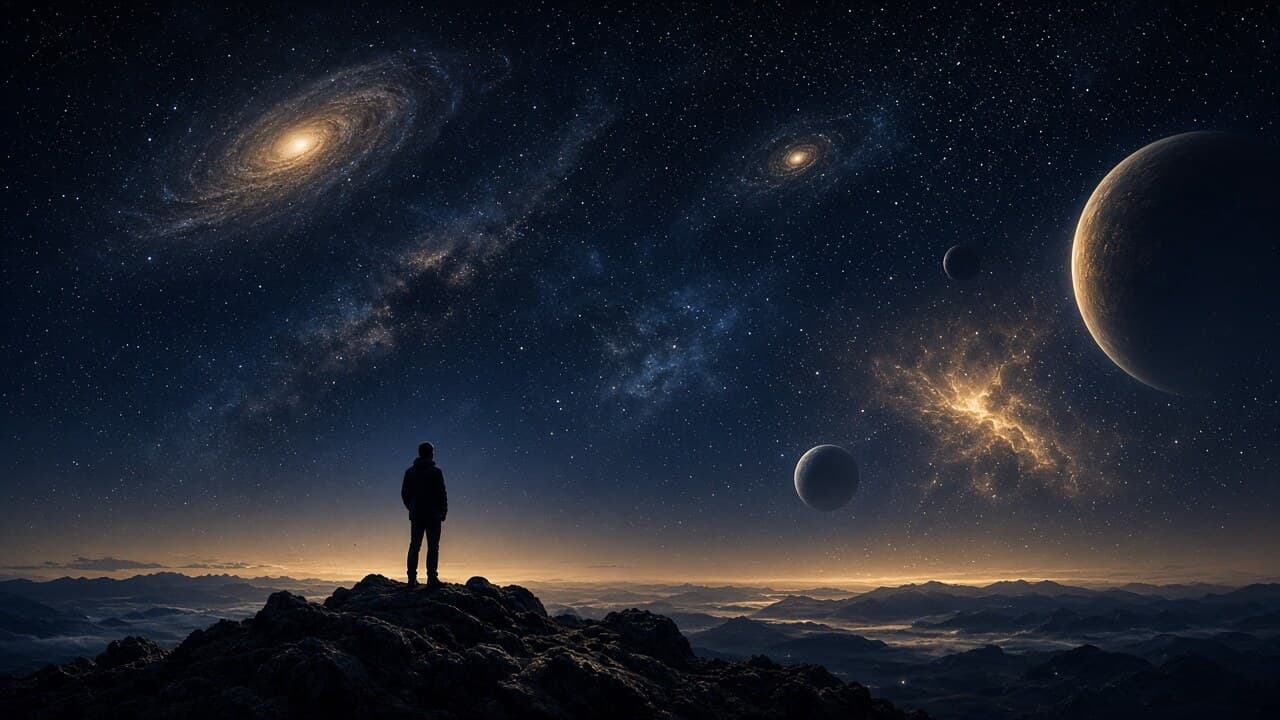
Imagine looking up at the night sky and realizing that every tiny point of light could be a star, many stars could have planets, and some of those planets might offer the ingredients for life. Now imagine that somewhere among those worlds, another civilization has developed science, built cities, explored its solar system, and looked toward the stars with the same question we ask today: Are we alone?
The observable universe contains an enormous number of galaxies. Our own Milky Way contains hundreds of billions of stars, and astronomers have confirmed thousands of planets beyond our solar system. Some orbit within their stars' habitable zones, where liquid water could potentially exist under suitable atmospheric conditions.
With so many possible places for life to emerge, it is tempting to imagine that the cosmos should be full of civilizations. Perhaps some have existed for millions of years longer than humanity. Perhaps others have developed technologies we cannot yet imagine.
Yet we have no confirmed evidence of life beyond Earth, no verified message from an extraterrestrial civilization, and no universally accepted discovery of alien technology.
This apparent contradiction is known as the Fermi Paradox. It asks a deceptively simple question: if intelligent life could be common in such a vast universe, why have we not found convincing evidence of it?
The answer could be surprisingly ordinary, profoundly unsettling, or something we have not considered. To understand the possibilities, we need to examine what scientists know, what remains uncertain, and why the silence itself has become one of astronomy's most fascinating mysteries.
The Fermi Paradox is named after physicist Enrico Fermi, who became associated with the question of why we do not observe evidence of extraterrestrial civilizations despite the enormous size and age of the universe.
The underlying reasoning is straightforward. The Milky Way has existed for billions of years. Stars and planets formed long before Earth appeared, and some other worlds could have had much longer periods in which life might develop. If technological civilizations arise relatively often and some expand beyond their home planets, why is there no clear, widely accepted evidence of their presence?
The apparent contradiction is sometimes described as the tension between the high potential for extraterrestrial life and the lack of observed evidence for it. But there is an important qualification: we do not know how common life is, how frequently intelligence evolves, or how long technological civilizations remain detectable.
In other words, the paradox is not proof that aliens must exist. It is a question about expectations. If several assumptions about life, intelligence, and expansion are true, the silence becomes surprising. If even one of those assumptions is wrong, the mystery may look very different.
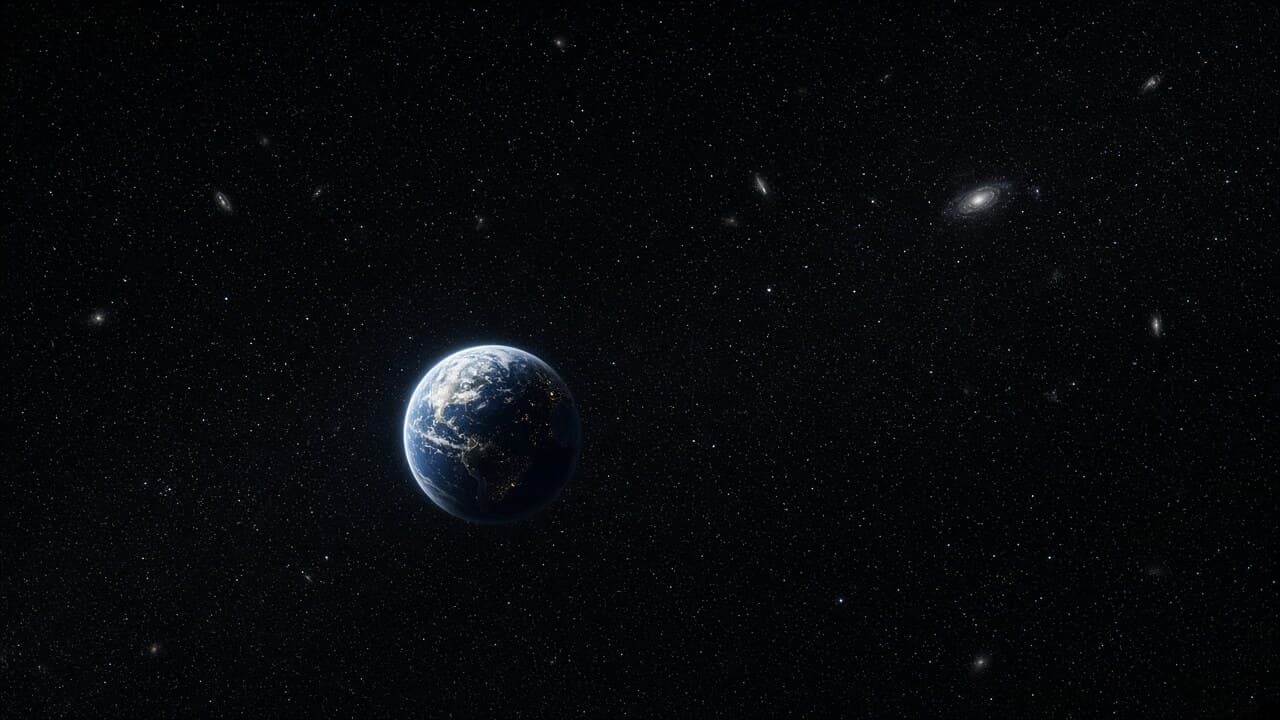
For much of human history, we did not know whether planets around other stars were common. That changed with the discovery and confirmation of exoplanets—worlds orbiting stars beyond our Sun.
NASA's Exoplanet Archive listed more than 6,400 confirmed planets in October 2026. These discoveries include gas giants, rocky worlds, planets in tightly packed systems, and planets orbiting stars very different from our Sun. The confirmed catalog is only a small sample of the planets believed to exist in the galaxy.
Some planets orbit in what astronomers call the habitable zone: a range of distances where temperatures could allow liquid water on a planet's surface, assuming suitable atmospheric conditions.
But the term habitable zone can be misleading if we interpret it too broadly. It does not mean that a planet has oceans, an atmosphere, life, or even a stable environment. Venus and Mars remind us that worlds with very different conditions can exist within the same planetary neighborhood.
Life as we know it requires more than a convenient distance from a star. Chemistry, energy sources, environmental stability, and the history of a planet may all matter. Scientists also cannot yet rule out unfamiliar forms of life that might exist under conditions very different from those on Earth.
The discoveries of exoplanets have made the search for life more concrete. They have not answered the most important question: how often does a planet actually become alive?
In 1961, astronomer Frank Drake developed an equation to organize the factors involved in estimating the number of detectable, communicating civilizations in the Milky Way. It became known as the Drake Equation.
Rather than providing a magic number, the equation breaks an enormous question into smaller questions that scientists can investigate.
- How quickly do suitable stars form in our galaxy?
- What fraction of those stars have planets?
- How many planets could provide conditions suitable for life?
- On how many suitable worlds does life actually begin?
- How often does life evolve into intelligent organisms?
- How often do intelligent species develop technology that can be detected over interstellar distances?
- How long do those detectable technological civilizations survive?
Astronomers have made substantial progress on some parts of this equation, especially the frequency of planets around stars. Other factors remain deeply uncertain. We have only one confirmed example of a planet with life, and only one known technological civilization: ourselves.
Imagine that planets are common but the emergence of life is extraordinarily rare. The equation could yield a very small number of civilizations. Alternatively, life might begin readily, but complex organisms or technological societies might be uncommon. The result changes dramatically depending on the assumptions.
The Drake Equation is therefore most useful as a framework for research and discussion. Until we understand more of its unknown variables, it cannot tell us reliably how many alien civilizations exist today.
There is no single accepted solution to the Fermi Paradox. Instead, scientists and philosophers have explored several possible explanations. They are not all mutually exclusive, and more than one could be true at the same time.
The first possibility is that the universe contains countless planets but that life itself is extremely difficult to start.
On Earth, life emerged from nonliving chemistry at some point in the planet's early history. Scientists study possible pathways through which simple molecules could have developed into systems capable of storing information, using energy, and reproducing. But the complete process by which life began remains unresolved.
Perhaps the necessary chemical conditions are rare. Perhaps several unlikely events must occur in the correct sequence. Or perhaps life can begin in many environments, but most forms never progress beyond simple microorganisms.
If the first steps toward life are extraordinarily improbable, even a galaxy containing billions of planets could host very few living worlds. This is one reason why finding microbial life beyond Earth would be such an important discovery: it would help scientists determine whether life emerged independently more than once.
Another possibility is that simple life emerges relatively often, while complex organisms and technological intelligence are much harder to develop.
Earth hosted microbial life for a substantial portion of its history before complex animals appeared. Technological civilization arrived much later. Evolution does not have a built-in goal of creating radio telescopes, computers, or spaceships. Natural selection favors traits that help organisms survive and reproduce in their environments, not traits that lead inevitably to advanced technology.
Intelligence is one possible evolutionary outcome, not a guaranteed destination. Other worlds might be filled with microbial ecosystems, ocean-dwelling organisms, or complex life that never develops industrial technology.
If that is true, the galaxy could contain life without containing many civilizations capable of communicating across interstellar distances.
Consider the age of the universe compared with the time humanity has been capable of sending detectable radio signals. Our technological era is extremely brief on a cosmic timescale.
An alien civilization could have flourished millions of years ago and disappeared long before humans existed. Another might not emerge until millions of years in the future. Even if both civilizations existed, their periods of detectable activity might never overlap.
This is sometimes called a cosmic timing problem. The galaxy can be old enough for many civilizations to have existed over its history while still containing very few that are detectable at the same moment.
The same issue applies to communication. A radio signal travels at the speed of light, but the distances between stars are enormous. A reply could take decades, centuries, or longer. A civilization might stop transmitting before its signal ever reaches another world.
The Milky Way is about 100,000 light-years across. Even a message traveling at light speed would need tens of thousands of years to cross much of the galaxy, and a spacecraft traveling far below light speed would take considerably longer.
Our search methods also have limits. Radio telescopes observe selected regions, frequencies, and periods. Optical searches may look for laser pulses or other unusual emissions. Astronomers cannot continuously examine every star, every wavelength, and every possible form of artificial activity.
An extraterrestrial civilization might not use radio communication in a way we can detect. Its signals could be too weak, too brief, directed elsewhere, or based on technologies we have not learned to recognize.
The silence may partly reflect the limitations of our search rather than the absence of everyone else. We have explored only a small portion of the possible space in which detectable signals could appear.
Many versions of the Fermi Paradox assume that an advanced civilization would eventually spread across the galaxy. But that assumption may say more about our expectations than about alien societies.
Interstellar travel would require enormous engineering effort, resources, and time. A civilization might prefer to explore through telescopes, robotic probes, or virtual environments rather than send large populations to distant stars.
It might also be content with its home system. Technological progress does not necessarily produce unlimited expansion, and a society that has different values or priorities may have little interest in colonizing other worlds.
The idea that advanced civilizations would inevitably create galaxy-spanning empires is a hypothesis, not an established law of nature.
One of the most unsettling proposed explanations for the Fermi Paradox is the Great Filter.
The idea is that somewhere between lifeless chemistry and a long-lived, spacefaring civilization, there may be a transition that is extraordinarily difficult. This barrier could be behind us, meaning humanity has already passed a rare milestone. Or it could lie ahead, meaning advanced civilizations commonly fail before spreading through the galaxy.
Perhaps the origin of life is extraordinarily rare. Or perhaps the development of complex cells, multicellular organisms, or some other major evolutionary transition requires conditions that seldom occur.
If one of these transitions is extremely unlikely, humanity may have crossed a barrier that few other worlds have crossed. This would help explain why a universe full of planets appears so quiet.
However, we do not yet know which evolutionary transitions are rare on a cosmic scale. Because Earth is our only confirmed example of life, scientists must be careful not to treat the details of our planet's history as a universal template.
The more disturbing version suggests that civilizations often reach technological capability but fail to survive for long enough to become widespread or detectable.
Potential risks for humanity include nuclear conflict, severe environmental disruption, engineered biological threats, or technologies that develop faster than society can manage their consequences. These are real categories of risk worth considering, but there is no evidence that they constitute a universal filter responsible for the silence of the cosmos.
A civilization could also disappear for reasons we have not imagined. A planet might become uninhabitable, a society might choose to stop producing detectable signals, or technological change could make its communications difficult for outsiders to recognize.
The Great Filter is a useful way to organize possibilities, not a discovered physical barrier. We currently have no evidence showing whether the hardest step is behind us, ahead of us, or even a single event.
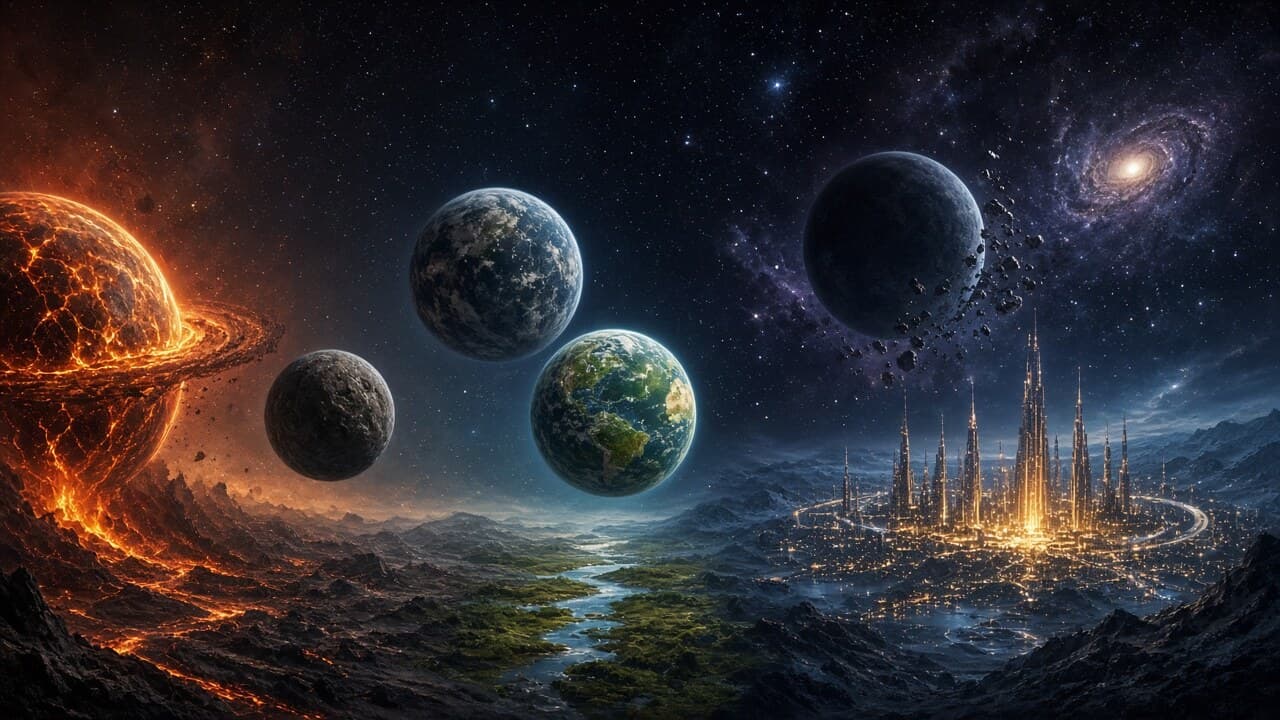
Another way to think about the Fermi Paradox is to ask what an advanced civilization might look like. Would it resemble humanity with better spaceships, or could it operate on a scale that is difficult for us to imagine?
In 1964, astronomer Nikolai Kardashev proposed a framework for classifying civilizations by the amount of energy they could use. The original scale described civilizations capable of using energy on the scale of a planet, a star, or an entire galaxy.
- Type I: A civilization able to harness energy on a planetary scale.
- Type II: A civilization able to harness energy on the scale of its star.
- Type III: A civilization able to harness energy on a galactic scale.
These categories are a conceptual framework, not a verified ranking of existing alien societies. Humanity has not reached the original Type I level, and there is no confirmed evidence of a Type II or Type III civilization.
A famous hypothetical example associated with Type II thinking is a Dyson sphere. In its popular form, this is a structure surrounding a star to capture its energy. The more physically plausible concept is a Dyson swarm: many independent structures orbiting a star, rather than a single rigid shell.
If a civilization collected enormous amounts of stellar energy, its activities might create detectable signatures in light or infrared observations. Astronomers can search for unusual objects and patterns, but no confirmed Dyson swarm or galaxy-spanning alien civilization has been discovered.
There is also no guarantee that advanced societies would maximize their energy consumption. A technologically mature civilization might become more efficient or choose to remain difficult to detect. These possibilities are speculative, but they remind us that intelligence does not have to follow one predictable path.
One particularly dramatic proposed answer is sometimes called the Dark Forest hypothesis. It imagines the galaxy as a place where civilizations remain silent because they cannot know whether another civilization would be friendly or dangerous.
If a society cannot reliably determine another society's intentions, it might decide that broadcasting its location is too risky. Staying quiet could be a defensive strategy, especially if the consequences of a mistaken decision were severe.
This idea is popular in science fiction because it transforms the silence of space into a potential survival strategy. It is also difficult to test. We have no confirmed evidence that alien civilizations are deliberately hiding from humanity, monitoring Earth, or destroying other societies to prevent competition.
The hypothesis also depends on assumptions about alien psychology, technology, and incentives. Different civilizations could behave in very different ways, and some might have little reason to view others as threats.
The Dark Forest is therefore an interesting thought experiment, not an established scientific explanation for the Fermi Paradox.
It is possible that humanity is unusually early in the history of technological life. The universe is about 13.8 billion years old, but the conditions required for life and long-term planetary stability have changed throughout cosmic history.
Stars create heavier elements through nuclear processes, and stellar explosions and other events distribute those elements into space. Rocky planets require elements such as silicon, oxygen, iron, and other materials. The early universe had a different chemical composition from the universe we inhabit today.
But the idea that humanity is the first civilization is not established. Some planets and planetary systems formed billions of years before Earth. Whether those worlds developed life, and whether that life became intelligent, remains unknown.
If humanity were among the earliest technological civilizations, our future could have unusual significance. We might be among the first species capable of deliberately preserving life beyond its original world. That is a possibility worth contemplating, but not a fact that the current evidence can establish.
The search for extraterrestrial life is not limited to listening for messages from distant stars. Scientists are investigating several kinds of evidence, from the chemistry of nearby worlds to unusual signals that could indicate technology.
A biosignature is a substance, pattern, or feature that could provide evidence of biological activity. On a distant planet, scientists may study atmospheric gases, surface chemistry, or other properties that might be associated with life.
For example, oxygen and methane together can be scientifically interesting because they may react with one another. But detecting these gases would not automatically prove life exists. Nonbiological processes can produce some of the same substances, so researchers must consider the planet's full environmental context.
Closer to home, Mars, Europa, and Enceladus are important targets in the search for environments that may have supported or could support life. Their study can help scientists understand how common habitable environments might be, even if no living organisms are discovered.
A technosignature is a possible sign of technology produced by an intelligent civilization. Researchers have considered radio transmissions, laser pulses, unusual atmospheric chemicals, and possible evidence of large-scale energy collection.
Radio astronomy has played an important role in the search for extraterrestrial intelligence, often called SETI. Researchers observe the sky for signals that differ from expected natural sources or ordinary human interference.
A promising signal would need careful verification. Scientists would need to rule out terrestrial interference, instrumental errors, and natural astrophysical explanations. A single unexplained observation would not be enough to establish an alien origin.
The search remains difficult because the possible signals are diverse and the observing time and resources are limited. A lack of confirmed detections tells us that we have not yet found a verified signal—not that every possible civilization has been ruled out.
The consequences would depend on what we discovered. Detecting a possible chemical biosignature on a distant planet would be very different from finding microbes on Mars or receiving an artificial signal from another star system.
Evidence of independent microbial life would show that life is not unique to Earth, although it would not automatically tell us how common complex organisms are. A verified artificial signal would be a major discovery about the existence of technological life, but it might not provide an easy way to communicate.
If a signal came from hundreds or thousands of light-years away, any reply would take at least as long to reach its source. First contact might therefore resemble an exchange of messages across generations rather than a conversation.
A physical object or biological sample would raise different scientific and practical questions. Researchers would need to establish its origin, protect samples from contamination, and allow independent verification. Extraordinary claims would require unusually careful evidence.
The discovery of extraterrestrial life could change biology, philosophy, and our understanding of humanity's place in the universe. But it would not necessarily answer the Fermi Paradox immediately. Finding one other example would still leave open the question of how common technological civilizations are.
Many discussions of the Fermi Paradox imagine alien civilizations behaving like humanity. They might build radio transmitters, launch spacecraft, construct enormous energy systems, or spread across their home galaxy.
But our technological history is very short, and our assumptions are based on a single known civilization. We do not know whether intelligent life elsewhere would use radio, develop industry, seek expansion, or leave signs that our instruments could recognize.
A civilization might communicate using methods we have not discovered. Its activity might be intermittent or too faint to distinguish from natural processes. It might also produce signatures that we have not yet learned to interpret.
This does not mean that aliens are definitely hiding in plain sight. It means that our search is shaped by our present understanding of physics, technology, and life. Improving our instruments and broadening our ideas about what to search for could reveal evidence we would otherwise overlook.
The Fermi Paradox may eventually be resolved not by discovering a dramatic secret, but by learning that one of our original assumptions was wrong.
- Established: Planets exist around many stars, and thousands of exoplanets have been confirmed.
- Established: Earth is the only world on which life has been confirmed so far.
- Established: Scientists are actively searching for biosignatures and technosignatures using telescopes, planetary missions, and other research methods.
- Established: The Drake Equation provides a framework for thinking about the factors that influence the number of detectable civilizations.
- Unknown: How frequently life begins on suitable planets.
- Unknown: How often life evolves into complex organisms and technological intelligence.
- Unknown: How long technological civilizations remain detectable.
- Unproven: That extraterrestrial civilizations are deliberately hiding from Earth.
- Unproven: That a Great Filter is responsible for the lack of confirmed alien detections.
- Unproven: That humanity is the only intelligent civilization in the universe.
These distinctions matter because a mystery can be fascinating without being evidence for any one explanation. The most useful approach is to keep multiple possibilities open while testing them against observations.
The Fermi Paradox begins with a striking contrast: a universe filled with stars and planets, and a humanity that has not yet confirmed another living world. But the contrast becomes less mysterious when we recognize how much remains unknown about the origin of life, the evolution of intelligence, and the survival of technological societies.
Perhaps life is rare. Perhaps simple organisms are common but intelligent civilizations are not. Perhaps societies do not last long, do not overlap in time, or have no reason to announce themselves. Perhaps we have barely begun searching in the right places.
The Great Filter offers a sobering possibility, while the Drake Equation gives researchers a framework for identifying the missing pieces. Neither provides a final answer. The science remains incomplete, and that uncertainty is part of what makes the question so important.
There is also a hopeful interpretation. If humanity has not yet found another civilization, we still have the opportunity to improve our understanding of life, protect our own planet, and explore beyond it. Our future may depend partly on how wisely we use the technology we develop.
For now, Earth is the only confirmed home of life. That does not make it insignificant. It makes this small planet an extraordinary place from which to ask one of the biggest questions imaginable.
And perhaps the most important question is not simply, 'Where is everybody?' It is this: if intelligent life is rare, what responsibility do we have to preserve it—and if it is common, how will we recognize it when we finally find it?
Continue with how big the universe is, why humans believe in aliens, and Area 51.
Fermi Paradox FAQ
What is the Fermi Paradox in simple terms?
Who came up with the Fermi Paradox?
Does the Fermi Paradox prove that aliens exist?
Why haven't scientists found aliens yet?
What is the Drake Equation?
What is the Great Filter theory?
Are there habitable planets beyond Earth?
What is the Kardashev Scale?
What is the Dark Forest hypothesis?
What is the difference between a biosignature and a technosignature?
Have scientists detected a confirmed alien signal?
Could humans be the only intelligent life in the universe?
What this paradox clarifies — and what remains unknown
What works
- Separates confirmed astronomy from speculative explanations.
- Explains the Drake Equation, Great Filter, Kardashev Scale, and Dark Forest without treating them as proven facts.
- Covers biosignatures, technosignatures, and the limits of current SETI searches.
What doesn't
- How often life begins and intelligence evolves remains unknown.
- No confirmed technosignature from an extraterrestrial civilization has been established.
- Several popular explanations remain untested hypotheses.