Imagine being the first person to look at the night sky and ask a question nobody around you can answer: What if we are not the only living beings in existence?
You are standing beneath a dark sky. There are no satellites crossing the stars, no telescopes revealing distant galaxies, no photographs of Mars, and no scientific explanation for what you see. Above you, thousands of points of light appear to stretch into a mysterious darkness. You know your world is full of life. But what about everything beyond it?
We cannot identify the first human who ever wondered whether other beings existed beyond Earth. That thought may be far older than written history. But once humans began recording their ideas, a remarkable question emerged: if nature can produce life here, must Earth be the only place where it has happened?
Thousands of years later, the same question appears in ancient philosophy, religious traditions, literature, science fiction, UFO reports, radio telescope experiments, and space exploration. The methods have changed dramatically, but the central curiosity remains.
This is not simply a story about little green visitors or mysterious lights in the sky. It is the story of how humans began to imagine other worlds, how that imagination became a scientific investigation, and why the universe's silence continues to fascinate us.
The honest answer is that we do not know. There is no historical record identifying the first human who imagined life beyond Earth. People may have wondered about other living worlds long before writing existed, and ancient cultures developed many different ideas about the heavens, spirits, celestial beings, and the origins of life.
It is also important to distinguish between believing in beings in the heavens and proposing that living organisms could exist on other planets. Those ideas are not necessarily the same. Modern extraterrestrial life means something specific: life that originated or exists beyond Earth, whether microscopic organisms or intelligent civilizations.
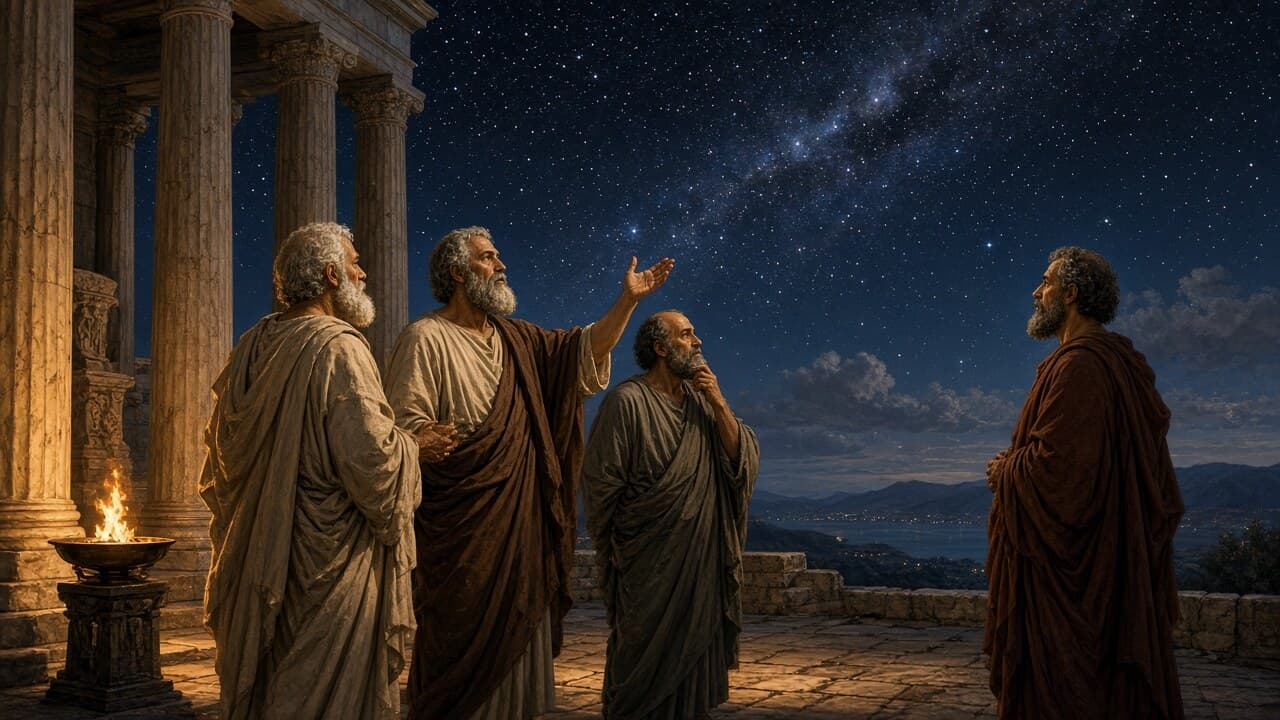
Among the earliest surviving philosophical arguments for multiple worlds are those associated with ancient Greek atomism. These thinkers tried to understand the universe through matter, motion, and natural processes rather than relying only on stories about divine beings.
Around 2,400 years ago, some Greek philosophers were already considering a possibility that still feels enormous today: our world might not be the only world in existence.
Epicurus, who lived approximately 341–270 BCE, developed a philosophy based on atomism—the idea that the world is composed of tiny particles moving through empty space. In his surviving Letter to Herodotus, he argued that there were infinitely many worlds, some resembling ours and others unlike it.
The reasoning followed from his picture of nature. If the universe contains an unlimited supply of atoms and space, then the materials that formed our world would not necessarily have been used up in creating it. Other worlds could form from the same fundamental ingredients.
Epicurus also considered the possibility of living things in other worlds. That makes his ideas particularly relevant to the history of extraterrestrial life. He did not have evidence from other planets, and his cosmology was not modern astronomy. He was reasoning from a philosophical model of matter and the universe.
There are infinite worlds both like and unlike this world of ours.
Think about how radical that idea was in its own time. No human had visited another planet. No telescope had revealed distant galaxies. Yet Epicurus considered the possibility that our world was not the only one.
His argument did not prove that aliens existed. Its importance is historical: the possibility of other worlds was being explored intellectually long before modern science had the instruments to investigate them.
Epicurus drew on an earlier atomist tradition associated with Leucippus and Democritus, who lived during the fifth century BCE. Ancient accounts connect this tradition with an enormous, potentially unlimited cosmos in which worlds could arise and change.
Because much of their work survives only through fragments and later writers, it is difficult to reconstruct every detail of their views. Still, their naturalistic approach helped create a space for questions that did not require Earth to be the center of every explanation.
This was one of the earliest intellectual paths toward the extraterrestrial question: if nature follows processes that operate beyond our immediate surroundings, perhaps our world is not the only place where those processes have produced something remarkable.
More than 1,800 years after Epicurus, the Italian philosopher Giordano Bruno helped revive and expand the idea of a vast universe containing countless worlds.
In the late sixteenth century, Bruno argued that the stars could be distant suns and that the universe might contain an immense number of worlds. He rejected the idea that the cosmos was a small, closed system built around humanity's home.
In his 1584 work On the Infinite Universe and Worlds, Bruno developed a vision of a universe without a single privileged center and entertained the possibility that other worlds might contain living inhabitants. His ideas were philosophical and cosmological speculation, not observations of extraterrestrial organisms.
Bruno was executed in Rome in 1600 after a long trial by the Roman Inquisition. His death is often simplified into the claim that he was killed just for believing in aliens. That is misleading. His trial involved a wider range of theological and philosophical issues, and historians debate the precise weight of particular beliefs in the final judgment.
Bruno's importance to this story is not that he proved other civilizations existed. It is that he challenged the intellectual comfort of a universe designed around one special location and one privileged perspective.
Why has this question survived for thousands of years? The answer probably involves several things: our ability to imagine what we cannot see, our curiosity about the natural world, our changing understanding of Earth's place in the cosmos, and the simple fact that we know life exists at least once.
Humans routinely imagine things they have never directly encountered. We reason about the inside of stars, the beginning of the universe, the far future, and the structure of matter. The same ability allows us to ask whether life could exist in an environment we have never visited.
Imagination does not establish that something is real. It helps generate possibilities that can later be tested. In science, that distinction matters: an idea can be worth investigating without being accepted as fact.
We do not know how frequently life begins, but we know it happened on Earth. Our planet contains organisms in deserts, deep oceans, acidic environments, polar ice, and places once thought too hostile for life. Research into extremophiles has expanded our understanding of the conditions under which organisms can survive.
That diversity has influenced astrobiology. Scientists studying Mars, Europa, Enceladus, and distant planets ask whether environments beyond Earth could have conditions suitable for life. The comparison is not that these places are known to contain organisms, but that Earth's own biology has taught us not to define habitability too narrowly.
For much of history, people had only limited ways to understand the scale of the cosmos. Astronomy gradually changed that picture. Earth is a planet orbiting the Sun, the Sun is one star among enormous numbers of stars in the Milky Way, and our galaxy is only one among many galaxies.
The discovery of planets around other stars made the question even more concrete. Exoplanets are no longer just philosophical possibilities; thousands have been confirmed. NASA reported more than 6,000 confirmed exoplanets by 2025, with additional candidates awaiting confirmation.
That number does not tell us how many planets contain life. It tells us that planets are common enough to make the search a serious scientific question. A universe containing many planets offers many places to investigate, but the probability that life begins on any particular planet remains unknown.
There is also an emotional dimension to the question. If another civilization exists, humanity would no longer be the only known example of technological intelligence. That possibility touches our ideas about identity, religion, history, and our place in nature.
Some people find the idea comforting because it suggests companionship on a cosmic scale. Others find it unsettling because another civilization could be radically different from us. Still others are drawn to the mystery itself.
It would be too simple to say that everyone believes in aliens because they are lonely or afraid of being alone. People hold different views for different reasons. Curiosity, cultural influences, personal experiences, scientific arguments, and entertainment can all shape how individuals think about extraterrestrial life.
For centuries, arguments about other worlds were largely philosophical. Astronomers could observe the heavens, but they lacked the instruments needed to investigate planets around distant stars or detect faint signals from potential civilizations.
During the twentieth century, advances in astronomy, radio technology, planetary science, and computing began to change that. Researchers could formulate testable questions: Could a planet have the chemical conditions required for life? Could a civilization produce a detectable signal? Could we distinguish a possible biological signature from a non-biological process?
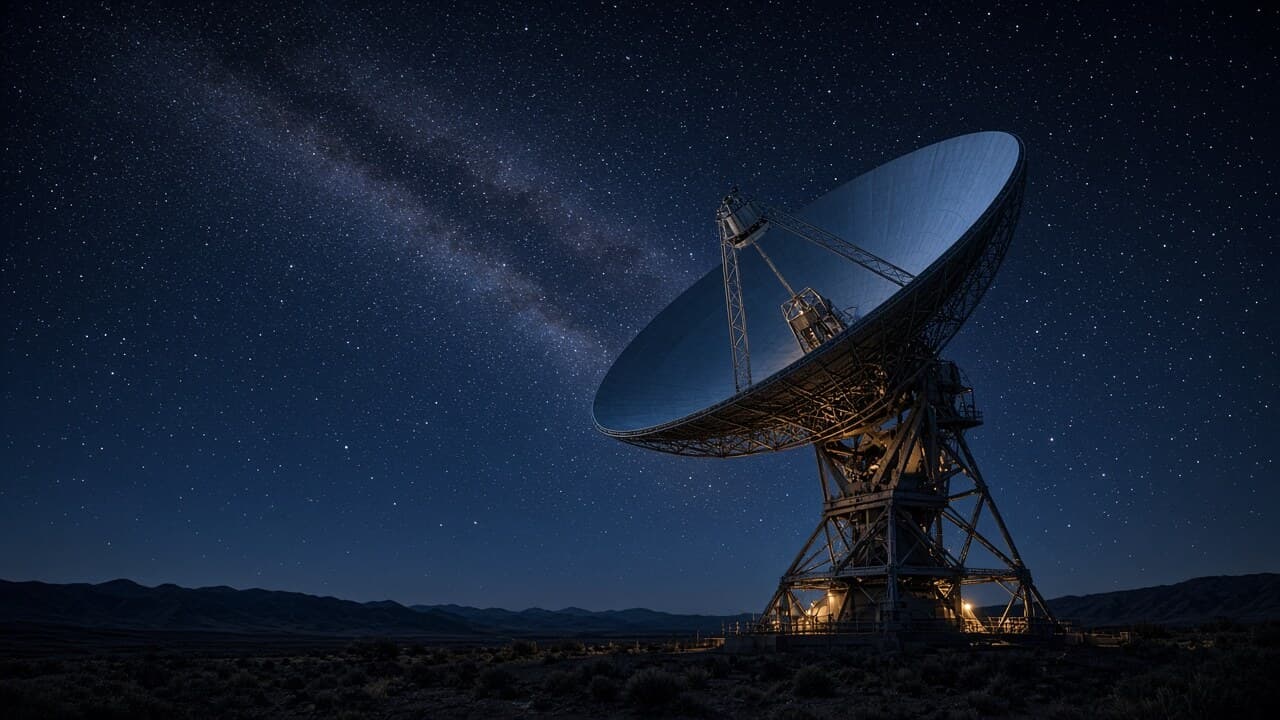
In 1960, American astronomer Frank Drake conducted Project Ozma, one of the first modern SETI experiments. Using a radio telescope, he observed nearby stars Tau Ceti and Epsilon Eridani while searching for signals that might indicate an extraterrestrial technological source.
The experiment did not find a confirmed signal from an alien civilization. Its importance was that it transformed a broad philosophical question into an organized observational program. Instead of only asking whether intelligent life might exist, researchers began testing whether a detectable sign of it could be found.
The modern Search for Extraterrestrial Intelligence, or SETI, includes searches for unusual radio signals and other possible signs of technology. A signal would have to be carefully checked against interference, natural astrophysical sources, and instrumental effects before anyone could reasonably attribute it to another civilization.
In 1961, Drake introduced an equation to organize a discussion about the number of technologically detectable civilizations that might exist in the Milky Way. It considers factors such as the rate of star formation, the fraction of stars with planets, the number of potentially suitable worlds, the probability that life and intelligence develop, and how long a civilization produces detectable signals.
The equation is often presented online as if it provides a definite count of alien civilizations. It does not. Several of its terms remain deeply uncertain, especially the likelihood that life begins, that intelligence evolves, and that a technological civilization lasts long enough to be detected.
Its real value is that it reveals what we need to learn. Astronomers can measure some factors far better than they could in 1961, particularly how common planets are. Other factors cannot yet be determined because Earth remains our only confirmed example of life.
One of the biggest changes in the alien question came from discovering that planets orbit stars other than the Sun. Before the early 1990s, no planet around a Sun-like star had been confirmed beyond our solar system. Today, exoplanet astronomy is an established field.
Scientists have identified rocky planets, gas giants, worlds orbiting two stars, and planets in a range of environments. Some orbit in what astronomers call a habitable zone—the range where temperatures could allow liquid water on a planet's surface under suitable atmospheric conditions.
But the term habitable zone can be misunderstood. A planet in that zone is not automatically habitable, and a potentially habitable planet is not automatically inhabited. Atmospheres, radiation, geology, water availability, chemistry, and a host of other factors affect whether life could emerge or survive.
NASA's James Webb Space Telescope can study some exoplanet atmospheres and help scientists investigate their chemistry. Researchers are interested in possible biosignatures—chemical patterns that might be associated with life. Yet atmospheric gases can also arise from non-biological processes, so any candidate signal needs careful interpretation and independent evidence.
The search is not limited to distant stars. Mars preserves evidence that liquid water once existed on its surface, making its ancient environments important targets in the search for signs of past microbial life.
Jupiter's moon Europa and Saturn's moon Enceladus are also intriguing because evidence points to oceans beneath their icy surfaces. Liquid water alone does not prove that life exists there, but these worlds offer environments where scientists can investigate the ingredients and energy sources that biology might require.
The first discovery of extraterrestrial life, if it happens, might not involve a spacecraft meeting an intelligent alien. It could be a chemical clue, fossil-like evidence, or a microbial organism that forces scientists to rethink how often life begins.
As the possibility of other civilizations became a serious scientific topic, another question grew difficult to ignore: if the universe has had billions of years to produce life, why have we not clearly detected anyone?
This is commonly known as the Fermi paradox, associated with physicist Enrico Fermi and the question often summarized as 'Where is everybody?' It highlights a tension between the enormous scale and age of the cosmos and the absence of confirmed evidence for extraterrestrial civilizations.
There is no single accepted solution. Perhaps technological civilizations are rare. Perhaps life is common but intelligence is unusual. Civilizations may not survive long, may not broadcast signals we can detect, or may use communication methods we have not considered. Interstellar travel may also be much more difficult than many fictional stories suggest.
Another possibility is that our search has been limited. We have not examined every star, every frequency, every time window, or every potential technosignature with sufficient sensitivity. The absence of a confirmed signal is important, but it does not establish that the entire universe is empty.
Imagine trying to find a single radio station by briefly scanning a small part of one frequency band while not knowing whether the station exists, how powerful its transmitter is, or when it broadcasts. Failure to hear it would tell you something about your search, but it would not prove that no station exists.
The analogy is imperfect, but it illustrates the challenge. SETI researchers must decide which stars, frequencies, signal types, and times to investigate. A civilization might be too distant, too faint, too short-lived, or simply not transmitting in a way our instruments can recognize.
This is why the silence is both intriguing and ambiguous. It can motivate better searches without being treated as evidence for any one explanation.
The modern public image of aliens is closely connected to unidentified flying objects, science fiction, and reports of unusual lights or objects in the sky. When something cannot be identified immediately, extraterrestrial technology can become one possible story people consider.
But an unidentified aerial phenomenon, or UAP, is not automatically an alien spacecraft. The term means that an observation has not yet been satisfactorily identified. Some cases may involve ordinary aircraft, balloons, atmospheric effects, sensor limitations, or incomplete information. Others can remain unresolved because the available data are insufficient.
The distinction matters because the scientific search for life and the investigation of unusual sightings are different tasks. Astrobiologists study whether environments can support life and how to detect its signs. SETI researchers search for potential technological signals. UAP investigators examine particular observations and available sensor data.
These fields can overlap in public imagination, but the evidence required is different. An unusual light is not proof of an extraterrestrial civilization, just as discovering a potentially habitable exoplanet is not proof that it contains intelligent life.
The twentieth century gave the alien question a new visual language. Science fiction imagined encounters, advanced civilizations, alien invasions, peaceful visitors, and worlds that resembled Earth. Movies, books, television, and later the internet helped make the extraterrestrial a familiar character in modern culture.
These stories let people explore questions that are difficult to test directly. What would happen if humanity met a civilization more advanced than ours? Would we cooperate, compete, panic, or learn? Would aliens share our biology, emotions, or moral values?
Fiction also influences how people interpret real observations. Someone who has seen hundreds of alien stories may recognize a strange light as a familiar kind of spacecraft, even when the observation itself contains too little information to support that conclusion.
This does not mean popular culture is responsible for every belief in extraterrestrial life. Humans were considering other worlds long before modern science fiction. Culture gives the question images and narratives, while the deeper question—whether Earth is the only inhabited world—has a much longer history.
The current scientific position is less dramatic than many headlines suggest, but it is far from boring. Earth is the only world on which life has been confirmed. No extraterrestrial organism has been conclusively identified, and no verified signal has established that an intelligent alien civilization is communicating with us.
At the same time, we know that planets are common, that the chemical ingredients associated with life are found beyond Earth, and that organisms on our planet can survive in a surprising range of environments. These findings make the search meaningful, but they do not yet tell us how often life emerges.
The biggest unknown may not be how many planets exist. It may be how difficult it is for non-living chemistry to become biology. If life begins easily under suitable conditions, it could be widespread. If the transition is extraordinarily rare, even a universe containing countless planets might have very few inhabited worlds.
We currently have only one confirmed example of life to study. Until we find a second, scientists cannot calculate the true frequency of life across the universe with confidence.
| Question | What science currently says |
|---|---|
| Are planets outside our solar system real? | Yes. Thousands of exoplanets have been confirmed. |
| Could some worlds have conditions suitable for life? | Yes. Some planets and moons have environments worth investigating, but suitability does not prove life exists. |
| Has life beyond Earth been confirmed? | No. Earth remains the only confirmed home of life. |
| Has an alien civilization sent us a verified signal? | No confirmed extraterrestrial technological signal has been established. |
| Does the absence of a detected signal prove we are alone? | No. The search remains incomplete, and many relevant probabilities are unknown. |
The first discovery might be modest. Scientists could find a compelling biosignature in a planet's atmosphere, identify a fossil-like structure in ancient Martian rocks, or detect evidence of biological chemistry in material from an ocean world. Such a discovery would require careful confirmation because non-biological processes can sometimes produce features that resemble signs of life.
Finding microbes would be a historic result, but it would not necessarily mean that intelligent civilizations are common. Simple life and technological intelligence are different stages, and we do not yet know how often one leads to the other.
A confirmed technological signal would create a different challenge. Researchers would need to verify its origin, rule out terrestrial interference, repeat observations where possible, and determine whether the signal carried information or simply revealed an unusual source.
A physical encounter with an extraterrestrial organism or artifact would raise still more questions about contamination, safety, planetary protection, and how the discovery should be independently examined. Extraordinary claims would require extraordinary evidence, not because scientists are unwilling to believe, but because the consequences of a mistaken conclusion would be enormous.
Perhaps the alien question has endured because it is also a question about ourselves. We look outward to discover whether life is common, but every possible answer changes the way we think about Earth.
If life is widespread, Earth may be one example of a broader cosmic process. If life is rare, the living world around us may be more exceptional than we imagined. If technological intelligence is extraordinarily uncommon, humanity may have a responsibility to protect the only known civilization capable of asking these questions.
None of these possibilities has been confirmed. But they explain why the search is bigger than a hunt for visitors from another planet. It touches biology, astronomy, philosophy, technology, and the future of our own species.
The ancient philosophers could only reason about other worlds. Modern scientists can observe planets, analyse atmospheres, study the chemistry of distant environments, and listen for signals. We have moved from speculation toward evidence, but we have not yet crossed the final gap between possibility and discovery.
We cannot name the first human who imagined life beyond Earth. That thought may have appeared in countless minds long before anyone wrote it down. But the surviving history is remarkable: ancient Greek philosophers considered multiple worlds, Giordano Bruno argued for a vast cosmos, and modern astronomers turned the question into a search that can be tested with instruments.
Today, scientists investigate exoplanets, search for chemical signs of life, explore potentially habitable environments in our solar system, and use radio telescopes to look for evidence of technological civilizations. These efforts have not confirmed that aliens exist, but they have made the question more precise and more scientifically approachable than ever before.
Why do humans believe in aliens? Not everyone does, and belief is not evidence. But humans have good reasons to ask whether life could exist elsewhere: we know life can emerge, we know planets are widespread, and we have only begun to investigate the enormous number of possible environments beyond Earth.
The mystery is that we have discovered so many possible places to look, yet still have only one confirmed example of life. We do not know whether the universe is full of living worlds or whether Earth is extraordinarily rare.
And perhaps that is why the question survives every generation. We are a species capable of looking beyond its home and imagining what might exist outside it. For thousands of years, we asked whether we were alone. Now, for the first time in history, we have tools that may eventually let us begin to answer.
So here is the question worth carrying into the next century: if humanity discovers life somewhere else, will it be the end of one of our oldest mysteries—or the beginning of an even bigger one?
Continue with unexplained UFO cases, pre-Sputnik sky mysteries, and creating life beyond Earth.
Aliens, SETI, and Extraterrestrial Life FAQ
Who was the first person to think aliens existed?
Did ancient Greeks believe in aliens?
Was Giordano Bruno the first person to believe in aliens?
Why do humans believe in extraterrestrial life?
When did scientists begin seriously searching for alien civilizations?
What is the Drake Equation?
Has NASA found aliens?
Does the Fermi paradox prove that aliens do not exist?
Are UFOs proof of extraterrestrial visitors?
What is the difference between astrobiology and SETI?
What this history clarifies — and what remains unknown
What works
- Connects the history of alien ideas with modern scientific research.
- Clearly distinguishes philosophical speculation from scientific evidence.
- Includes Epicurus, Giordano Bruno, Frank Drake, SETI, the Drake Equation, and the Fermi paradox.
- Uses current scientific context about exoplanets and the search for biosignatures.
What doesn't
- The first human to imagine extraterrestrial life cannot be identified from surviving historical evidence.
- Ancient arguments for multiple worlds are not equivalent to modern scientific proof.
- The probability that life begins elsewhere remains uncertain because Earth is our only confirmed example.
- No extraterrestrial organism or technological civilization has been conclusively detected.