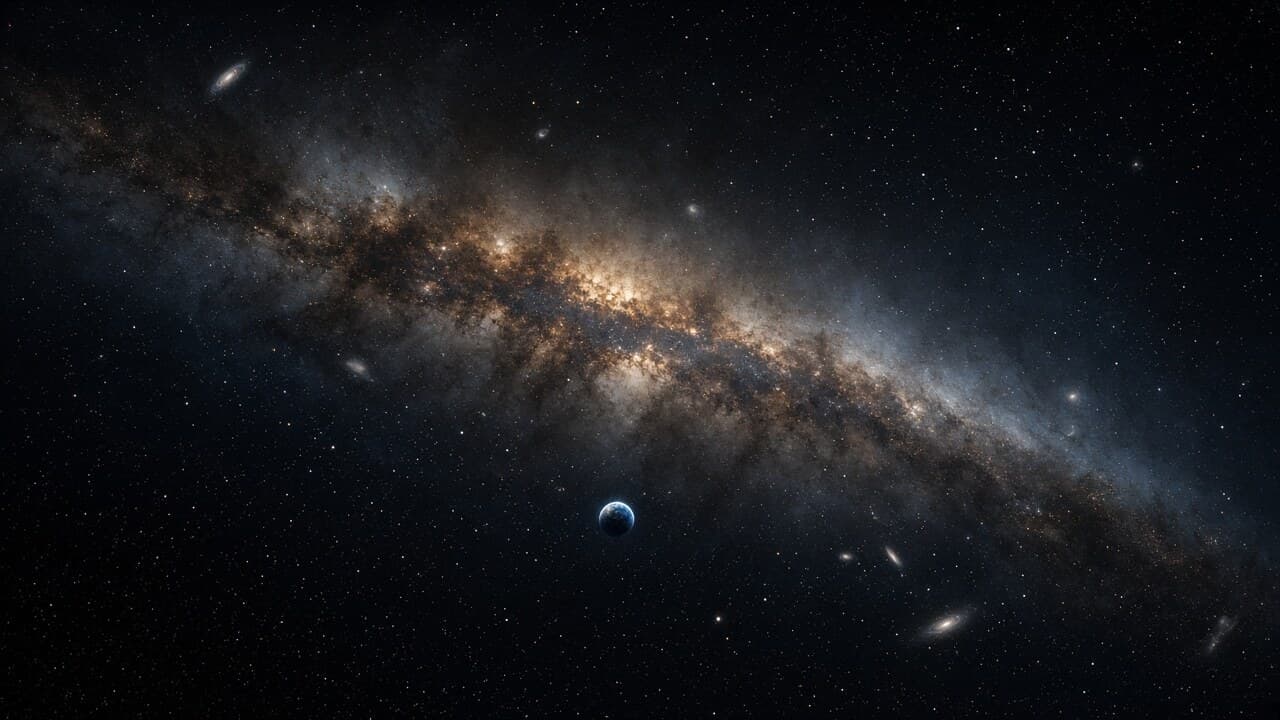
Imagine travelling through space faster than any spacecraft humanity has ever built. You leave Earth behind, pass the Moon, cross the Solar System, and eventually watch the Milky Way shrink into a distant collection of stars. Galaxies become smaller points of light. Entire clusters disappear into the darkness behind you.
But suppose you keep going. Millions of light-years become billions. The universe stretches in every direction, filled with structures so enormous that even the largest galaxies seem insignificant. Eventually, you begin asking a question that sounds almost childish but leads straight into the deepest problems of modern cosmology.
Where does everything end?
Is there a final boundary, like a wall surrounding a giant cosmic room? Could you travel far enough to reach a place where space simply stops? If the universe has no edge, does that mean it continues forever? And if it does have a limit, what could possibly exist beyond it?
These are not merely science-fiction questions. Astronomers investigate the universe's geometry, expansion, age, and observable limits using telescopes, mathematical models, and measurements of ancient radiation left over from the early cosmos.
Their discoveries have produced an extraordinary picture: the universe we can observe is finite, but the entire universe may be vastly larger—and could even be infinite. We have found no evidence of a physical wall at the edge of space, and we do not yet know the total size of everything that exists.
To understand why, we must first separate three ideas that sound similar but mean very different things: the observable universe, the entire universe, and the edge of space itself.
Our home planet is about 12,742 kilometres in diameter. The Sun is approximately 150 million kilometres from Earth, and sunlight takes about eight minutes to reach us. Beyond the Solar System, the distances become so large that kilometres stop being convenient. Astronomers use light-years: the distance light travels in one year, approximately 9.46 trillion kilometres.
The Milky Way is roughly 100,000 light-years across. It contains enormous numbers of stars, along with planets, gas, dust, and dark matter. And our galaxy is only one member of a universe containing a vast population of other galaxies.
Some galaxies are relatively close neighbours. Others are billions of light-years away. When astronomers observe extremely distant galaxies, they are also looking back in time, because their light has taken billions of years to reach us.
The deeper we look into space, the further back into cosmic history we can investigate. Powerful observatories, including the James Webb Space Telescope, allow scientists to study galaxies that formed during the universe's early history.
But even the most powerful telescope cannot show us everything. There is a limit to how far information has been able to reach us since the universe began evolving from its early hot, dense state.
The number sounds impossible when you remember that the universe is approximately 13.8 billion years old. How can we see objects whose present-day distances are much greater than 13.8 billion light-years if light has not had more than 13.8 billion years to travel?
The answer is that space itself has expanded while the light was travelling. The distant regions that emitted the light are now much farther away than they were when that light began its journey.
This distinction is essential. The age of the universe, the travel time of ancient light, and the present-day distance to the source are related, but they are not interchangeable measurements.
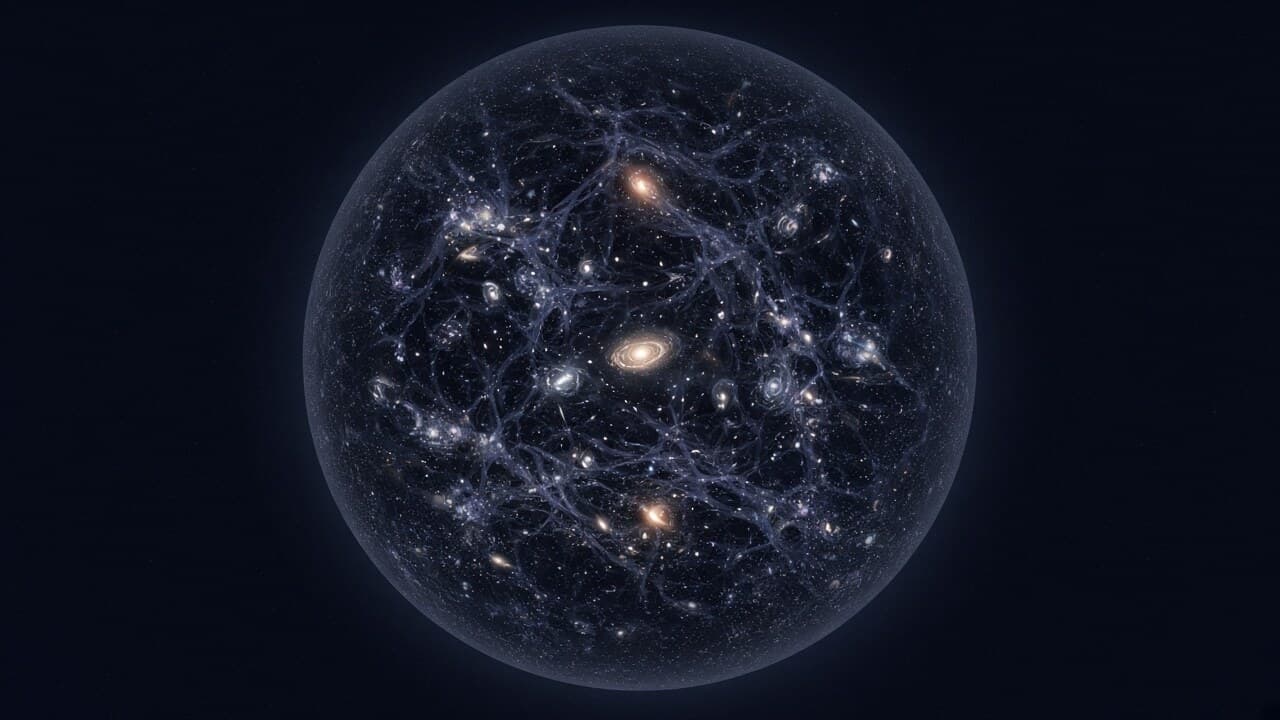
Imagine standing on a beach. The ocean appears to meet the sky at the horizon. No matter how far you look, you cannot see the entire ocean at once. Buildings, waves, and the curvature of Earth limit what reaches your eyes.
But the horizon is not a physical wall. It marks the limit of your view from that location. Move somewhere else, and your horizon changes.
The observable universe has a related limitation. We can receive information only from regions whose light or other signals have had enough time to reach us, taking the history and expansion of space into account. Beyond our cosmic horizon, there may be more galaxies and structures, but their light has not reached us in a way that allows us to observe them today.
This is a limit on what we can observe, not proof that space ends there.
A person in a distant galaxy would have their own observable universe. Their horizon would be centred on their location, and they might be able to observe regions we cannot see. The observable universe is therefore not a special bubble with Earth at the physical centre of all existence. It is the region from which information can reach a particular observer.
The cosmic horizon also changes as the universe evolves. As space expands and light travels, the boundaries of what can be observed depend on cosmic history and the universe's expansion rate.
This is where our everyday intuition begins to fail.
When a balloon inflates, its surface grows because the rubber stretches into the surrounding room. When an explosion occurs, fragments spread through the space around them. It is natural to imagine the Big Bang as a similar event, with matter flying outward from a central point into an enormous empty space.
But the Big Bang is not simply an ordinary explosion occurring at one location inside a pre-existing universe. In the standard cosmological model, space itself has been expanding from an earlier, hotter, denser state.
On very large scales, distant galaxies generally become farther apart because the space between them expands. There is no known central location in ordinary space from which all galaxies are flying outward like pieces of debris from a bomb.
The balloon analogy can help explain this idea, provided we use it carefully. Imagine tiny dots drawn on the balloon's surface. As the balloon inflates, the dots move farther apart, even though none of them occupies a privileged centre on the surface.
However, the balloon's surface is two-dimensional and sits inside a larger three-dimensional space. That surrounding space is part of the analogy, not evidence that our three-dimensional universe must be expanding into an external room.
In cosmology, expansion describes how distances within space change over time. General relativity does not require the universe to expand into a pre-existing external void.
So what is the universe expanding into? In the standard model, asking what external space it expands into may not be a necessary or well-defined question. The universe includes space itself, rather than being an object that must occupy a larger room.
There are speculative theories involving higher dimensions or larger structures, but no confirmed observation establishes that our universe is expanding into an external space.
One possibility is that the universe extends without limit. Travel in any direction, and you would never encounter a final boundary. Galaxies might continue beyond every region we can observe, with no ultimate edge.
An infinite universe is difficult to picture because we experience everything within finite spaces. Rooms have walls. Cities have boundaries. Even the oceans have coastlines. We are used to objects existing inside larger environments.
But space does not necessarily have to behave like an object inside a room. If the universe is infinite, it does not need an outside region to contain it, because it would not have a spatial boundary in the first place.
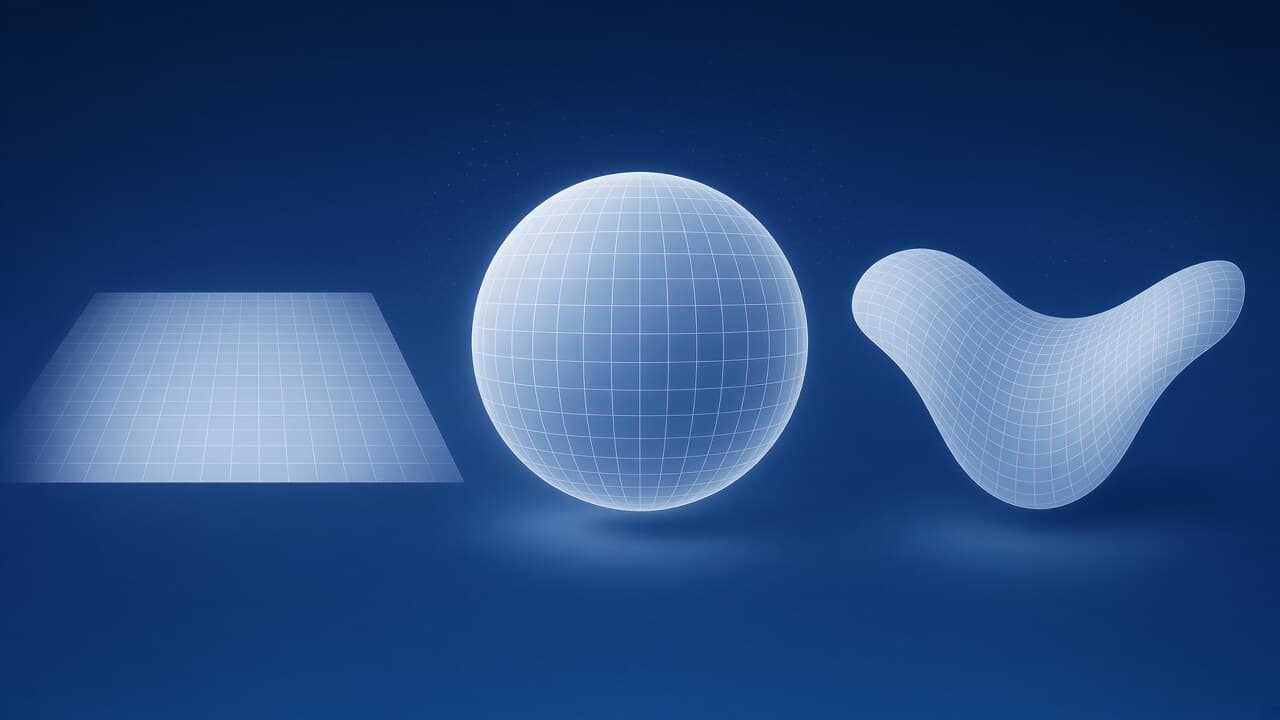
Measurements of the cosmic microwave background—the ancient radiation released when the universe became transparent to light—allow scientists to investigate the geometry of the cosmos. Combined with other cosmological observations, these measurements indicate that space is very close to geometrically flat on the largest scales we can measure.
That finding is important, but it does not prove that the universe is infinite. A space that is flat on large scales could still have a more complicated global topology, meaning that its overall structure might be finite without having an ordinary edge.
Think of a video game in which moving off the right side of the screen makes your character reappear on the left. The playable world can have a finite area, yet its boundaries wrap around rather than ending at a wall. This is only a simplified analogy, but it helps illustrate how a finite space need not have a conventional edge.
The universe might be infinite. It might instead be finite but much larger than the observable region. Current observations do not establish the total size of the entire cosmos.
At first, this sounds impossible. If something has a limited size, surely there must be a point where it ends.
Consider Earth's surface. It has a finite area, yet you can travel across it without finding an edge where the ground suddenly stops. If you could continue travelling around the globe, you would eventually return to your starting point.
The surface of Earth is two-dimensional, so it is not a complete model of the three-dimensional universe. But it demonstrates an important geometric principle: finiteness does not always require a boundary.
In cosmology, one possibility is that three-dimensional space is curved and connected in a way that makes its total volume finite without an edge. Another possibility is a more complex global topology in which space wraps around in certain directions.
These are mathematical possibilities, not confirmed descriptions of our universe. Scientists use observations of the cosmic microwave background, large-scale structure, and other cosmic signals to constrain possible geometries and topologies.
The challenge is that we can observe only a limited region. If the entire universe is much larger than what we can see, its global structure may be difficult—or perhaps impossible—to determine conclusively from our location.
This means two statements can both be true: the universe could be finite, and it could have no physical edge. The exact geometry of the entire universe remains unknown.
Now comes the question that makes this subject so compelling: if the observable universe is only the part we can see, what exists beyond it?
The simplest expectation in standard cosmology is that the universe continues beyond our observational horizon. If the large-scale universe follows the same broad patterns outside our view as it does within it, there could be more galaxies, stars, planets, and cosmic structures beyond the region whose light has reached us.
That expectation is consistent with the observed large-scale uniformity of the universe, but we cannot directly inspect every region beyond our horizon. We should therefore distinguish a reasonable inference from a direct observation.
It is tempting to imagine that the space beyond the observable universe contains entirely different physics, strange dimensions, or alternate realities. Such possibilities appear in some theoretical discussions, but the observational horizon does not itself provide evidence for any of them.
There may be more of the same kind of universe beyond our view. The total cosmos might be much larger than we can observe. Its geometry could be finite or infinite. At present, we do not know the full answer.
There is an important difference between something being beyond our current observational reach and something being impossible to know in principle. New technology may allow us to measure the universe more precisely, but signals from beyond a cosmic horizon may never reach us. Some limits arise not from the quality of our telescopes but from the physical structure and history of the universe.
The honest answer is that we cannot describe the exact contents of every region beyond the observable universe. We can make scientifically motivated inferences, but we must not pretend to have directly seen what remains outside our cosmic view.
If the observable universe is not all that exists, could our cosmos be only one part of something even larger?
Some ideas in theoretical physics and cosmology explore versions of a multiverse: a broader reality containing multiple universes or regions with different properties. Certain models of cosmic inflation, for example, can produce scenarios in which inflation ends in different regions at different times, potentially creating separate cosmic domains.
Other proposals arise from interpretations of quantum mechanics or theories that investigate additional dimensions and possible physical structures beyond the observable cosmos. These ideas differ significantly from one another. The word 'multiverse' does not describe one single, established scientific model.
The idea is intriguing because it could offer ways to investigate why the physical constants and conditions of our universe have the values we observe. But the explanatory promise of a theory is not the same as confirmation.
No widely accepted direct evidence has established the existence of other universes. Some multiverse proposals also face difficult questions about testability: what observation could distinguish them from alternatives, and how could we evaluate predictions about regions that may never communicate with ours?
A scientific theory becomes stronger when it makes predictions that can be tested and potentially shown to be wrong. A multiverse idea that cannot produce distinguishable evidence is much harder to evaluate than one that leads to observable consequences.
So could other universes exist? Some theoretical frameworks allow that possibility, but the answer remains unknown. The edge of the observable universe is not evidence that another universe begins on the other side.
If the universe is expanding, it is natural to imagine a central point from which everything moves outward. Perhaps the Big Bang happened at one location, and galaxies have been travelling away from it ever since.
That picture is misleading. In the standard cosmological model, the early hot, dense state was not an ordinary explosion at one point in pre-existing space. The expansion occurred throughout space, and on large scales galaxies generally move apart as the distance between them grows.
Imagine a two-dimensional surface covered in dots. As the surface stretches, the dots become farther apart. An observer on any one dot sees distant dots receding, without finding a special centre on the surface itself.
The analogy does not prove that our universe is a balloon surface. It simply illustrates how expansion can occur without a central point within the space being described.
Earth lies at the centre of our observable universe in the limited sense that we observe the cosmos from Earth and our observational horizon surrounds our location. An observer in another galaxy would have a different observable region centred on them.
That does not make Earth the centre of the entire universe. It means that every observer has a local cosmic horizon.
The distinction is important because it changes how we imagine the edge. If there is no central point in the ordinary spatial sense, there is no reason to assume that there must be a single outer boundary surrounding everything.
Imagine building a spacecraft capable of travelling far beyond anything humanity has ever launched. You leave the Solar System, cross the Milky Way, and head toward the distant galaxies at the limits of observation.
Could you eventually reach the edge?
If by 'edge' you mean the horizon of the observable universe, there is no simple physical boundary waiting for you there. The horizon is a limit defined by the propagation of information and the history of cosmic expansion, not a wall fixed in space.
Travelling through space also does not mean that you can catch every galaxy whose light we can observe. The universe is expanding, and at sufficiently large distances the expansion of space affects the relationship between us and distant objects. The future paths of light and spacecraft depend on the universe's expansion history.
Some distant regions are beyond the reach of any signal we could send now if the universe continues expanding as current observations suggest. Other regions may be observable in principle but practically unreachable because of the enormous distances and travel times involved.
If the universe is infinite, there is no final edge to reach. If it is finite but without a boundary, travelling far enough might not bring you to a wall either. Depending on the universe's global geometry and topology, the concept of travelling around it could be very different from travelling across a room or around a planet.
For now, interstellar travel remains far beyond our ability to use as a practical experiment on the universe's global structure. Astronomers must rely on light, gravitational effects, cosmic background radiation, and other observations to study the largest scales.
Picture a spacecraft approaching what appears to be the end of space. Would the stars stop? Would there be a wall? Could a traveller look beyond it and see nothing?
These images are easy to imagine because we are accustomed to objects with surfaces and boundaries. But a physical edge of the universe is not a feature predicted by the standard cosmological model.
If space had a genuine boundary, scientists would need a physical description of what that boundary means. Does space end there? Do the laws of physics change? Is there a region beyond it? And if that region contains space, in what sense was the original boundary the edge of all space?
These questions expose a problem with picturing the universe as an object inside something larger. If the universe includes all space, then an ordinary outside region is not automatically part of the picture. To propose one, a theory would need to define what that external structure is and how it relates to our universe.
This does not mean scientists have proved that no imaginable boundary or larger structure can exist. It means there is currently no observational evidence for a literal wall at the edge of the cosmos, and standard cosmology does not require one.
The most scientifically useful question may therefore be not what a cosmic wall looks like, but what observations can tell us about the geometry, size, and history of the universe as a whole.
Modern astronomy has revealed an extraordinary amount about the universe. Scientists can estimate its age, measure its expansion, study ancient radiation, map galaxies, and test mathematical descriptions of cosmic geometry.
Yet some fundamental questions remain open. We do not know the total size of the universe. We have not established whether space continues infinitely or closes back on itself in a finite but boundary-free structure. And we cannot directly observe every region beyond our cosmic horizon.
Future observations may tighten the limits on possible geometries and topologies. Better measurements of the cosmic microwave background and large-scale structure could reveal new clues about the universe's shape. But determining the entire global structure may remain difficult if the relevant features extend far beyond our observable region.
This is not a failure of science. Every observation comes from a particular place and time, and the universe's age, expansion, and finite speed of light constrain the information we can collect.
The same cosmic horizon that limits our view also gives us a remarkable archive of history. When we observe distant galaxies, we see earlier stages of cosmic evolution. When we study the cosmic microwave background, we investigate a universe much younger than the one we inhabit today.
The universe is not simply a vast collection of objects. It is a history unfolding across space and time, and the light reaching our telescopes carries evidence of that history.
The question 'Where does the universe end?' seems to demand a destination. We imagine travelling far enough to find the last galaxy, crossing a final stretch of darkness, and arriving at a boundary beyond which nothing exists.
But the universe may not work like an object inside a larger room. Its observable horizon is a limit on what we can see, not a confirmed physical wall. Beyond that horizon, the universe may continue with more galaxies and cosmic structures. The entire cosmos could be infinite, or it could be finite without having an edge.
We also do not know whether other universes exist. Multiverse ideas are explored in some theoretical frameworks, but they remain unconfirmed and should not be confused with what the observable universe tells us.
Perhaps the most surprising possibility is that there is no final boundary to discover—not because we have failed to travel far enough, but because the geometry of reality does not require one.
For now, the best answer is both simple and extraordinary: the observable universe has a limit, but the edge of the entire universe remains unknown. We can measure the cosmos with increasing precision without yet knowing whether everything has a final size.
And somewhere beyond the farthest light we can see, the greatest mystery may not be what is waiting at the edge of the universe. It may be whether an edge exists at all.
Continue with how big the universe is, why we are here now, and the universe's point of no return.
Edge of the Universe FAQ
Does the universe have an edge?
What lies beyond the observable universe?
How big is the observable universe?
How can the universe be 13.8 billion years old but 93 billion light-years across?
Is the universe infinite?
If the universe is finite, must it have an edge?
What is the universe expanding into?
Does the universe have a centre?
Could other universes exist beyond ours?
What astronomy establishes — and what remains open
What works
- Separates the observable universe from the entire cosmos.
- Explains why a cosmic horizon is not evidence of a physical wall.
- Clarifies that expansion does not require an external room for the universe to expand into.
What doesn't
- The total size of the universe has not been established.
- Global geometry and topology remain unconstrained beyond the observable region.
- Multiverse proposals remain unconfirmed hypotheses.