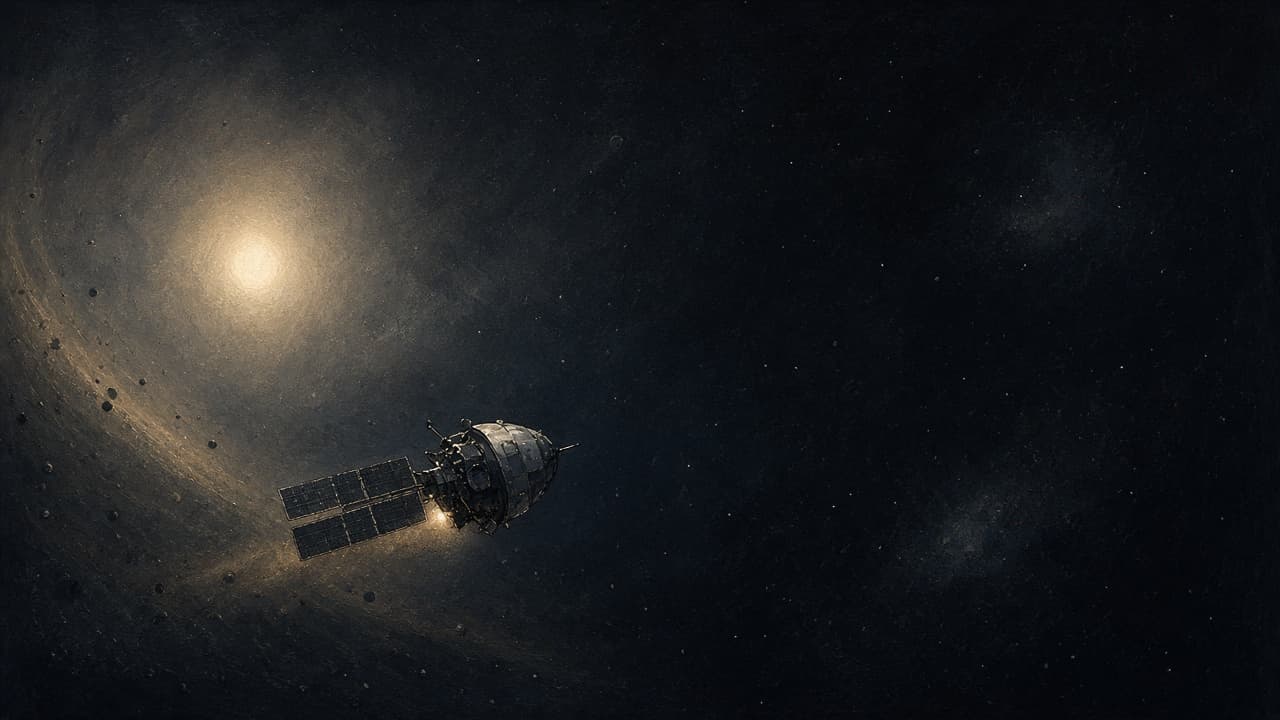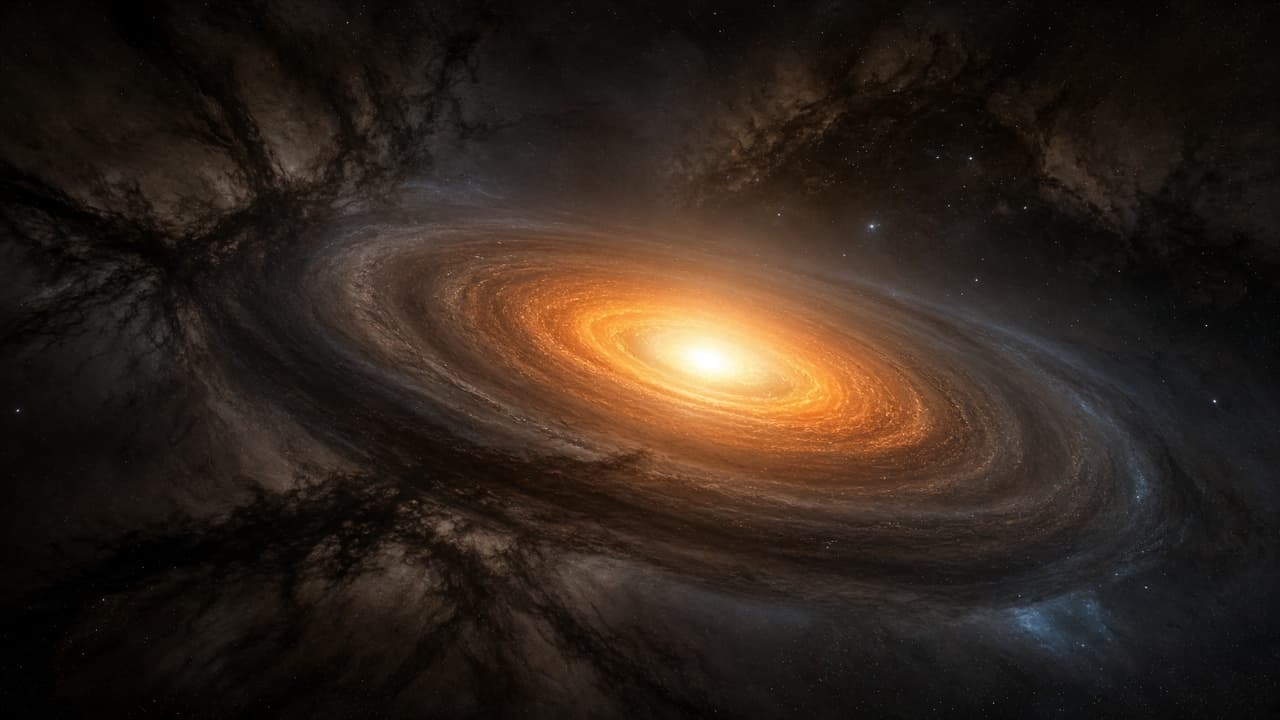
We know that planets exist. We live on one. We have explored the others in our Solar System and discovered thousands more around distant stars. But until recently, we had never directly witnessed the earliest steps that turn a young star's surrounding material into the ingredients for planets.
For centuries, scientists have used observation and experimentation to uncover the mysteries of the universe. Yet one of the most important cosmic processes is remarkably close to home: how does a solar system like ours actually begin?
Scientists have built detailed models using meteorites, observations of our Solar System and simulations. Those models broadly explain how planets could emerge from a young star's disk of gas and dust. But some of the earliest stages have remained hidden.
Now, observations of the extremely young star HOPS-315 are providing a rare opportunity to study that missing chapter. The system is young enough that researchers can investigate material at the stage when some of the first solid planetary ingredients are beginning to form.
It sounds strange. We know about thousands of planets. We have visited worlds across our own Solar System with spacecraft, landed on Mars, collected meteorites and studied distant exoplanets.
So why don't we simply know how planets form?
The problem is time. A planetary system develops over timescales that are vastly longer than a human lifetime. We cannot watch a cloud of gas and dust transform into a planetary system from beginning to end.
Instead, scientists have reconstructed the process using evidence left behind by our own Solar System and observations of other systems at different stages of development.
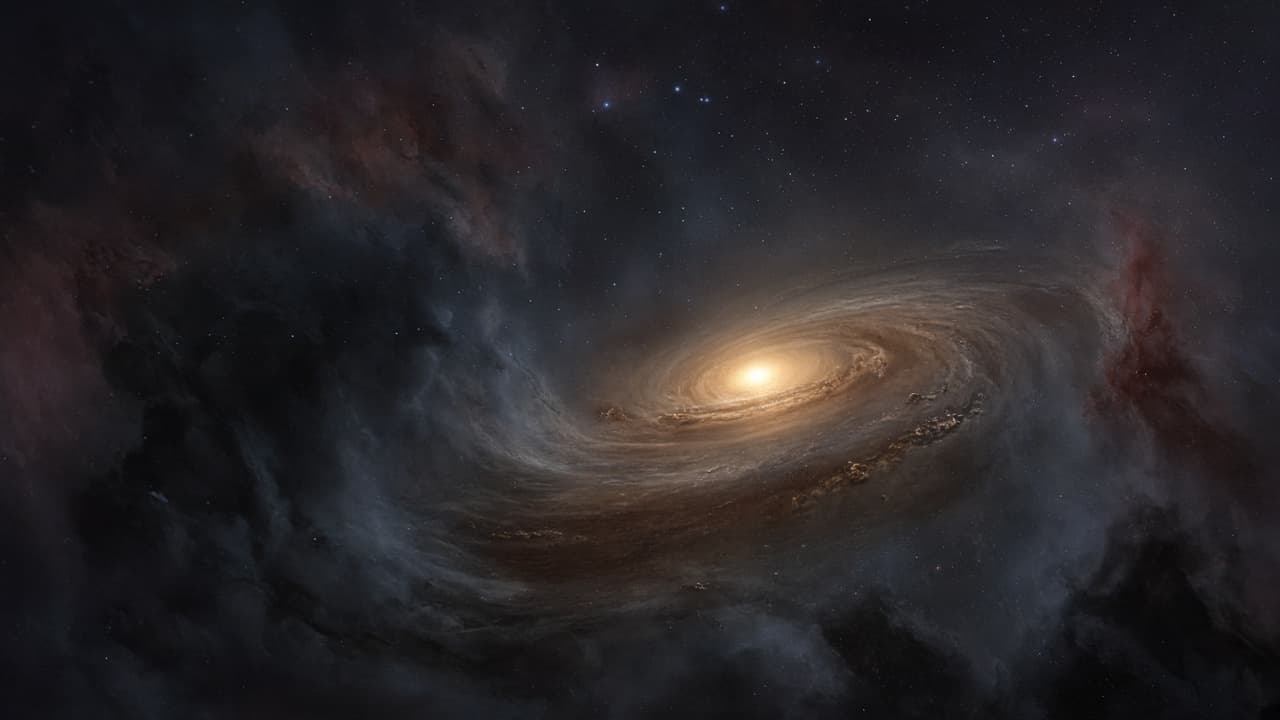
The story begins inside enormous molecular clouds containing gas and dust. These clouds can remain relatively stable for millions of years as different forces compete.
Gas particles produce pressure that pushes outward, while gravity pulls material inward. When something disturbs the balance — potentially including a shock wave from a nearby cosmic event — parts of the cloud can begin collapsing under gravity.
As the cloud collapses, material falls toward its center. Because the collapsing material conserves angular momentum, the rotation speeds up, much like a figure skater spinning faster when pulling their arms inward.
From molecular cloud to young star
Molecular cloud
A huge region of gas and dust exists in a relatively stable state.
Gravitational collapse
If gravity overcomes the opposing pressure, material begins falling inward.
Increasing density and temperature
The collapsing material becomes denser and hotter toward the center.
Rotation accelerates
Conservation of angular momentum causes the collapsing material to spin faster.
Protostar forms
Most of the material concentrates in the center, forming a growing protostar.
Protoplanetary disk
Remaining material spreads into a rotating disk surrounding the young star.
Once a protostar begins forming, not all of the surrounding material falls directly into it. Some remains in orbit, creating a rotating protoplanetary disk.
This disk contains the raw ingredients needed to build planets: gas, dust and increasingly complex solid material.
But there is a major observational problem. Young stars are surrounded by enormous amounts of material, and that material can obscure what is happening inside.
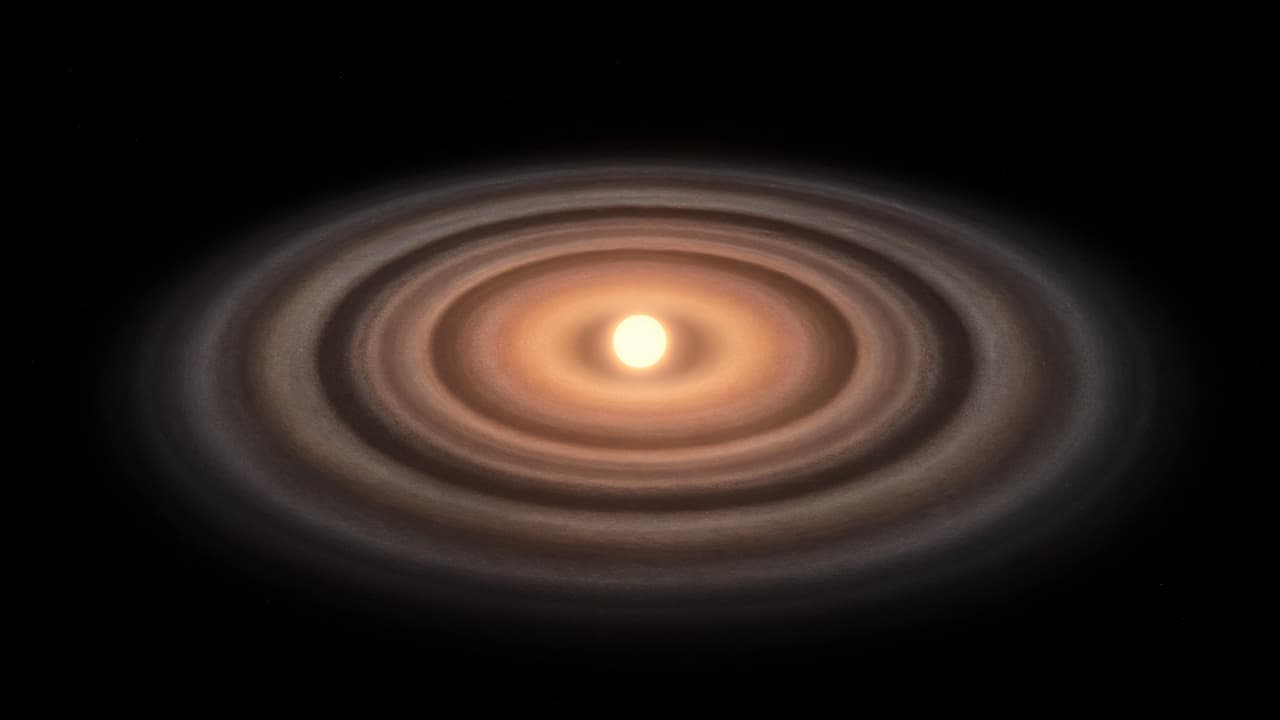
As astronomical technology improved, researchers began finding increasingly young protostars. One important effort was the Herschel Orion Protostar Survey, which examined the Orion Molecular Cloud Complex.
The survey identified previously unseen protostars embedded within extremely cold envelopes of gas and dust. These objects were young enough that their surroundings had not yet been significantly warmed by the developing stars.
These observations gave scientists valuable targets for testing models of how stars evolve. But another major mystery remained: what happens when the material around those young stars starts becoming planets?
The basic idea is deceptively simple. Dust and gas inside the protoplanetary disk begin interacting and, under suitable conditions, solid material forms and grows.
Microscopic solids can accumulate into larger grains. Over much longer periods, these particles can become larger bodies called planetesimals — some of the fundamental building blocks from which planets can develop.
Eventually, gravity and collisions can cause these bodies to grow into planetary embryos and, given the right conditions, planets.

| Stage | What happens | Scale |
|---|---|---|
| Dust grains | Small particles begin accumulating | Microscopic |
| Solid aggregates | Particles become larger bodies | Millimetres and beyond |
| Planetesimals | Larger gravitationally important building blocks emerge | Kilometres and larger |
| Planetary embryos | Growing bodies dominate their local regions | Much larger |
| Planets | Mature worlds develop through continued growth and evolution | Planetary scale |
Astronomers have already observed young planets. Some are only a few million years old. But there is a huge difference between observing a young planet that already exists and observing the process that creates the first solid planetary material.
That left an enormous gap in our observations. We could see the starting environment and we could see relatively young planets, but the crucial transition between them was much harder to observe.
<150,000 years
Approximate age of HOPS-315, placing it extremely early in stellar development
Nature, 2025
Around 1,300 light-years away lies HOPS-315, an exceptionally young protostar. The star is estimated to be less than 150,000 years old and has a mass of roughly 0.6 times that of the Sun.
It is still growing and remains surrounded by an envelope of gas and dust. That makes it an extraordinary laboratory for studying what happens at the beginning of planetary-system formation.
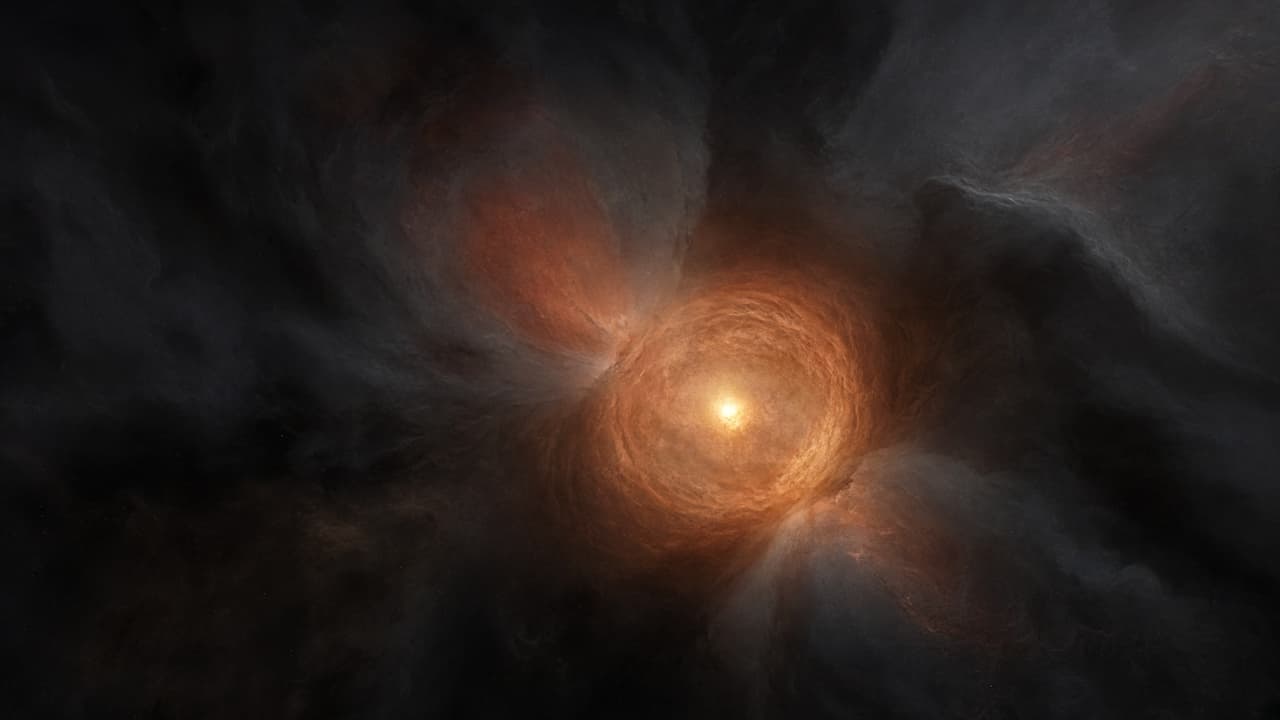
The James Webb Space Telescope observes the universe primarily through infrared wavelengths, making it particularly useful for studying warm material hidden inside dusty environments.
When researchers studied HOPS-315, Webb's infrared spectroscopy revealed signatures associated with warm silicon monoxide gas and tiny crystalline silica material near the young star.
That combination is significant because it provides evidence that material is undergoing the transition from gas into solid crystalline material — an early step in the formation of planetary building blocks.
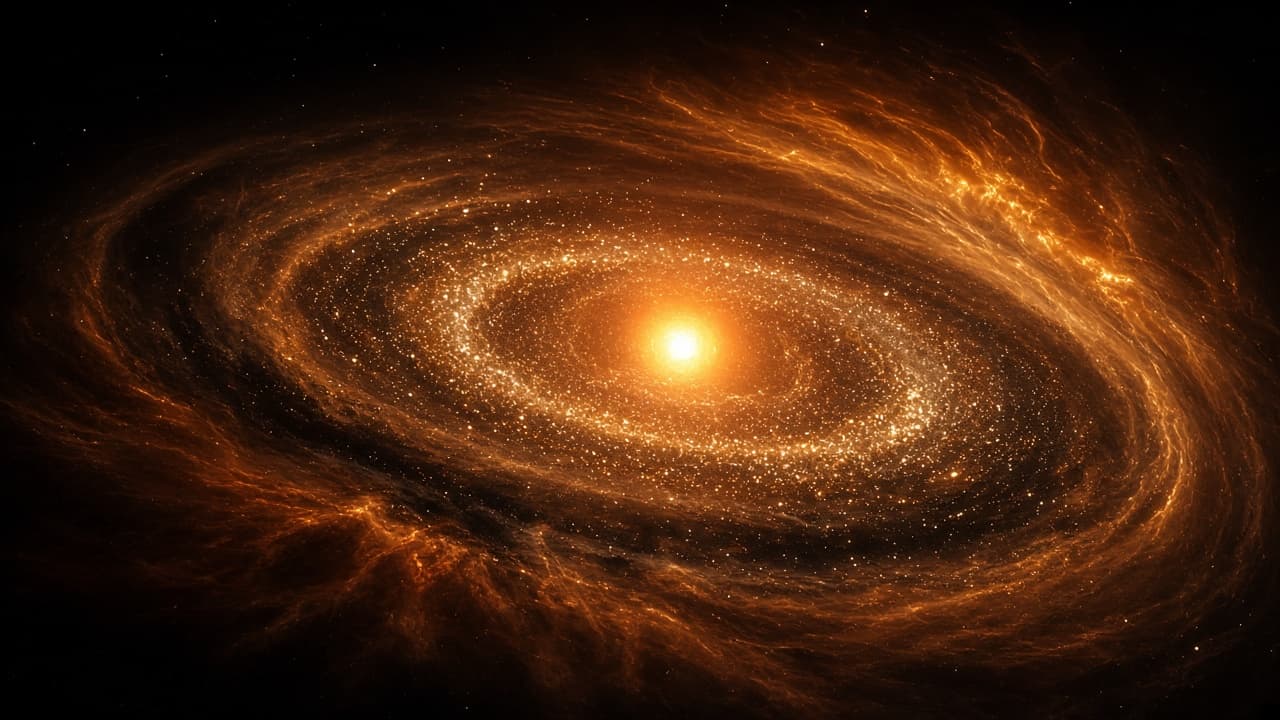
A young planetary disk is not the same temperature everywhere. Regions close to the star are hotter, while material farther away is cooler.
As the disk cools, different compounds can transition from gas to solid at different temperatures. This creates what scientists call a condensation sequence.
- Condensation sequence
- The ordered process in which different chemical compounds condense from gas into solid material as temperature decreases in a cooling planetary disk.
This sequence is important because it influences what kinds of solid material are available at different distances from a young star. Those chemical differences can ultimately affect the types of planets that form.
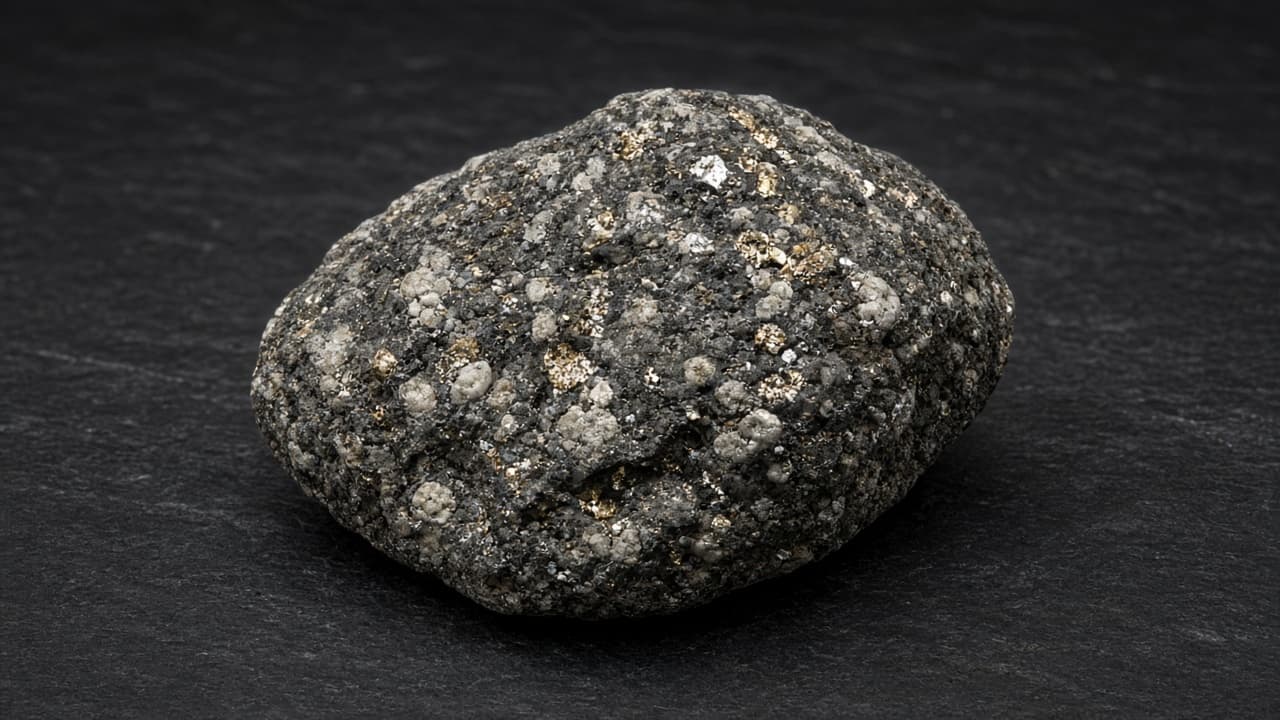
Scientists have long used primitive meteorites as clues to the chemistry of the early Solar System. Some contain extremely ancient inclusions that formed during the earliest stages of Solar System development.
The material detected around HOPS-315 gives astronomers an opportunity to compare an actively forming system with the chemical evidence preserved in ancient Solar System material.
JWST was not working alone. Researchers also turned to the Atacama Large Millimeter/submillimeter Array, better known as ALMA.
While JWST can reveal warm material through infrared observations, ALMA is particularly useful for studying colder gas and dust at millimetre and submillimetre wavelengths.
This gave researchers complementary information. Webb provided evidence for the early chemical process, while ALMA helped locate that activity within the disk.
| Observatory | What it reveals | Why it matters |
|---|---|---|
| James Webb Space Telescope | Infrared signatures from warm material | Reveals chemical evidence associated with early solid formation |
| ALMA | Cold gas, dust and molecular structure | Helps determine where the process occurs within the disk |
One of the most important implications of HOPS-315 is timing.
Researchers once expected significant condensation and planet formation to occur after the young star had evolved further, when much of its surrounding stellar envelope had disappeared.
HOPS-315 provides evidence that important planet-forming processes can begin while the star is still extremely young and actively embedded in its birth environment.
That does not mean a finished planet appears in 150,000 years. It means some of the earliest physical and chemical steps toward planetary construction are already underway.
Seeing the first solids is an enormous step forward, but another major mystery remains.
How do tiny grains eventually become kilometre-scale planetesimals?
Small particles do not necessarily stick together efficiently after every collision. At intermediate sizes, interactions with gas in the disk can also cause particles to lose orbital energy and drift inward.
This creates a difficult growth problem. Somehow, material has to pass through a range of sizes without simply drifting into the young star.
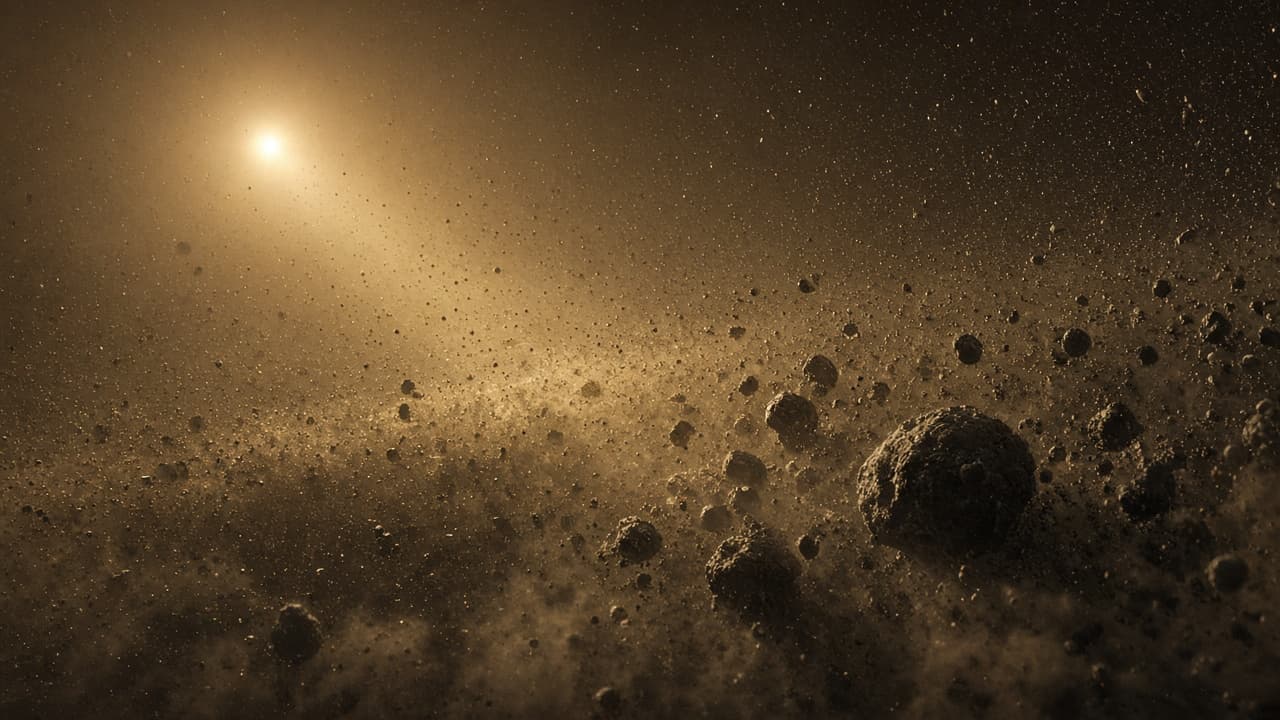
One proposed solution involves regions of concentrated dust becoming gravitationally unstable. Instead of every individual grain gradually sticking to another, large concentrations of solids could potentially collapse into planetesimals more directly.
One way to picture it is a rock emerging from a sandstorm: rather than building the rock grain by grain through countless simple collisions, gravity could help a concentrated region collapse into a much larger object.
Perhaps the most fascinating part of this discovery is not HOPS-315 itself, but what it might tell us about our own origins.
Our Solar System formed roughly 4.6 billion years ago. We cannot observe that event directly. But we can compare ancient Solar System material with young systems that are forming today.
If the chemistry and condensation patterns around HOPS-315 resemble those preserved in primitive Solar System material, it could strengthen the case that similar early processes occurred around the young Sun.
The temperature of a protoplanetary disk changes with distance from the star. That means different materials can survive and condense in different regions.
This creates an important boundary known as the snow line — the region beyond which temperatures are low enough for volatile materials such as water to exist as ice.
- Snow line
- A region in a young planetary disk beyond which temperatures are low enough for volatile substances such as water to condense into solid ice.
The location of the snow line can influence planetary architecture. Beyond it, icy material can contribute additional solid mass to growing planetary cores. If those cores become massive enough while gas remains available, they may capture large amounts of gas and develop into giant planets.
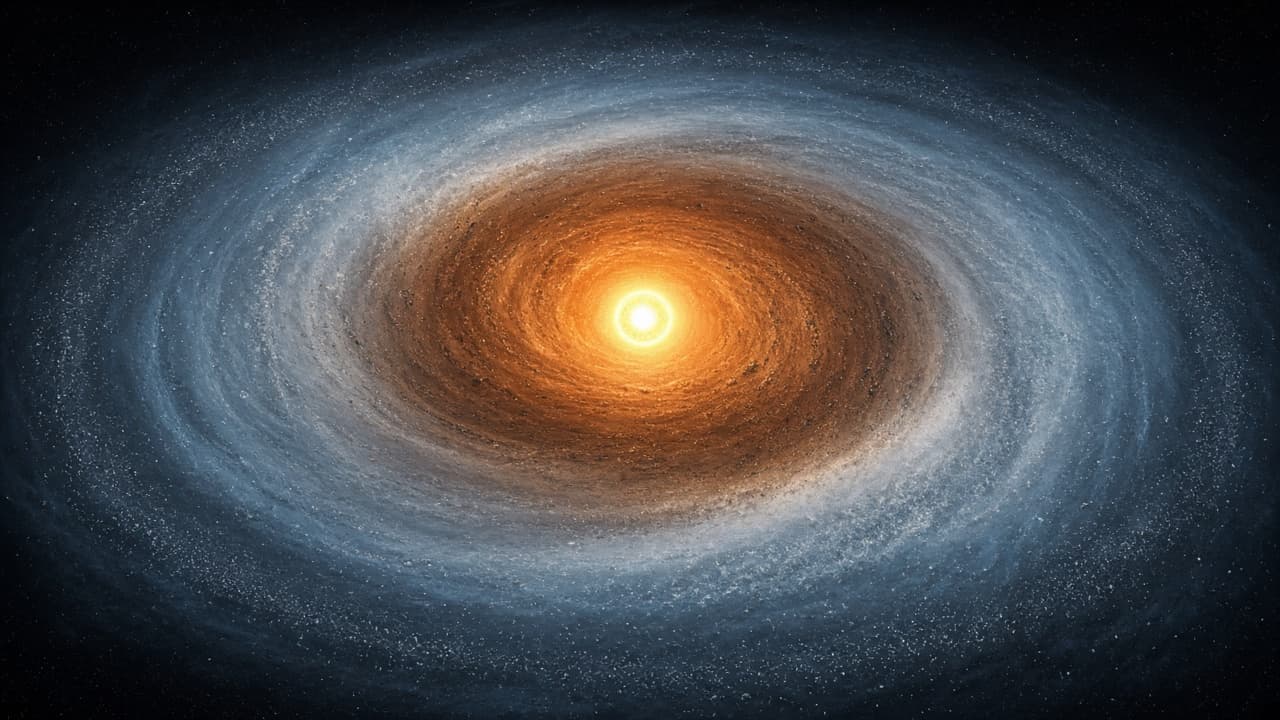
Closer to a young star, temperatures are higher. Many volatile materials remain gaseous, leaving behind materials capable of surviving at higher temperatures, including rocky and metallic components.
Farther out, colder conditions allow more volatile compounds to freeze. Those additional solids can help planetary cores accumulate mass.
| Region | Typical conditions | Potential result |
|---|---|---|
| Inner disk | Hotter; many volatile materials remain gaseous | Rocky planets |
| Beyond snow line | Colder; more volatile material can become solid | Large icy cores and potentially gas-rich planets |
This broad pattern provides one possible explanation for the architecture of our own Solar System, where relatively small rocky planets occupy the inner region and gas giants orbit farther out.
There is another intriguing possibility. If HOPS-315 develops a planetary architecture resembling our own, could it eventually contain an asteroid belt?
Our asteroid belt occupies the region between Mars and Jupiter. One explanation for its existence involves Jupiter's enormous gravity disrupting material that might otherwise have participated in forming another planet.
As Jupiter grew, its gravitational influence and orbital resonances disturbed the surrounding planetesimals, leaving behind a population of rocky bodies rather than allowing the region to assemble into a single planet.
If HOPS-315 eventually develops a sufficiently massive giant planet in a comparable region, its gravitational influence could potentially shape the distribution of leftover planet-forming material.
It is tempting to look at HOPS-315 and imagine another version of the Solar System being assembled in real time.
That possibility is scientifically interesting, but it is too early to know whether its final architecture will resemble ours. Planetary migration, gravitational interactions and differences in the original disk can produce very different outcomes.
What we can say is that the early chemistry observed around HOPS-315 gives researchers a rare opportunity to investigate processes that may have been part of our own Solar System's beginning.
Every major discovery in astronomy tends to create new questions. HOPS-315 is no exception.
- How common is this extremely early stage of planet formation?
- Does planet formation begin this early around most young stars?
- How quickly do the first solid grains grow?
- How do microscopic particles overcome the barriers to becoming planetesimals?
- How similar is HOPS-315's chemistry to the chemistry of the early Solar System?
- Will the system eventually develop rocky planets, gas giants, asteroid belts or a very different architecture?
- Are the earliest steps of planet formation universal across the galaxy?
HOPS-315 is only one system. To understand whether its behaviour represents a universal pattern, astronomers need to find and study more extremely young stars.
If multiple young systems display similar chemical signatures and structures, scientists will gain a much stronger statistical foundation for understanding how planetary systems begin.
Future observations could effectively build a library of planetary systems at different moments of their development — allowing astronomers to reconstruct the process from the first solid grains through to mature worlds.
From cosmic cloud to planetary system
Millions of years before star formation
Molecular cloud
Gas and dust exist in a vast molecular cloud.
Collapse begins
Gravitational collapse
A region becomes unstable and begins collapsing under gravity.
Early stellar evolution
Protostar
Material concentrates at the center while a rotating disk develops around it.
<150,000 years for HOPS-315
Earliest solid formation
Observations indicate that material around HOPS-315 is already undergoing processes associated with solid condensation.
Millions of years
Planetesimals and planets
Solid material can grow into increasingly large planetary building blocks and eventually planets.
Billions of years
Mature planetary system
Planets and smaller bodies evolve into the architecture we observe around mature stars.
There is something almost poetic about HOPS-315. We are looking at a system that is beginning a journey our own Solar System completed billions of years ago.
The Earth did not always exist. Neither did Jupiter, Saturn or the asteroid belt. Before any of them appeared, the material that would eventually become our Solar System was part of a rotating cloud of gas and dust.
By studying HOPS-315, astronomers are effectively searching for clues about that forgotten beginning.
What HOPS-315 does and does not tell us
What works
- Provides a rare look at an extremely early stage of planetary-system formation.
- Combines JWST infrared observations with ALMA measurements of colder material.
- Allows scientists to test planet-formation models against observations.
- May provide clues about the early history of our own Solar System.
- Creates a target for future observations as the system evolves.
What doesn't
- HOPS-315 is only one young planetary system.
- Scientists cannot yet observe the entire process from dust grains to mature planets in real time.
- The mechanism that turns small grains into large planetesimals remains an active research question.
- The final planetary architecture of HOPS-315 is currently unknown.
For decades, the birth of planets has existed somewhere between observation and reconstruction. Scientists had strong models, ancient meteorites and observations of young planetary systems, but the earliest transition from gas and dust into solid planetary material remained difficult to witness.
HOPS-315 is changing that. By combining observations from the James Webb Space Telescope and ALMA, astronomers have gained a rare glimpse of a planetary system at an extraordinarily early stage.
We still do not know what HOPS-315 will eventually become. It could develop planets that resemble our Solar System, or its final architecture could be completely different. That uncertainty is exactly what makes it scientifically valuable.
Because somewhere in the distant past, our own Solar System went through a similar beginning. Before Earth was a world, it was simply part of a swirling cloud of material. HOPS-315 gives us a chance to look back at that kind of cosmic beginning — not through imagination alone, but through actual observations.