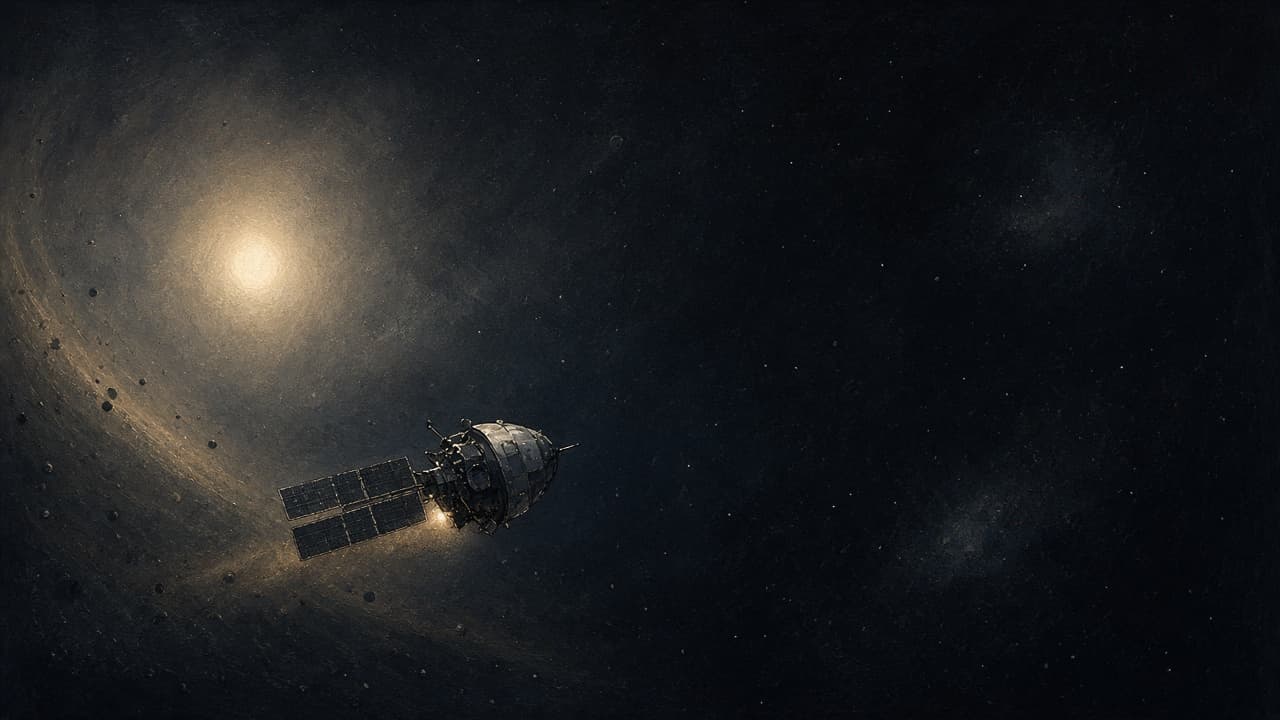
For more than 40 years, Voyager 2 traveled away from Earth toward a boundary that no human had ever crossed. Then, on November 5, 2018, something remarkable happened: the spacecraft passed beyond the protective bubble created by our Sun.
Spacecraft usually explore planets, moons, asteroids and comets. Voyager 2 did something different. It kept going. After completing its historic encounters with the giant planets, the spacecraft continued outward into a region where the influence of the Sun gradually gives way to the environment between stars.
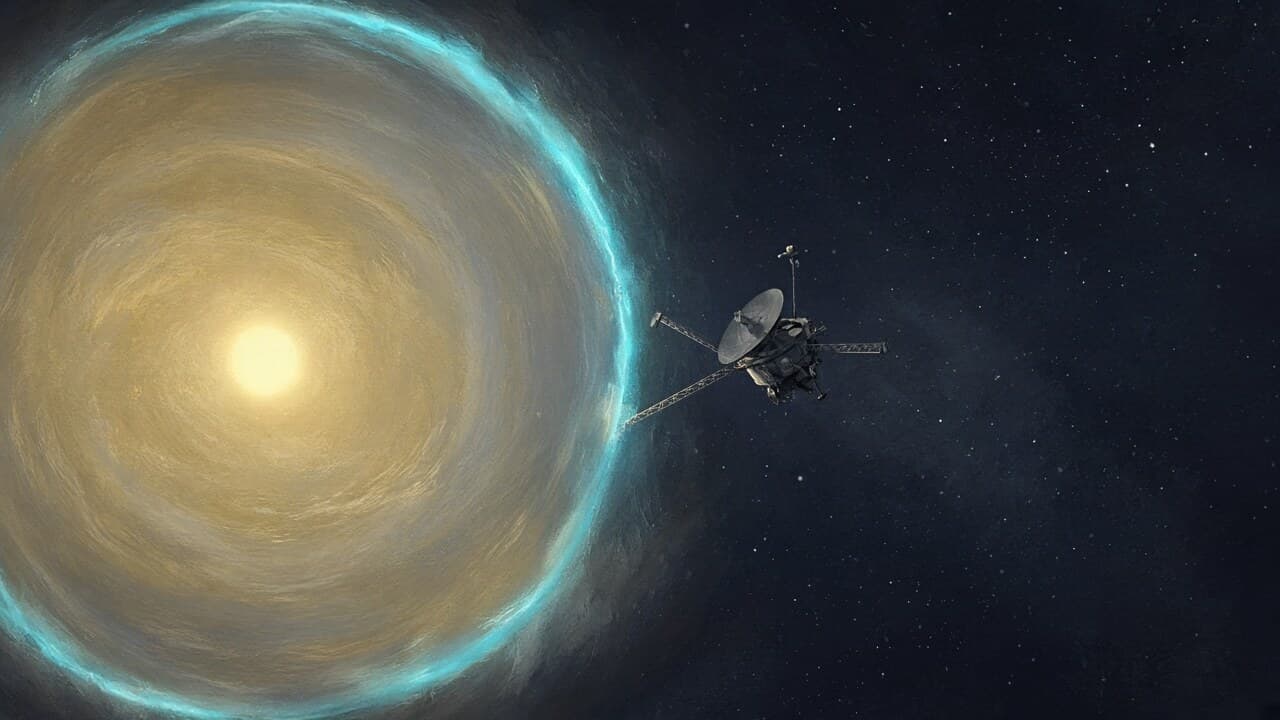
When Voyager 2 crossed the heliopause at roughly 119 astronomical units from the Sun, it did not simply pass an invisible line and enter an empty void. Its instruments detected changes in particles, plasma and magnetic fields that revealed the boundary between our solar neighborhood and interstellar space to be surprisingly complicated.
And this is where Voyager 2 becomes more than an old spacecraft. It has become one of humanity's first scientific messengers into the space between stars.
Voyager 2 launched in 1977 as part of a mission designed to take advantage of a rare planetary alignment. Its journey eventually carried it past Jupiter, Saturn, Uranus and Neptune, giving humanity unprecedented close-up views of the outer planets.
But the most distant destination of Voyager 2 was never a planet. Its real long-term destination was the space beyond the Sun's influence.
The spacecraft continued outward long after its planetary encounters were finished. Every additional year of travel pushed Voyager 2 farther away from the familiar solar system and closer to an environment dominated by the space between stars.
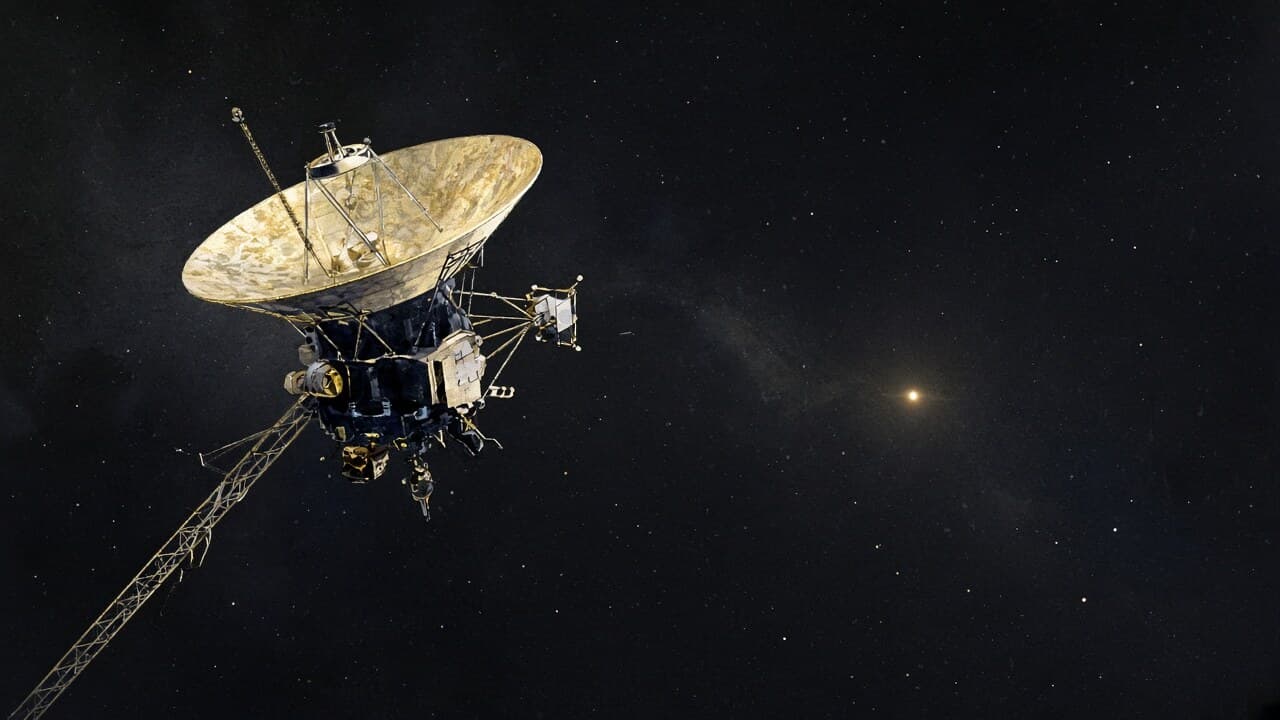
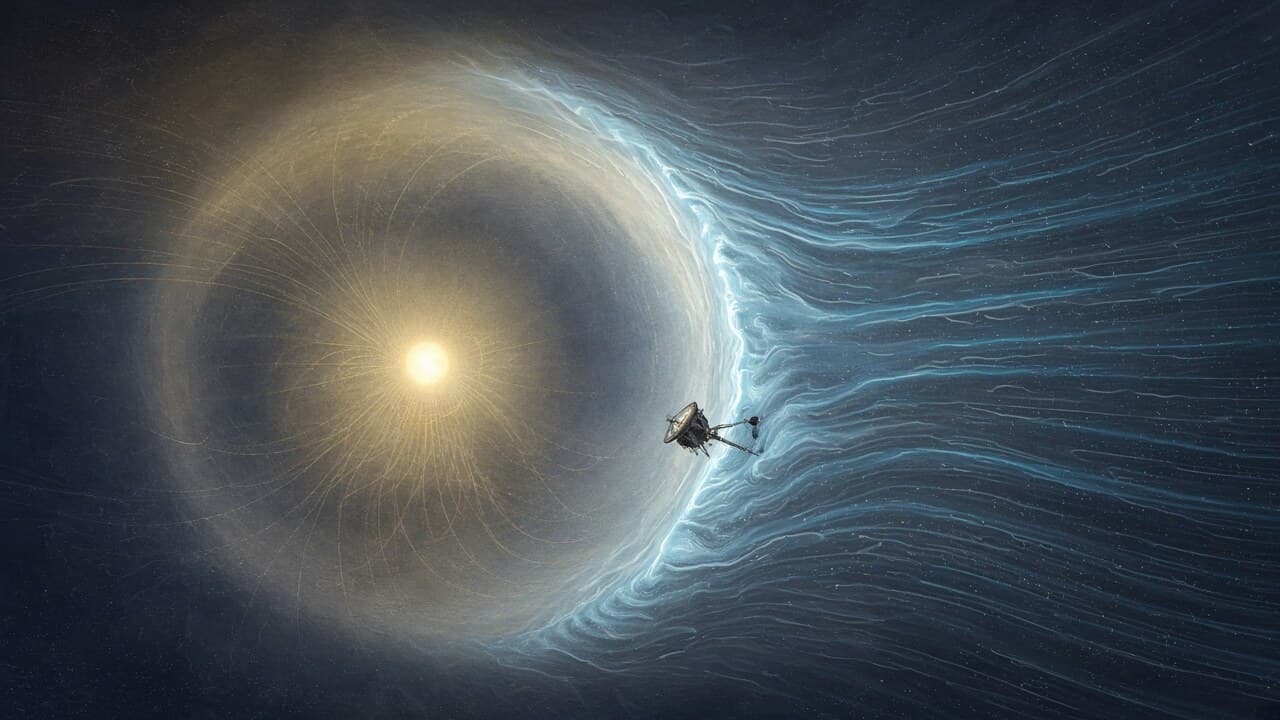
The Sun does more than provide light and heat. It continuously releases a stream of charged particles called the solar wind. As this solar wind travels outward, it creates a huge region of space dominated by solar particles and the Sun's magnetic influence.
- Heliosphere
- The enormous bubble of plasma and magnetic influence produced by the Sun as the solar wind expands into surrounding interstellar space.
The heliosphere is not a perfect sphere. Its shape and boundary are influenced by the solar wind, the Sun's activity and the surrounding interstellar environment.
At some distance from the Sun, the outward-flowing solar wind can no longer dominate its surroundings. The pressure of the interstellar medium becomes important, producing a complicated transition region.
The heliopause is the boundary between the heliosphere's outer plasma environment and the very local interstellar medium. It is better imagined as a dynamic shoreline than a physical wall.
Voyager 2 crossed this boundary at approximately 119 astronomical units from the Sun. One astronomical unit is the average distance between Earth and the Sun, so the spacecraft was roughly 119 times farther from the Sun than Earth is.
119 AU
Approximate distance of Voyager 2's heliopause crossing
NASA; Nature Astronomy
Scientists did not determine that Voyager 2 had entered interstellar space because of a single measurement. Several instruments recorded changes consistent with the spacecraft crossing the heliopause.
One of the clearest signals came from Voyager 2's Plasma Science Experiment. The instrument observed a sharp decline in the outward flow of solar-wind plasma. Around the same time, other instruments detected changes in energetic particles and magnetic fields.
Together, these measurements provided a much stronger picture than any individual instrument could provide.
- Solar-wind plasma flow dropped dramatically.
- Heliospheric energetic particles decreased.
- Galactic cosmic rays increased.
- Magnetic-field measurements changed as Voyager approached and crossed the boundary.
- Plasma density measurements beyond the heliopause confirmed the transition into interstellar space.
One of the most interesting lessons from Voyager 2 is that the heliopause is not a clean dividing line between two completely separate environments.
Researchers found a boundary region before the heliopause where the plasma slowed, heated up and became denser. The transition included a broader region followed by a much thinner boundary layer immediately around the heliopause.
The plasma measurements indicated that the very local interstellar medium near the boundary was hotter than some models and earlier observations had predicted.
30,000–50,000 K
Temperature measured for nearby interstellar plasma
Nature Astronomy
The Sun's influence is not only about particles. Magnetic fields are also central to the structure of the heliosphere.
Voyager 2 detected a magnetic barrier in the heliosheath near the heliopause. This region appears to strongly influence how energetic particles and cosmic rays move between the heliosphere and interstellar space.
Even more intriguing was what happened to the magnetic-field direction. Voyager 2 observed only a small change, or potentially no significant change, in field direction across the heliopause.
Voyager 2 also provided evidence that the heliosphere is not an impenetrable bubble.
Some particles originating inside the heliosphere can leak through the boundary into interstellar space. Voyager 2's position and trajectory suggested that the region around its crossing could be more porous than the region encountered by Voyager 1.
That makes the heliopause much more interesting than the simple idea of a border. Particles, magnetic fields and plasma interact across the region, creating a constantly changing cosmic interface.
As Voyager 2 approached the heliopause, its particle detectors recorded another dramatic change.
Particles associated with the heliosphere dropped sharply while higher-energy galactic cosmic rays increased. This provided another important indication that Voyager 2 had crossed into the interstellar medium.
The change also tells us something about the protective role of the heliosphere. The Sun's enormous bubble affects the particle environment surrounding our planetary system, altering the flow of some energetic radiation from interstellar space.
Voyager 2 was not the first spacecraft to cross the heliopause. Voyager 1 crossed it in 2012. But comparing the two spacecraft became scientifically valuable because they encountered the boundary at different locations.
| Feature | Voyager 1 | Voyager 2 |
|---|---|---|
| Heliopause crossing | August 25, 2012 | November 5, 2018 |
| Approximate distance | 121.6 AU | 119 AU |
| Direction | Northern hemisphere trajectory | Southern hemisphere trajectory |
| Boundary observations | Complex transition region | Thinner and simpler boundary observed |
| Interstellar magnetic field | Measured beyond heliopause | Stronger field measured in the local region |
The differences between the two spacecraft show that the heliopause is not identical everywhere. Its structure depends on location and the changing interaction between the Sun and the surrounding interstellar medium.
Not exactly.
This is one of the most important distinctions when talking about Voyager 2. Crossing the heliopause means the spacecraft entered interstellar space, but it does not mean Voyager 2 has passed the absolute gravitational edge of the solar system.
Far beyond the planets and the heliosphere lies the hypothesized Oort Cloud, a vast population of distant icy objects believed to surround the solar system. Its outer boundary could extend thousands of astronomical units from the Sun.
Distance is not just a number. The scale of interstellar space quickly becomes difficult to comprehend.
Voyager 2's journey is a perfect real-world demonstration. A spacecraft launched in 1977 took more than four decades to reach the heliopause. And the heliopause is still nowhere near the boundary of the Oort Cloud, let alone another star.
Even traveling to the nearest stars would require vastly more advanced propulsion systems or extremely long mission durations. The enormous distances between stars turn speed, energy, shielding, reliability and communication into fundamental engineering challenges.
Speed alone does not solve interstellar travel. As a spacecraft approaches a substantial fraction of the speed of light, even tiny particles become dangerous.
Gas, dust and microscopic particles exist between stars. At extreme velocities, impacts with those particles can release enormous amounts of energy and damage a spacecraft. A future interstellar vehicle would therefore need extraordinary shielding as well as a propulsion system capable of accelerating it to a significant fraction of light speed.
Voyager 2 is giving scientists something that telescopes cannot provide in quite the same way: direct measurements from within the interstellar environment.
The spacecraft is effectively sampling the neighborhood through which a future interstellar probe would have to travel. It is measuring particles, plasma and magnetic fields in the space beyond the Sun's heliosphere.
That makes Voyager 2 more than a historical artifact. It is an early scout for a future civilization that may eventually attempt to travel beyond its home star.
There is something almost strange about Voyager 2's situation. It was built decades ago using technology from another era, yet it is now sending measurements from a region no human being has ever visited.
The spacecraft is not carrying astronauts. It cannot turn around and come home. It cannot be repaired by a technician. Its computers are extraordinarily primitive compared with modern consumer devices.
And yet it keeps working.
That makes Voyager 2 a remarkable experiment in long-duration exploration. Every additional measurement is effectively a message from farther away than humanity has ever traveled.
Voyager 2 will continue traveling outward through interstellar space. Its power supply is gradually declining, so mission controllers must progressively reduce the spacecraft's energy demands and scientific operations.
As long as useful instruments continue operating and communication remains possible, Voyager 2 can keep contributing measurements from farther into the interstellar medium.
It will not reach another star anytime soon. The distances involved are simply enormous.
Voyager 2 answered some important questions, but it also exposed new ones.
- Why does the heliopause have different structures in different directions?
- How exactly does the solar magnetic field interact with the interstellar magnetic field?
- How do particles cross the heliopause?
- How does the heliosphere protect the planetary system from energetic cosmic radiation?
- How does the heliosphere change as solar activity rises and falls?
- What does the local interstellar medium look like farther from the heliopause?
Voyager 2 has shown that the boundary around our solar system is dynamic, porous and more complicated than a simple invisible wall.
Humanity often imagines space exploration as a journey toward distant planets, alien civilizations or other galaxies. Voyager 2 offers a quieter perspective.
Before we seriously travel to another star, we first need to understand the environment between stars. Voyager 2 is helping us do exactly that.
It is also a reminder that the solar system is not an isolated collection of planets floating in empty darkness. The Sun creates a vast bubble around us, and that bubble is constantly interacting with the galaxy beyond it.
Voyager 2 is providing our first look at the space we would have to pass through if humanity ever were to travel beyond our home star.
A Journey Measured in Decades
1977
Launch
Voyager 2 begins its journey from Earth.
1979
Jupiter
Voyager 2 makes its close encounter with Jupiter.
1981
Saturn
The spacecraft continues its grand tour with a Saturn flyby.
1986
Uranus
Voyager 2 becomes the first spacecraft to visit Uranus.
1989
Neptune
Voyager 2 becomes the first spacecraft to visit Neptune.
2018
Heliopause Crossing
Voyager 2 crosses the heliopause at approximately 119 astronomical units and enters interstellar space.
2019
Detailed Findings
A collection of peer-reviewed studies publishes detailed measurements of Voyager 2's plasma, magnetic field and energetic particle observations.
Today
Continuing Outward
Voyager 2 continues its journey through interstellar space while its remaining instruments gradually become limited by declining spacecraft power.
Voyager 2's greatest discovery may not be a single particle measurement or magnetic-field reading. It may be the perspective it gives us.
We have now sent a machine beyond the heliosphere. We know that the boundary is real, but also complicated. We know that interstellar space is not simply an empty darkness beyond the planets. It contains plasma, magnetic fields, cosmic rays and structures that interact with our star.
But Voyager also shows us the other side of the problem. Reaching the edge of the Sun's heliosphere took more than four decades. The nearest stars are unimaginably farther away.
The future of interstellar exploration therefore depends on technologies that are dramatically more capable than today's spacecraft. Better propulsion, autonomous systems, advanced materials, radiation protection and new approaches to energy will all be important.
Maybe humanity will eventually develop those technologies. Maybe future generations will look back at Voyager 2 the way we look at the earliest aircraft today: as an astonishing first step, but nowhere near the final form of transportation.
For now, Voyager 2 continues moving outward, carrying a small piece of Earth into a place where no human has ever stood.
Voyager 2 did not find an alien civilization or a mysterious wall at the edge of the solar system. It found something scientifically more valuable: a complicated boundary where the environment created by our Sun meets the space between stars.
Its measurements showed that the heliopause is dynamic, that particles can cross it, that magnetic fields interact across it, and that the nearby interstellar medium contains surprises of its own.
But Voyager 2's journey also leaves us with a humbling realization. Crossing the Sun's heliosphere required more than 40 years. The stars beyond it are vastly farther away.
Perhaps that is the real message Voyager 2 is sending home: space is not just unexplored. It is enormous. And if humanity ever becomes an interstellar civilization, Voyager 2 may be remembered as one of the tiny first machines that showed us what lies beyond our cosmic home.
What Voyager 2 gives us — and what it cannot
What works
- Provides direct measurements from beyond the heliosphere.
- Offers a unique view of the interaction between the Sun and interstellar space.
- Helps scientists understand plasma, magnetic fields and cosmic rays near the heliopause.
- Provides a real-world benchmark for understanding future interstellar exploration.
What doesn't
- Voyager 2 has limited power and increasingly constrained scientific operations.
- The spacecraft cannot directly explore distant stars or planetary systems.
- Measurements come from only a few locations, making it difficult to map the entire heliosphere.
- Its very long travel time demonstrates how difficult practical interstellar travel remains.