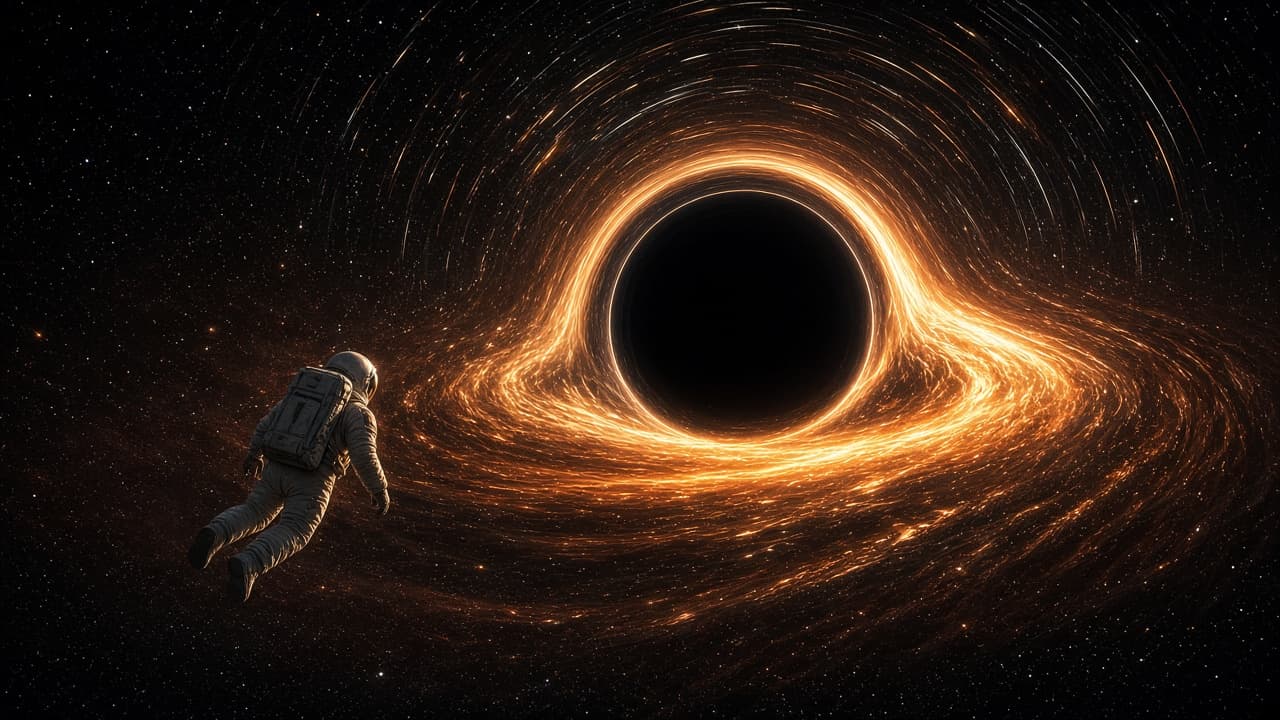
Imagine floating through space when a strange darkness appears ahead of you. It is not a planet. It is not a star. Around it, distant stars seem to bend into arcs, and a brilliant ring of superheated gas swirls through the darkness. You are approaching a black hole—the kind of place where gravity can overwhelm even light.
Black holes are among the most extreme objects known to science. They form when enormous amounts of matter are concentrated into a sufficiently compact region, creating gravity so strong that nothing can escape from within a boundary called the event horizon.
But what would actually happen if you fell into one? Would you be stretched apart? Would time stop? Could you see the future of the universe? And is there any possibility of surviving the journey?
The answers are stranger than many science-fiction stories suggest. Einstein's theory of general relativity allows scientists to describe much of the journey mathematically. Yet the deepest interior of a black hole remains beyond our complete understanding.
Let's imagine a journey toward a black hole, one stage at a time, using established physics to explore what might happen—and clearly marking the point where scientific predictions become uncertain.
A black hole is a region of spacetime whose gravity is so strong that, once something crosses a particular boundary, it cannot send a signal back to the distant universe. Even light cannot escape from inside that boundary.
Black holes are not empty tunnels punched through space. They are compact concentrations of mass. Some form when massive stars collapse at the end of their lives, while supermassive black holes containing millions or billions of solar masses occupy the centers of many galaxies.
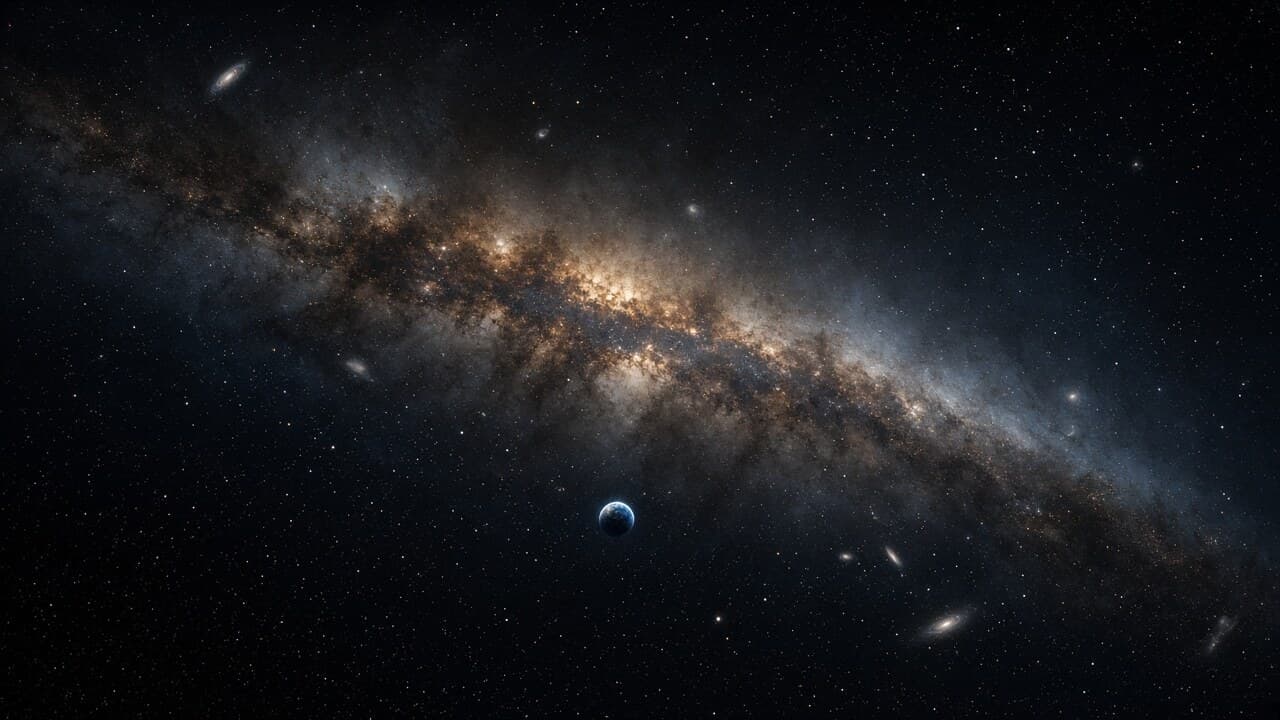
Our own Milky Way contains a supermassive black hole called Sagittarius A*, located roughly 27,000 light-years from Earth. Its existence has been established through observations of stars orbiting an invisible, extremely massive object near the galactic center.
Despite their reputation, black holes do not automatically pull in everything around them. If the Sun could somehow be replaced by a black hole with exactly the same mass, Earth would not suddenly be sucked inward. Our orbit would remain approximately the same, although Earth would lose the sunlight needed to support its current climate and ecosystems.
The real danger comes when you approach sufficiently close. There, gravity, the curvature of spacetime, and the difference in gravitational pull across your body begin to produce extraordinary effects.
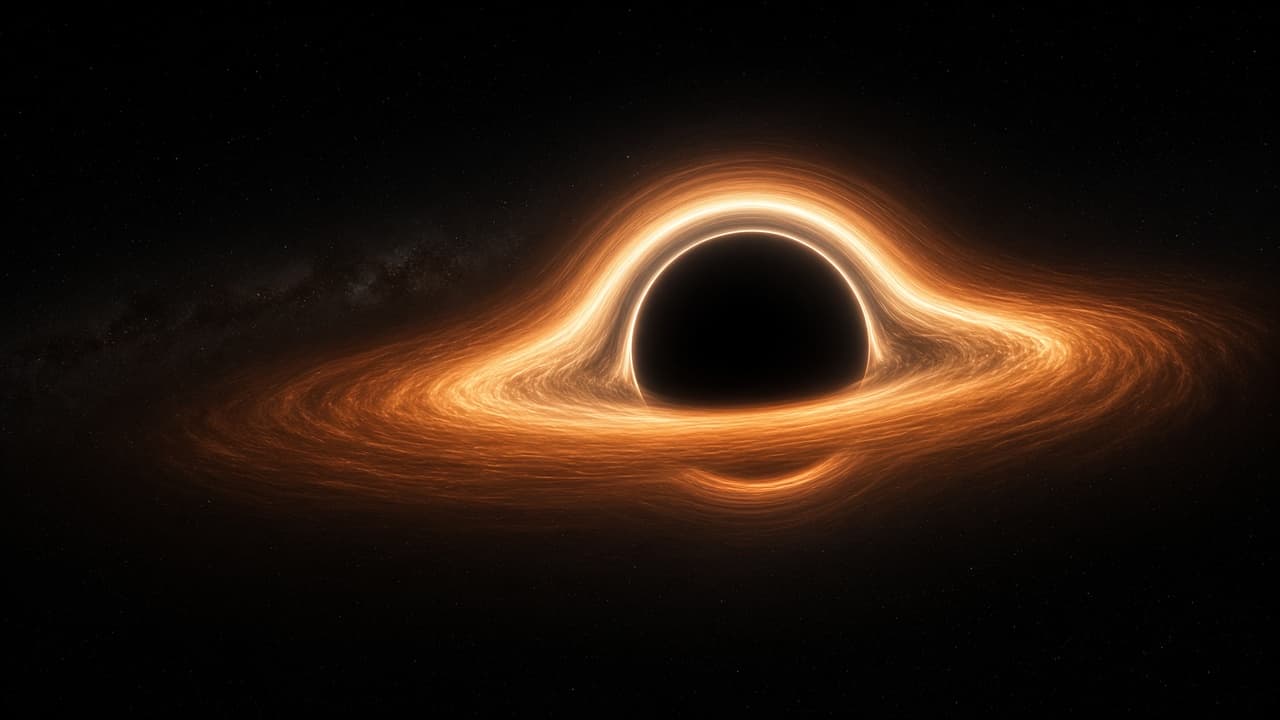
As your spacecraft approaches a black hole, the universe ahead would no longer look quite like the sky we know. A black hole's gravity curves spacetime, and light follows that curved geometry. Light from objects behind or beside the black hole can therefore be redirected toward your eyes or telescope.
This effect is called gravitational lensing. Depending on your position, distant stars could appear displaced, stretched into arcs, or arranged in rings. Light from parts of the sky that would normally be hidden behind the black hole could bend around it and become visible.
If the black hole is surrounded by an accretion disk—a rotating collection of gas and dust spiraling inward—the scene could become even more dramatic. Friction, compression, and magnetic processes can heat the material to extreme temperatures, causing it to emit intense radiation.
The black hole itself would remain dark, but its surroundings could shine brightly. The result would be a dark central region surrounded by distorted light and, in some systems, energetic jets emerging from regions near the poles.
That last detail matters: not every black hole has a brilliant accretion disk or powerful jets. A black hole without much nearby material could be comparatively dark and difficult to detect.
The event horizon is often described as the point of no return. It is not a solid surface, and it is not a wall that you would necessarily collide with. It is a boundary in spacetime beyond which future-directed paths cannot carry a signal back to the outside universe.
Before crossing it, a spacecraft could in principle turn around if it had enough thrust and was not already trapped by its trajectory. After crossing the event horizon, no ordinary rocket engine could bring it back out. This is not merely a problem of building a powerful enough engine: within the horizon, all future-directed paths lead farther inward in the classical description.
Here is the surprising part. If you fell freely toward a sufficiently large black hole, you might not notice a special physical barrier at the exact moment you crossed the event horizon. In a simple, nonrotating black hole model, the local laws of physics do not suddenly switch off at that boundary.
What matters is the black hole's size and your trajectory. Near a small black hole, tidal forces can become destructive before you reach the horizon. Near a sufficiently massive black hole, those forces at the horizon can be much weaker.
One of the most famous predictions associated with falling into a black hole is spaghettification. The name sounds almost comical, but the physics is anything but.
Gravity becomes stronger as you get closer to a black hole. If your feet are closer to the black hole than your head, your feet experience a stronger gravitational pull. The difference between the forces acting on the two ends of your body is called a tidal force.
As that difference increases, your body would be stretched along the direction toward the black hole and compressed in directions perpendicular to it. If the forces became sufficiently intense, they would overwhelm the forces holding your body together.
You would not remain a person floating calmly through a dark tunnel. In a sufficiently strong tidal field, the physical structure of your body and spacecraft would be destroyed.
The exact point at which spaghettification becomes fatal depends on the black hole's mass, your distance from it, and your trajectory. There is no single distance that applies to every black hole.
A stellar-mass black hole can have an event horizon only tens of kilometers across, depending on its mass. Because the horizon is relatively small, the difference in gravity between your head and feet can be enormous when you approach it.
For a sufficiently small black hole, tidal forces could destroy you before you reach the event horizon. In that scenario, your journey ends outside the boundary itself.
A supermassive black hole has a much larger event horizon. Because the gravitational gradient at the horizon decreases as the black hole's mass increases, the tidal forces there can be much weaker than those near the horizon of a stellar-mass black hole.
In an idealized scenario involving a sufficiently massive black hole, an astronaut could cross the event horizon without immediately being torn apart by tidal forces. That does not mean survival would continue indefinitely. The astronaut would still be unable to return to the outside universe, and tidal forces would become increasingly severe farther inward in the classical picture.
There is another danger: a real black hole may be surrounded by hot gas, intense radiation, and energetic particles. An accretion disk could be lethal long before you reached the horizon. The thought experiment assumes a suitably safe approach so we can isolate the effects of gravity.
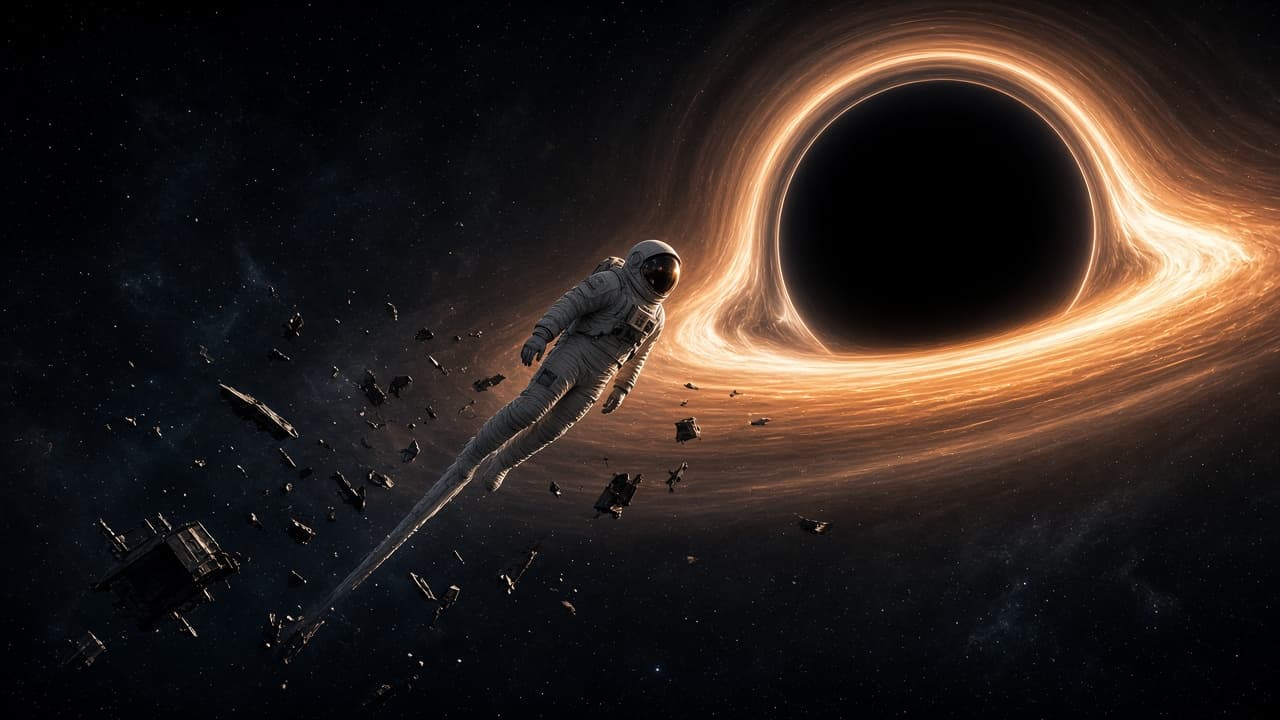
Black holes do not merely challenge our ideas about space. They also reveal how deeply space and time are connected.
According to Einstein's general theory of relativity, clocks can run at different rates depending on their gravitational environment. A clock positioned deep in a gravitational field runs more slowly relative to a comparable clock far away, when the clocks are compared using the appropriate signals and definitions of time.
This effect is called gravitational time dilation. It is not exclusive to black holes: small differences in gravitational potential affect clocks on Earth as well. Near a black hole, however, the effect can become extreme.
Suppose you and a friend begin the journey together. Your friend stays far away and observes you using a telescope and incoming light signals. As you approach the event horizon, the signals your friend receives become increasingly delayed, stretched toward longer wavelengths, and dimmer.
From your friend's perspective, your image appears to slow and fade. In the idealized mathematical description, light emitted ever closer to the horizon takes on increasingly extreme gravitational redshift. The practical result is not a clear, endlessly visible picture of you frozen at the boundary; your image becomes too faint and redshifted to follow.
From your own perspective, however, your clock does not simply stop. If you fall freely into a sufficiently large black hole, you can cross the event horizon in a finite amount of your own time.
You may have heard that a person falling into a black hole could watch the entire future of the universe unfold before their eyes. It is an exciting idea, but it is not a general prediction that applies to every black hole or every falling trajectory.
Relativity allows the rate at which clocks accumulate time to differ between observers. But that does not mean an astronaut automatically receives an infinite stream of future information simply by approaching an event horizon.
The amount of outside information the astronaut could actually receive depends on the black hole's geometry, the trajectory, and how much time remains before reaching the interior endpoint predicted by the model. Signals may also be redshifted, weakened, or unavailable because of the physical environment.
The popular idea of seeing the entire future of the universe is therefore misleading as a universal claim. The more defensible conclusion is that gravity changes the relationship between time measurements, and the details become highly dependent on the specific situation.
Crossing the event horizon creates a fundamental limit on communication. No message you send from inside can reach a distant observer outside the horizon. The same is true for light, radio transmissions, and any other signal that follows a path constrained by relativity.
For a simple, nonrotating black hole described by classical general relativity, the interior geometry means that moving toward smaller radial distances becomes as unavoidable as moving toward the future. You cannot simply stop and hover at a fixed radius or turn around to escape.
But what you would see through a window is a more complicated question. Light can be bent, and the appearance of the outside universe depends on the trajectory and the black hole's properties. Popular illustrations of a black hole as a perfectly black tunnel with a bright ring are visual aids, not literal views guaranteed for every falling observer.
For a sufficiently massive black hole, tidal forces may initially be modest after horizon crossing. As the astronaut continues inward, the tidal field grows stronger in the classical nonrotating model. Eventually, those forces would destroy ordinary matter.
The mathematical description then leads toward a region called the singularity. But this is where we need to be especially careful: a singularity in classical general relativity signals that the theory's description becomes incomplete. Physicists do not yet have a confirmed, experimentally tested account of the ultimate interior.
In the simplest classical model of a black hole, matter collapses toward a singularity where the equations predict quantities such as spacetime curvature to become unbounded. This is not a place scientists have visited or directly observed. It is a result of extending our current mathematical theory into an extreme regime.
General relativity describes gravity and spacetime on large scales extremely well. Quantum theory describes the behavior of matter and energy at very small scales. A complete understanding of a black hole's deepest interior likely requires a framework that can consistently account for both.
Physicists are investigating ideas in quantum gravity, but there is no experimentally confirmed theory that settles exactly what replaces the classical singularity inside a real black hole.
That uncertainty has inspired many imaginative possibilities, including tunnels to other regions of spacetime and connections to other universes. Such ideas arise in some theoretical discussions, but they should not be presented as established descriptions of what a person would experience after crossing the horizon.
Not all black holes produce the same experience at the event horizon. One of the most important differences is their mass.
- Stellar-mass black holes: These form through processes involving massive stars and typically have masses of several to dozens of Suns. Their event horizons are relatively small, and tidal forces near the horizon can be devastating.
- Supermassive black holes: These contain millions or billions of solar masses. Their event horizons are much larger, and tidal forces at the horizon can be weaker than those around smaller black holes.
- Black holes with active accretion disks: These may be surrounded by extremely hot gas and intense radiation, creating additional hazards well outside the event horizon.
- Quiet black holes: A black hole with little nearby material may lack a bright disk, although its gravitational influence can still reveal its presence.
This is why the phrase 'a black hole would instantly stretch you into spaghetti' is incomplete. It describes a real physical effect, but not the exact experience for every black hole. The outcome depends on mass, distance, trajectory, rotation, and the surrounding environment.
Before crossing the event horizon, escape may be possible in principle if the spacecraft has a suitable trajectory and enough propulsion. The practical engineering challenges near a real black hole could still be enormous.
After crossing the event horizon, classical general relativity offers no route back to the outside universe for a normal future-directed traveler or signal. Increasing engine power cannot solve the problem because the restriction comes from the geometry of spacetime, not merely from insufficient thrust.
Ideas about wormholes or shortcuts through spacetime sometimes appear in discussions of black holes. Certain mathematical solutions to gravitational equations contain unusual structures, but that does not establish that traversable wormholes exist in nature or that a person could use a black hole as a portal.
For a real astronaut crossing a conventional astrophysical black hole's event horizon, there is no known practical escape plan.
If a black hole cannot emit light from within its event horizon, how can astronomers know that black holes exist? The answer is that scientists observe their effects on their surroundings.
They measure the orbits of stars around invisible, massive objects, detect radiation from hot gas falling inward, and observe gravitational waves produced when black holes merge. Each method reveals different information about these extreme objects.
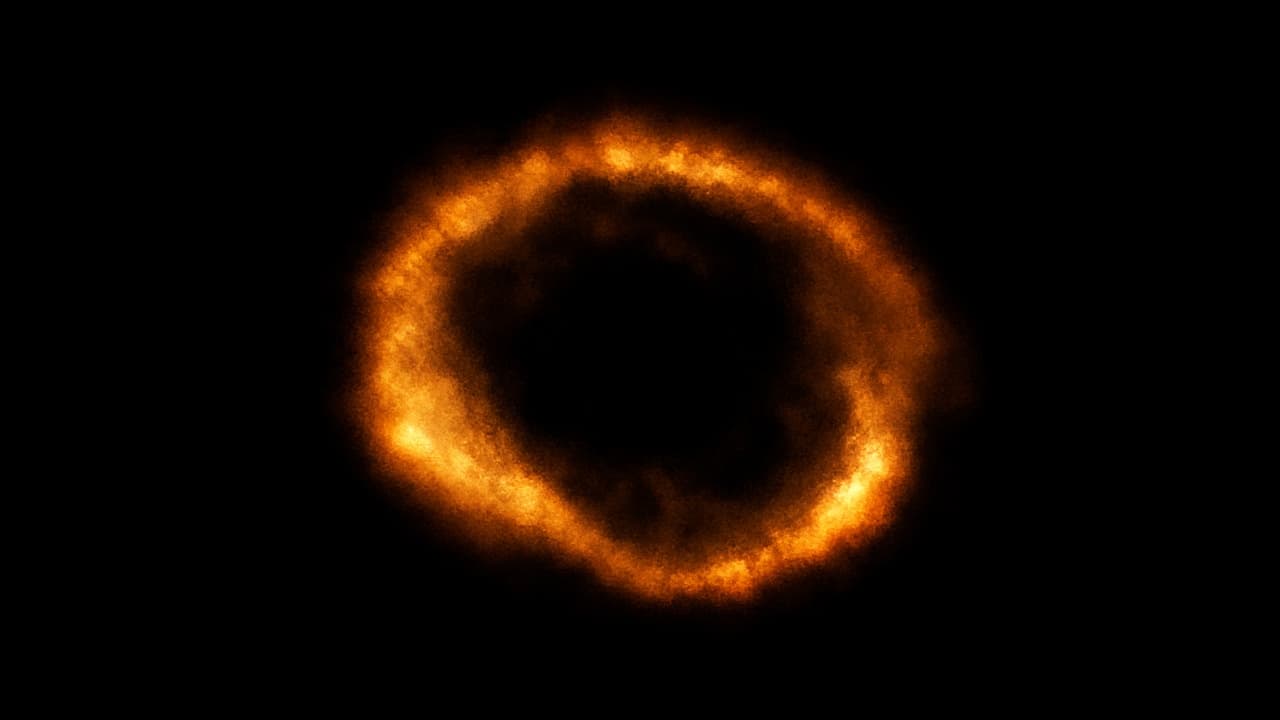
In April 2019, the Event Horizon Telescope collaboration released the first image of a black hole's shadow in the galaxy M87. The image showed a dark central region surrounded by emission from hot material, with the light shaped by the black hole's strong gravity.
In 2022, the collaboration released an image of Sagittarius A*, the supermassive black hole at the center of the Milky Way. These images are not ordinary photographs of a black hole's interior. They are reconstructions based on radio observations of the surrounding emission and the black hole's shadow.
Black hole research therefore combines observation, mathematics, computer modeling, and fundamental physics. Although the event horizon hides the interior from direct observation, the region around it can still reveal a remarkable amount of information.
- Myth: Black holes suck in everything in the universe. Reality: Their gravitational effects depend on distance and mass. Objects far away can orbit them just as they can orbit other massive bodies.
- Myth: Every astronaut is instantly spaghettified at the event horizon. Reality: Tidal forces depend on the black hole's mass and the astronaut's trajectory. A sufficiently large black hole can have weaker tidal forces at its horizon.
- Myth: Time literally stops for the person falling in. Reality: The falling person's own clock continues normally along their path. A distant observer receives increasingly delayed and redshifted signals.
- Myth: Scientists know exactly what lies at the singularity. Reality: Classical relativity predicts a singularity in simple models, but a complete description of the deepest interior remains unresolved.
- Myth: Black holes are proven portals to other universes. Reality: Such ideas are speculative and have not been demonstrated as real, traversable pathways.
A journey into a black hole would be more than an encounter with extreme gravity. It would expose the limits of our everyday intuition about space, time, and cause and effect.
The event horizon shows that the universe can contain boundaries that are not walls but limits on which signals can reach which observers. Gravitational time dilation shows that time is not measured identically in every gravitational environment. Spaghettification reveals that gravity can affect different parts of an object in radically different ways.
Yet black holes also remind us that scientific knowledge has boundaries. We can test general relativity in many settings and observe the behavior of black holes from outside. We still lack a complete theory describing the most extreme interior conditions.
That is not a failure of science. It is a map of where new discoveries are needed.
If you fell into a black hole, the outcome would depend on the kind of black hole and the path you took. You might encounter extreme radiation, destructive tidal forces, and an event horizon beyond which no return is possible. What happens at the deepest point remains an open problem in fundamental physics.
Perhaps the most astonishing fact is not that black holes destroy our familiar picture of reality. It is that the universe follows rules precise enough for us to predict so much about them from millions or billions of light-years away.
And the next time you look at an image of a black hole, remember: the bright ring is not the black hole itself. It is a glimpse of the extreme environment around a boundary beyond which the universe cannot send us a message.