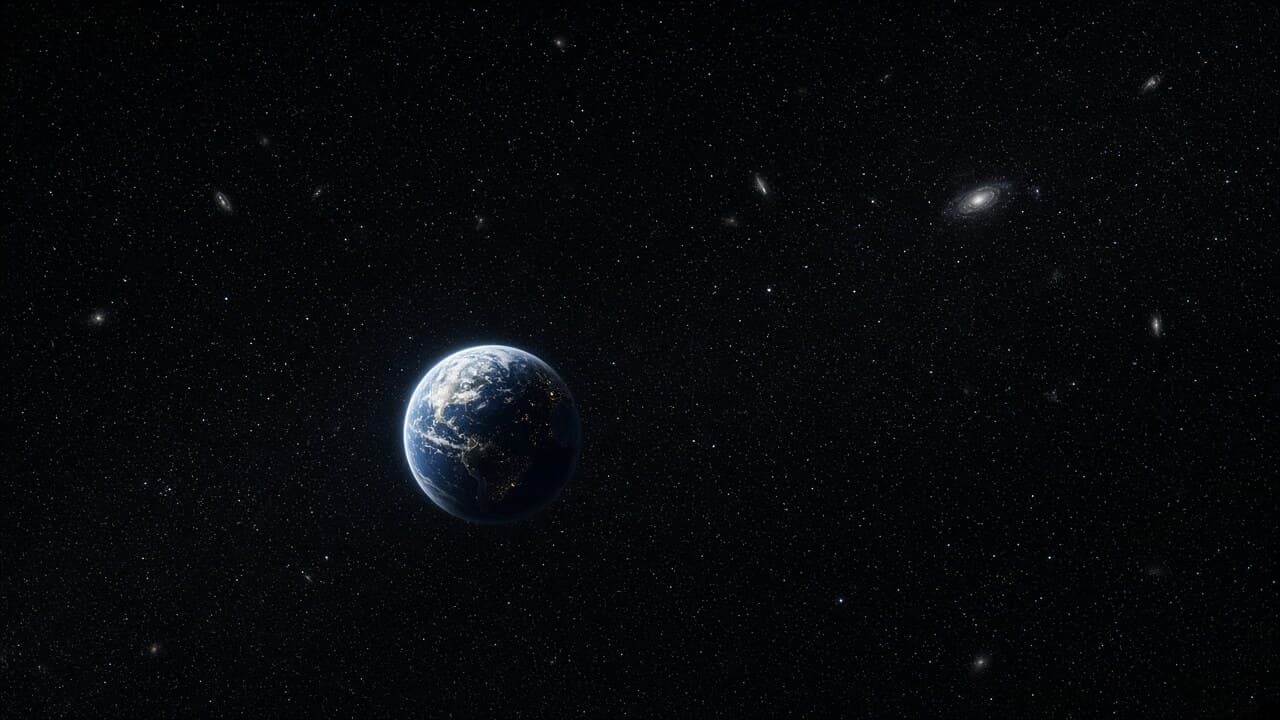
On December 24, 1968, Apollo 8 astronaut William Anders photographed Earth rising above the Moon’s barren horizon. The image became known as Earthrise. It showed our planet as a small, bright world surrounded by an almost absolute darkness. From that distance, borders disappear. Cities become invisible. Every person, every memory and every chapter of human history seems to fit inside one fragile-looking sphere.
That view captures something unsettling about space: it is beautiful, but it is also unimaginably vast, physically hostile and largely indifferent to us. The planets can be worlds of crushing pressure and extreme weather. Black holes challenge our understanding of time. Galaxies contain billions of stars, yet the distances between them are so enormous that even light needs years to cross them.
So why do pictures of the cosmos make some people feel wonder while others feel dread? This journey explores astrophobia, enormous planets, strange exoplanets, black holes, cosmic scale, the Fermi paradox and humanity’s lonely message aboard Voyager. The science is real; where an idea is uncertain, we will say so.
Space fear is not one single experience. Some people are unsettled by the darkness, some by enormous celestial objects, and others by the thought of being isolated in an environment where the human body cannot survive. Images of a planet hanging in blackness can combine all three feelings at once.
The term astrophobia is commonly used for an intense fear of space or celestial objects. It is not, by itself, a precise scientific explanation for why someone feels afraid, and the word is often used informally online. When a fear is persistent, overwhelming and interferes with daily life, a qualified mental-health professional can help assess whether it fits a specific phobia or another anxiety-related condition.
One reason space imagery can feel uncanny is that it presents familiar shapes in unfamiliar conditions. Mars has mountains, valleys and dusty landscapes, but no breathable atmosphere or familiar ecosystem. Jupiter looks like a striped sphere, yet it is a world of immense pressure and deep layers of fluid hydrogen. The objects look almost recognizable—until we remember that they are not places humans can simply visit.
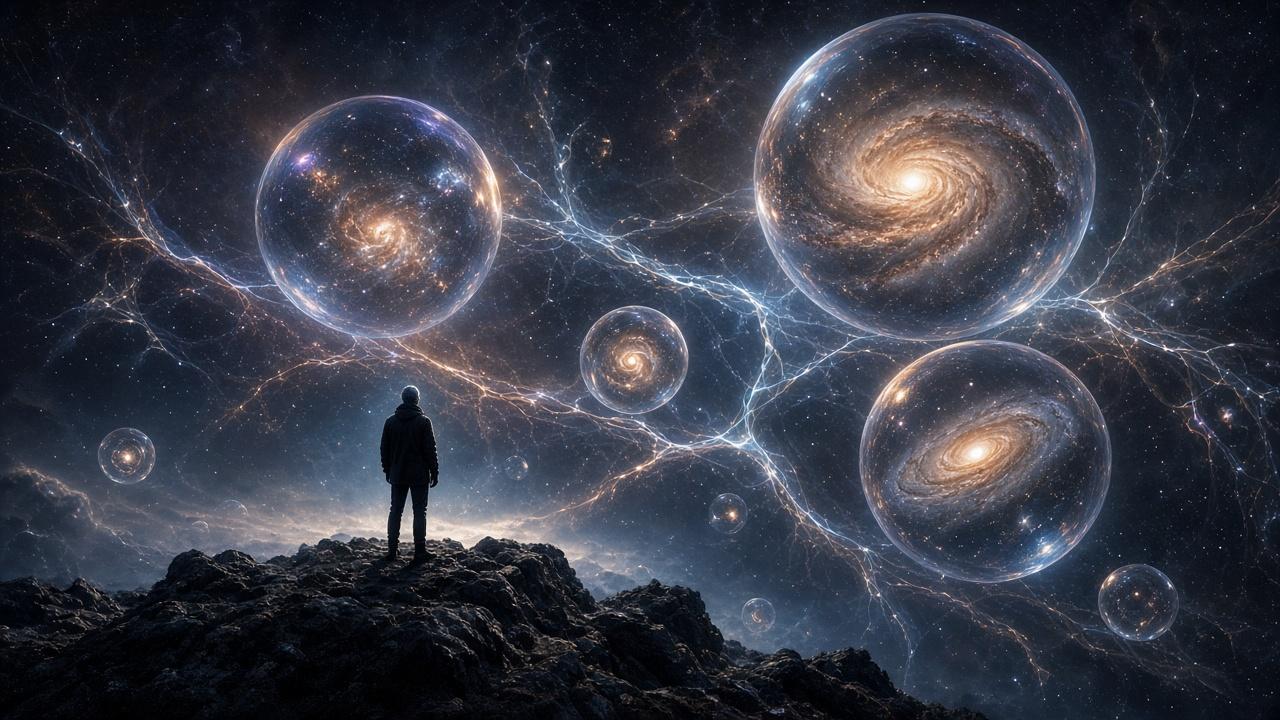
Psychologists use the word awe for an emotion that can arise when we encounter something vast enough to challenge our usual mental picture of the world. Awe can feel uplifting, humbling or frightening. The same photograph can inspire one person and overwhelm another because our brains are trying to make sense of a scale that everyday experience rarely prepares us for.
A useful distinction is between fear of a direct threat and existential unease. A storm approaching your home is an immediate danger. A galaxy millions of light-years away cannot reach out and harm you, but contemplating its scale can make human concerns feel suddenly tiny. The emotion is real even when the distant object is not a personal threat.
Jupiter and Saturn are often shown as beautiful striped spheres, but their appearance hides an alien environment. They are gas giants made mostly of hydrogen and helium. Neither has a solid surface like Earth where a spacecraft—or a person—could land and stand. As you descend into their atmospheres, gas becomes denser, pressure and temperature rise, and the material gradually behaves more like a fluid.
Imagine falling into Jupiter. At first, you would pass through cloud layers. Deeper down, the pressure would become crushing and temperatures would climb to levels that destroy ordinary equipment. There is no open-air ground waiting below. Instead, the atmosphere transitions into increasingly dense material, with hydrogen becoming electrically conducting in the planet’s deep interior.
Saturn is less dense on average than water, which is why the famous claim that it could float in a sufficiently large ocean is sometimes repeated. But this is a comparison of average density, not a practical possibility: no ocean or container could hold a planet-sized Saturn, and its atmosphere would still be lethal to a human.
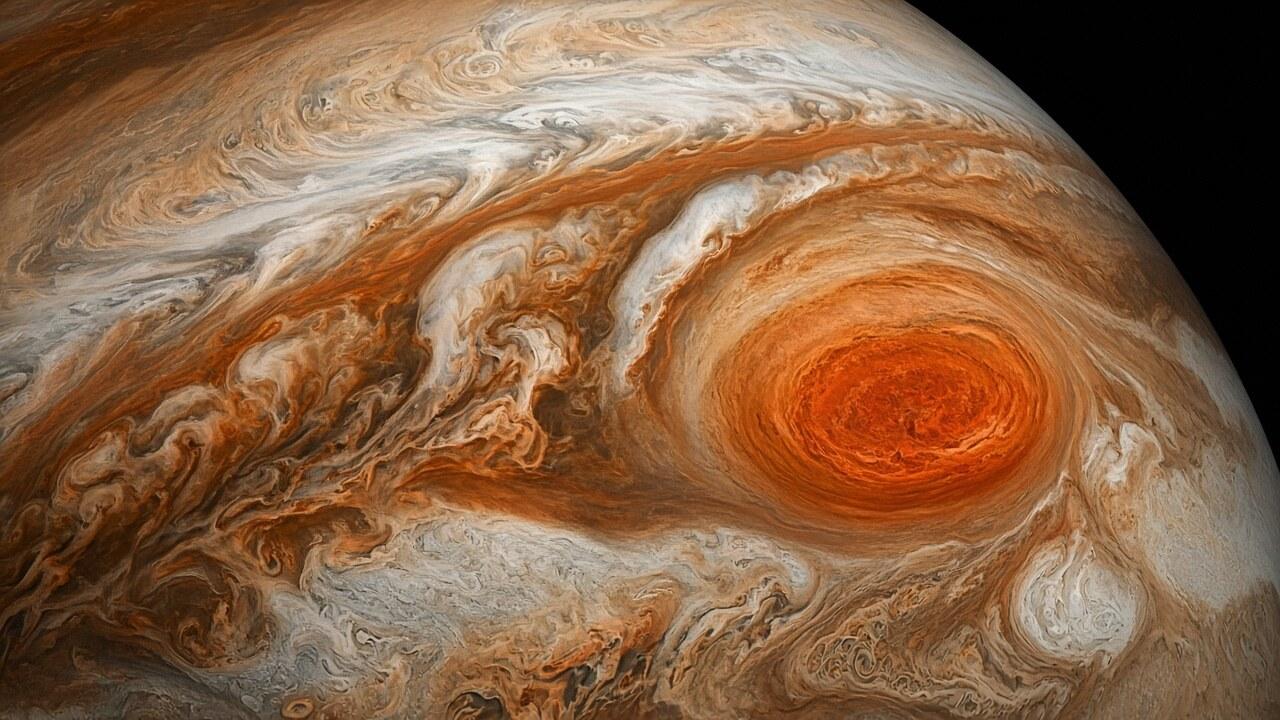
Jupiter’s Great Red Spot is a gigantic, long-lived anticyclonic storm. It has been observed for centuries, although its size and shape have changed over time. It is not a permanent feature frozen in place: measurements show that the storm has shrunk compared with historical observations. Its winds and turbulent cloud bands reveal how energetic a giant planet’s atmosphere can be.
The unsettling part is not simply that the storm is large. It is that a weather system can persist on a world with no familiar continents, oceans or seasons like Earth's. Jupiter’s atmosphere is a dynamic machine powered by internal heat, rapid rotation and complex circulation patterns.
Uranus and Neptune are called ice giants, not because they are giant balls of ordinary surface ice, but because their interiors contain substantial amounts of water, ammonia and methane-rich material under extreme pressure. Their blue appearance is linked largely to methane in their atmospheres, which absorbs red light more strongly than blue light.
Neptune is farther from the Sun than Uranus and receives much less sunlight. Yet its atmosphere is remarkably active, with powerful winds and large storms. The contrast between a deep blue planet and the blackness around it can make it look almost unreal, but the colour is a result of atmospheric chemistry and the way sunlight interacts with the planet’s clouds and gases.
School diagrams usually shrink the distances between planets so that all the worlds fit on a page. They are useful for showing order and approximate size, but they are not to scale in distance. In reality, the space between the planets is enormous. Neptune orbits roughly 30 times farther from the Sun than Earth does, and the distances continue far beyond Neptune into the distant region where icy bodies orbit.
This emptiness is one of the most difficult parts of space to imagine. A scale model that makes the Sun the size of a ball would need planets separated by distances far larger than most people expect. The planets are not clustered together like beads on a short string; they are separated by vast stretches of space.
Beyond Neptune lies the Kuiper Belt, a region containing many icy objects, including dwarf planets such as Pluto. Farther out still, astronomers infer the existence of the Oort Cloud, a vast reservoir of icy bodies thought to surround the Solar System. The Oort Cloud has not been directly imaged as a complete structure, and its boundaries are estimates based on the orbits of long-period comets and models.
The planets orbiting other stars are called exoplanets. Thousands have been confirmed, and they have revealed that our Solar System is only one possible planetary arrangement. Some exoplanets orbit extremely close to their stars. Others are larger than Jupiter, orbit multiple stars or have atmospheres unlike anything in our neighbourhood.
Gliese 436 b is a Neptune-sized exoplanet that orbits very close to its host star. It is often described in popular media as a world of ‘burning ice’. The phrase is dramatic, but it needs context. The planet is hot, and models suggest that intense pressure may allow water-rich material to exist in unusual high-pressure forms. This is not ordinary ice sitting on a surface while flames burn around it.
The planet’s atmosphere has also presented chemical puzzles, including observations that have challenged simple expectations about methane. Such findings are reminders that planetary atmospheres are complicated and that early measurements and interpretations can be revised as better data arrive.
HD 189733 b is a hot Jupiter, a gas giant orbiting very close to its star. Observations indicate a hot atmosphere and extremely fast winds. It is famous in popular science for the image of a blue planet where silicate particles may contribute to the colour and where glass-like particles could be carried by fierce winds.
The familiar headline that it ‘rains glass sideways’ is a vivid way to communicate a model of its atmosphere, not a weather report from a surface that a probe has visited. Scientists infer atmospheric conditions using light from the planet-star system, including how the planet’s atmosphere absorbs and scatters different wavelengths.
The object often called J1407 b became famous because observations of the young star J1407 suggested a dramatic series of eclipses. One proposed explanation was a companion surrounded by an enormous ring system, sometimes compared with a vastly enlarged Saturn. The ring interpretation is intriguing, but the companion’s nature and the proposed ring structure remain uncertain. It is more accurate to call it a candidate ring-system explanation than to present the spectacular illustration as a confirmed photograph of a planet.
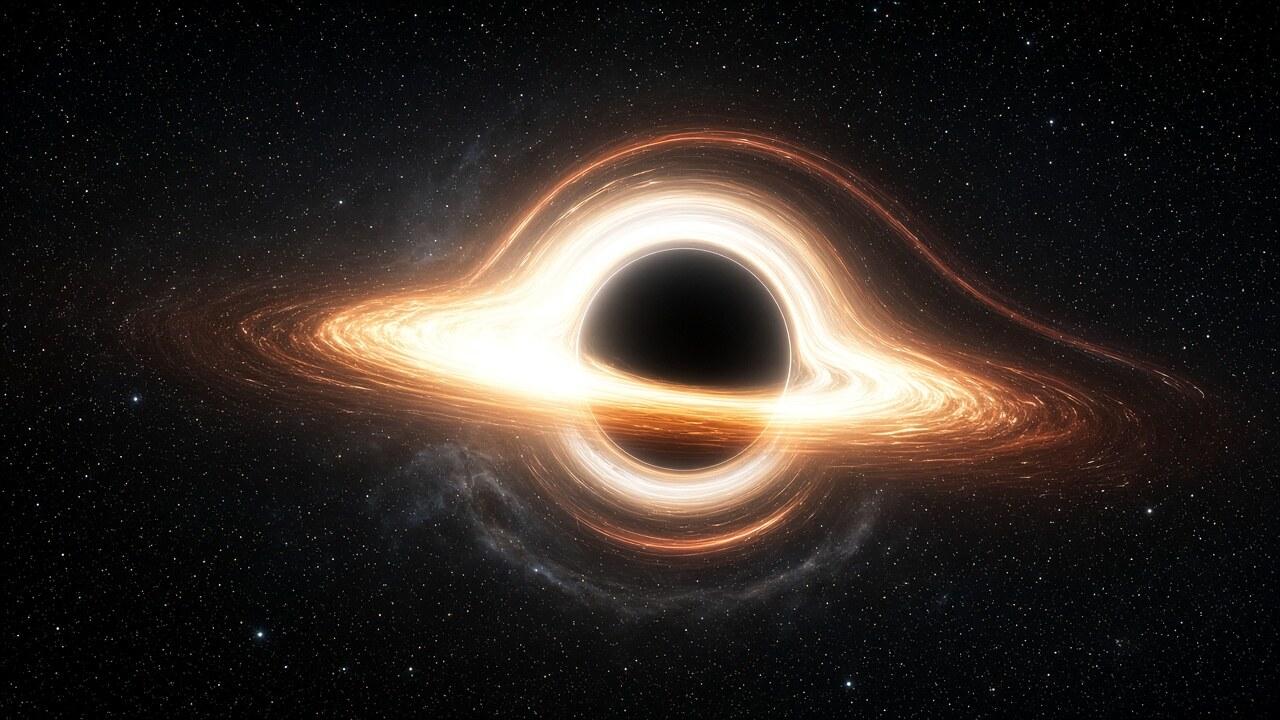
Black holes are among the most extreme objects predicted by Einstein’s general theory of relativity. They form when enough mass is compressed into a small enough region that a boundary called the event horizon appears. Once something crosses that boundary, no known signal or object can travel back out to the distant universe—not even light.
A black hole is not a cosmic vacuum cleaner roaming space and sucking in everything nearby. From far away, its gravity behaves like the gravity of any other object with the same mass. If the Sun were replaced by a black hole of exactly the same mass, Earth would not suddenly be pulled into it; Earth’s orbit would remain approximately the same, although the planet would lose sunlight and become uninhabitable.
The answer depends partly on the black hole’s mass. Near a small black hole, the difference in gravitational pull between your head and feet could become enormous before you reached the event horizon. This stretching effect is popularly called spaghettification. For a supermassive black hole, the tidal forces at the event horizon can be much weaker, so a falling observer might cross that boundary without experiencing an immediate dramatic jolt at that exact moment.
That does not mean the journey would be survivable. Inside the event horizon, all future-directed paths lead deeper inward in classical general relativity. Eventually, the falling observer would encounter destructive conditions. What happens at the deepest interior is not fully understood because a complete theory combining gravity and quantum physics is still missing.
Time behaves differently in strong gravity. To a distant observer using a particular coordinate description, signals from an object approaching the event horizon become increasingly delayed and redshifted. The falling observer’s own clock, however, continues to tick normally as they cross the horizon (assuming a sufficiently large black hole and ignoring other hazards). The two perspectives are not contradictory; they reflect how relativity describes time and observations in curved spacetime.
A common dramatic claim says that someone falling into a black hole watches the entire future of the universe unfold in a few hours. That is not a reliable general description of what an infalling observer sees. The exact experience depends on the black hole’s geometry and the observer’s path, and popular explanations often confuse the distant observer’s view with the falling observer’s experience.
TON 618 is an extremely luminous quasar powered by matter falling toward a supermassive black hole. It is often discussed as one of the most massive black holes known, with estimates reaching tens of billions of solar masses. Exact mass estimates depend on indirect methods and carry substantial uncertainty, so a single number should not be treated as perfectly measured.
A quasar is not simply a black hole shining by itself. The light comes mainly from the hot accretion flow: gas and dust orbiting and heating up as they spiral inward. Some quasars also launch powerful jets. These systems can outshine entire galaxies, even though the energy source is concentrated in a region much smaller than the galaxy around it.
Earth feels enormous when we cross an ocean, but from the outer Solar System it becomes a tiny point of light. NASA’s Cassini spacecraft captured a famous view of Earth from near Saturn in 2013. In that image, our planet is a small speck in the darkness, with the rings of Saturn in the foreground. It is a modern echo of Earthrise: a reminder that the world we share is physically small and precious.
The Milky Way contains hundreds of billions of stars, and many stars host planets. Our galaxy is about 100,000 light-years across, although its boundaries are not a sharp edge. A light-year is the distance light travels in one year—about 9.46 trillion kilometres. Even at light speed, crossing the Milky Way would take tens of thousands of years.
The Milky Way belongs to the Local Group, a collection of galaxies that includes Andromeda and many smaller galaxies. The Local Group is part of a larger cosmic environment often described in terms of the Laniakea Supercluster. These labels help astronomers map the large-scale distribution and motion of galaxies, but superclusters are not necessarily compact structures held together by gravity as a single unit.
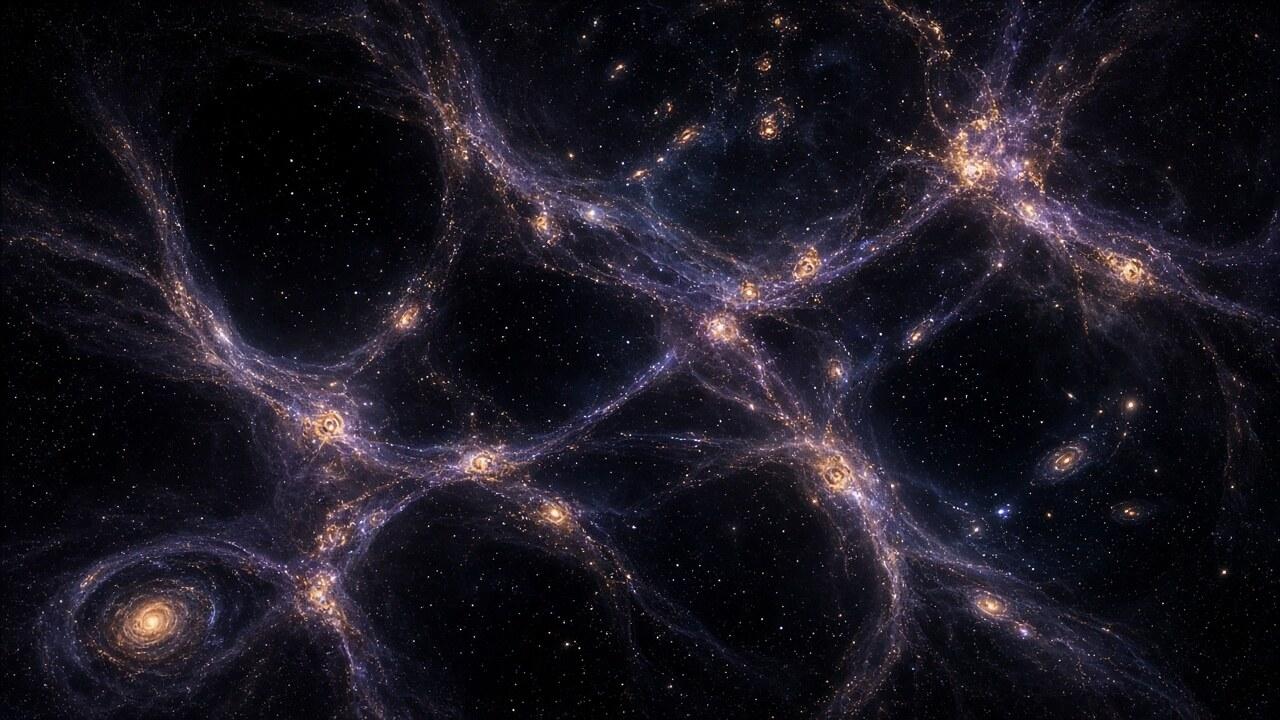
The universe is about 13.8 billion years old, yet the observable universe is roughly 93 billion light-years in diameter. That sounds impossible until we remember that space itself has expanded while the light was travelling. The most distant matter we can observe today is now much farther away than 13.8 billion light-years.
Observable does not mean the entire universe. It means the region from which light has had time to reach us since the early universe. Beyond that horizon, there may be vastly more universe. It could be finite or infinite; current observations do not tell us the total size with certainty.
The nearest star system beyond the Sun is Alpha Centauri, more than four light-years away. That is close by astronomical standards, but still an immense distance. With current spacecraft technology, a journey to another star would take far longer than a human lifetime. The problem is not simply building a faster rocket; it is the energy, shielding, navigation and life-support challenges involved in travelling at a meaningful fraction of light speed.
Voyager 1 illustrates the scale problem. Launched in 1977, it crossed the heliopause—the boundary where the solar wind gives way to the interstellar medium—in 2012. It is in interstellar space, but it has not left the Sun’s full gravitational domain; the distant Oort Cloud is far beyond the planets and extends much farther out. Voyager is moving away from Earth, but it will take an extraordinarily long time to pass through the outermost reaches of the Solar System’s gravitational neighbourhood.
The spacecraft carries the Golden Record, a message created to represent Earth and humanity. It includes sounds, music, greetings in 55 languages and 116 encoded images, along with instructions intended to help a technically capable finder interpret it. The record is a symbolic message, not a practical communication system: the chance of it being found by another civilisation is unknown and likely extremely small.
There is something moving about the idea. A small spacecraft carries a portrait of our world into a vast darkness, with no guarantee that anyone will ever find it. It is both a scientific artefact and a time capsule—an attempt to say that we were here.
The Fermi paradox describes a tension between two ideas: the universe contains an enormous number of stars and planets, so intelligent life might seem possible elsewhere; yet we have no confirmed evidence of extraterrestrial technology or communication. If advanced civilisations are common and long-lived, why have we not noticed them?
There is no settled answer. Perhaps life itself is rare. Perhaps simple life is common but complex life is difficult to develop. Civilisations may be separated by immense distances, may not overlap in time, may communicate in ways we do not recognise, or may choose not to broadcast. Our searches have examined only a tiny fraction of the possible signals, places and timescales.
Some possible explanations
- Life may be rare or require an unusually long chain of unlikely events.
- Intelligent life may emerge, but technological civilisations may not last long.
- Interstellar distances and signal delays may make contact difficult.
- Civilisations may use technologies or communication methods we have not searched for.
- We may simply not have looked long enough or broadly enough.
The paradox is not proof that aliens do not exist, nor is it evidence that they are hiding. It is a question about probability, timescales and the limits of our observations. A scientifically careful answer is that we do not yet know whether humanity is alone.
In 1964, astronomer Nikolai Kardashev proposed classifying hypothetical civilisations by the amount of energy they could use. A Type I civilisation would use energy on a planetary scale, Type II on the scale of its star, and Type III on the scale of its galaxy. The scale is a thought framework for discussing technological capability, not a ranking system for real alien societies that we have observed.
| Type | Energy scale | Basic idea |
|---|---|---|
| Type I | Planetary | Can harness energy on the scale available to its home planet. |
| Type II | Stellar | Can use energy on the scale of its host star. |
| Type III | Galactic | Can use energy on the scale of an entire galaxy. |
Humanity is below Type I. Estimates of our exact position vary with the formula used and how energy consumption is counted. The often-quoted decimal rating is not an official measurement from a universal standard. The central idea is more useful than the precise number: our civilisation is still learning how to manage energy on its own planet.
Space contains real hazards, including asteroid impacts, solar storms, radiation and rare high-energy cosmic events. But the existence of a hazard does not mean catastrophe is imminent. Astronomers track near-Earth asteroids, study the Sun’s activity and monitor energetic events across the sky. Risk is assessed through observation and probability, not fear alone.
A gamma-ray burst is an extremely energetic explosion associated with certain stellar events. A sufficiently close burst aimed toward Earth could have serious atmospheric consequences, but such events are rare and the likelihood of a dangerous nearby event is low. It is not accurate to imagine the planet as being constantly one random cosmic second away from destruction.
Asteroid impacts are another natural hazard. Large impacts have shaped Earth’s history, but modern surveys identify and track many near-Earth objects. Planetary defence research—including missions that test whether a spacecraft can change an asteroid’s motion—turns this threat into something that can be studied and, potentially, mitigated.
The most powerful part of the Earthrise photograph may be what it does not show: borders, flags, arguments or the everyday divisions that occupy human attention. From the Moon, Earth looks like one shared home. The image helped many people think about the planet as a connected and vulnerable system, although its influence on environmental awareness is part of a broader history rather than the result of one photograph alone.
The same lesson appears in the Cassini image of Earth from Saturn and in the famous Pale Blue Dot photograph taken by Voyager 1 in 1990. In each image, our planet is a tiny point. The photographs do not make human lives meaningless. They can do the opposite: they show how rare and valuable the conditions that support life may be, and how much we share with one another.
Space is terrifying because it exposes the limits of our bodies, technology and imagination. But the cosmos is also the reason we exist. The atoms in our bodies were forged through earlier generations of stars and cosmic events. We are not separate from the universe looking in; we are part of it, capable of studying it and asking questions about our place within it.
The Two Sides of Cosmic Scale
What works
- Astronomy reveals how planets, stars and galaxies form and evolve.
- Space exploration has expanded our understanding of Earth and its place in the cosmos.
- Studying cosmic hazards helps improve asteroid detection and planetary defence.
- The scale of space can inspire humility, curiosity and a stronger sense of shared responsibility for Earth.
What doesn't
- Space is hostile to unprotected human life because of vacuum, radiation and extreme temperatures.
- Interstellar distances make travel and communication extraordinarily difficult.
- Many cosmic objects are studied indirectly, so some popular descriptions remain model-dependent.
- The vastness of the universe can provoke anxiety or existential unease for some people.
The cosmos does not need monsters to feel frightening. A gas giant with no solid ground, an ocean of stars separated by impossible distances, a black hole that bends the meaning of time, or a silent spacecraft carrying a message into interstellar space is already enough to stretch the imagination.
But the same universe that makes us feel small also gave rise to a planet where matter became alive, where life evolved eyes to look at the stars, and where one species learned to photograph its home from the Moon. Perhaps the most astonishing fact is not that space is enormous. It is that, for a brief moment in cosmic history, the universe became able to look back at itself—and ask what it all means.
Space can be frightening without being malevolent. Its planets, black holes and immense distances remind us that human life exists in a very particular set of conditions. Yet Earthrise and the Pale Blue Dot also reveal the extraordinary value of our shared home. The universe is vast, but our ability to understand even a small part of it is remarkable.