Somewhere in the vast possibilities of reality, could another version of you have made a completely different choice? Perhaps that version followed another career, moved to another country or never took the decision that changed your life. It is a fascinating thought. But is it science, philosophy or simply a story we have learned to love?
The idea of parallel universes has become a favourite of science fiction. Films and television shows use alternate timelines to imagine worlds where history unfolded differently and familiar people became strangers. Yet the idea has a more serious connection to modern physics.
Quantum mechanics describes a microscopic world that behaves very differently from the everyday world we experience. Some interpretations of its mathematics suggest that the universe may not have just one history. One of the most famous is the Many-Worlds Interpretation, which proposes that all outcomes allowed by a quantum event can remain represented in different branches of the universal quantum state.
Other ideas in cosmology suggest that our observable universe might be only one region of a much larger reality. These possibilities are often grouped under the broad word multiverse, even though they come from different theories and do not all describe the same kind of parallel world.
So where did these ideas come from? What does Schrödinger's famous cat actually tell us? Are there clues in the cosmic microwave background, quantum entanglement or quantum computers? And could another version of you really exist?
The thought that reality may contain more than one world is not entirely new. Different philosophical and religious traditions have imagined multiple worlds or vast cycles of creation. Some Hindu philosophical and cosmological traditions, for example, describe innumerable worlds or cosmic realms. These ideas belong to their own historical and spiritual contexts; they should not be treated as the same thing as the modern scientific multiverse.
The scientific discussion developed for different reasons. During the late nineteenth and early twentieth centuries, experiments revealed that the microscopic world could not be fully described by the familiar rules of classical physics. The emerging theory of quantum mechanics provided extraordinarily successful mathematical predictions, but its meaning raised difficult questions.
Particles such as electrons do not always behave like tiny billiard balls with definite positions and paths. Under suitable experimental conditions, quantum systems produce interference patterns that are best described using wave-like mathematical states. This is one of the foundations of the strange world that inspired later discussions about parallel realities.
Imagine firing individual electrons toward a barrier containing two narrow openings. Beyond the barrier is a detector screen. If we do not measure which opening each electron passes through, repeated experiments can build an interference pattern on the screen—something associated with wave-like behaviour.
If the experiment is changed so that information about which slit the electron passes through is recorded, the interference pattern disappears. The result depends on whether the paths remain indistinguishable or become physically distinguishable through measurement.
It is tempting to say that an electron travels through both slits and then chooses one when someone looks. That is a simplified picture, not a complete description. Quantum mechanics assigns a state to the system and predicts the probabilities of different measurement outcomes. What the state means physically is part of the interpretation debate.
This is the deeper puzzle: quantum theory works with extraordinary precision, but what does its mathematical description tell us about reality when no measurement is being made?
In 1935, Austrian physicist Erwin Schrödinger introduced a famous thought experiment involving a cat inside a sealed box. The box also contains a radioactive atom, a detector and a mechanism that can release poison if the atom decays.
- If the atom decays during the chosen interval, the detector triggers the mechanism and the cat dies.
- If the atom does not decay, the mechanism is not triggered and the cat remains alive.
- Quantum mechanics can describe the atom before measurement as a superposition of decay and no-decay possibilities.
- If the entire setup is treated quantum mechanically, the cat becomes entangled with the possible outcomes.
The popular summary says the cat is both alive and dead until the box is opened. But Schrödinger did not propose a practical experiment to show that ordinary cats literally occupy two everyday conditions. He used the scenario to highlight how strange it seems to extend quantum superposition from microscopic systems to familiar objects.
Opening the box gives an observer a definite experience: the cat is found alive or dead. Different interpretations of quantum mechanics explain how to understand the relationship between the mathematical superposition and that definite experience.
The cat is not a demonstration that consciousness creates reality. It is a thought experiment about the measurement problem and the boundary between quantum and everyday descriptions.
In 1957, American physicist Hugh Everett III proposed what became known as the Many-Worlds Interpretation of quantum mechanics. Instead of adding a special physical collapse of the wave function when a measurement occurs, Everett's approach treats the quantum state as continuing to evolve according to the ordinary quantum equations.
When a quantum system interacts with a measuring device and its environment, the different possible outcomes become entangled with different states of the wider system. Through a process called decoherence, those branches stop producing observable interference under ordinary conditions and behave, for practical purposes, like separate histories.
In a simplified Many-Worlds description, the combined quantum state contains a branch in which the detector records decay and the cat is dead, and another branch in which no decay is recorded and the cat is alive. An observer becomes correlated with the outcome in each branch.
From inside one branch, an observer experiences one result. The other outcome is not available as a second experience in that same branch. The interpretation does not describe a person consciously choosing a universe or jumping between realities.
This is why the idea is so captivating: it offers a way to understand quantum outcomes without introducing a separate collapse rule. But it also raises difficult questions. What exactly counts as a branch? How should probabilities be understood if all outcomes occur in the universal state? And does the interpretation add anything testable beyond the predictions shared with other interpretations?
There is no simple, universally agreed count. In Many-Worlds, branching is not best pictured as a universe splitting neatly every second whenever a person makes a decision. The underlying quantum state evolves continuously, and the appearance of separate branches is an approximate description that emerges through interactions and decoherence.
The number of branches depends on how a person chooses to describe and divide the quantum state. It is therefore misleading to imagine a precise catalogue containing one separate universe for every thought, choice or imaginable life story.
The familiar examples—one Earth where dinosaurs survived, another where a different career was chosen, or another where a historical event unfolded differently—are imaginative illustrations. They are not specific alternate worlds that the theory has identified or shown to exist.
This is where the distinction between a mathematical possibility and an observed fact becomes essential. Several areas of physics have inspired multiverse proposals or discussions about possible clues. None has so far produced confirmed direct evidence that another universe exists.
The cosmic microwave background, or CMB, is ancient radiation released when the early universe became transparent, about 380,000 years after the Big Bang. It is observed today as a faint microwave glow arriving from every direction in the sky. Tiny temperature variations in this radiation preserve information about the early universe.
One feature that attracted attention is a large region known as the CMB Cold Spot. Some researchers have explored whether an unusual feature like this could be related to a collision between our cosmic region and another bubble universe in certain inflationary models.
That is a hypothesis, not a detection. The Cold Spot may have explanations involving ordinary cosmological structure, statistical variation or foreground effects. Its existence does not establish that another universe collided with ours.
Quantum entanglement occurs when two or more quantum systems share a joint state that cannot be fully described by assigning each system its own independent state. Measurements on the systems can show correlations that are stronger than any correlations allowed by classical local theories.
Albert Einstein famously objected to the implications of quantum theory, describing the phenomenon in a phrase translated as “spooky action at a distance.” Experiments have since confirmed quantum entanglement and violations of Bell inequalities.
However, entanglement does not allow usable information to travel faster than light. Measuring one particle does not send a controllable message to the other. Nor is entanglement evidence that particles are communicating through parallel universes. Some Many-Worlds supporters find the interpretation conceptually compatible with entanglement, but the phenomenon does not uniquely prove Many-Worlds.
Measurements indicate that ordinary atoms make up only a small fraction of the universe's total energy budget. Dark matter and dark energy account for most of the rest in the standard cosmological model. Dark matter is inferred from its gravitational effects, while dark energy is the name given to whatever is driving the observed accelerated expansion of the universe.
Because these components are not understood at a fundamental level, they have inspired many speculative ideas. Some extra-dimensional models explore whether gravity could behave in ways that involve dimensions beyond the familiar three dimensions of space.
But dark matter is not known to be gravity leaking from a parallel universe, and dark energy is not evidence of another cosmos. These are open scientific questions with many proposed explanations; connecting them to parallel universes requires additional assumptions and evidence.
A quantum computer uses quantum states such as superposition and entanglement to process information. A qubit can be prepared in a superposition of zero and one, and quantum algorithms use interference to amplify useful outcomes and suppress others.
Physicist David Deutsch has been a prominent advocate of the Many-Worlds Interpretation and has discussed quantum computation in terms of computation across branches. This is an interpretation of what quantum computation means, not a laboratory demonstration that a computer is literally sending calculations to accessible parallel universes.
Quantum computers do not simply try every answer in separate universes and bring back the correct one. Their power comes from carefully controlling quantum amplitudes and interference. Their operation is explained by standard quantum mechanics without requiring an experimental conclusion that parallel worlds have been detected.
Cosmologist Max Tegmark proposed a classification that groups several different multiverse ideas into four levels. It is a way to organise possibilities, not a list of four proven locations beyond our universe.
The observable universe is limited by the distance light has been able to travel to us since the early universe. Space may extend far beyond that horizon. If it is sufficiently large or infinite, distant regions could contain arrangements of matter similar to those in our observable region.
In some versions of this idea, regions beyond our cosmic horizon could contain copies or near-copies of familiar arrangements. This would not necessarily mean they are separate universes with different laws of physics; they could be distant parts of the same larger space-time.
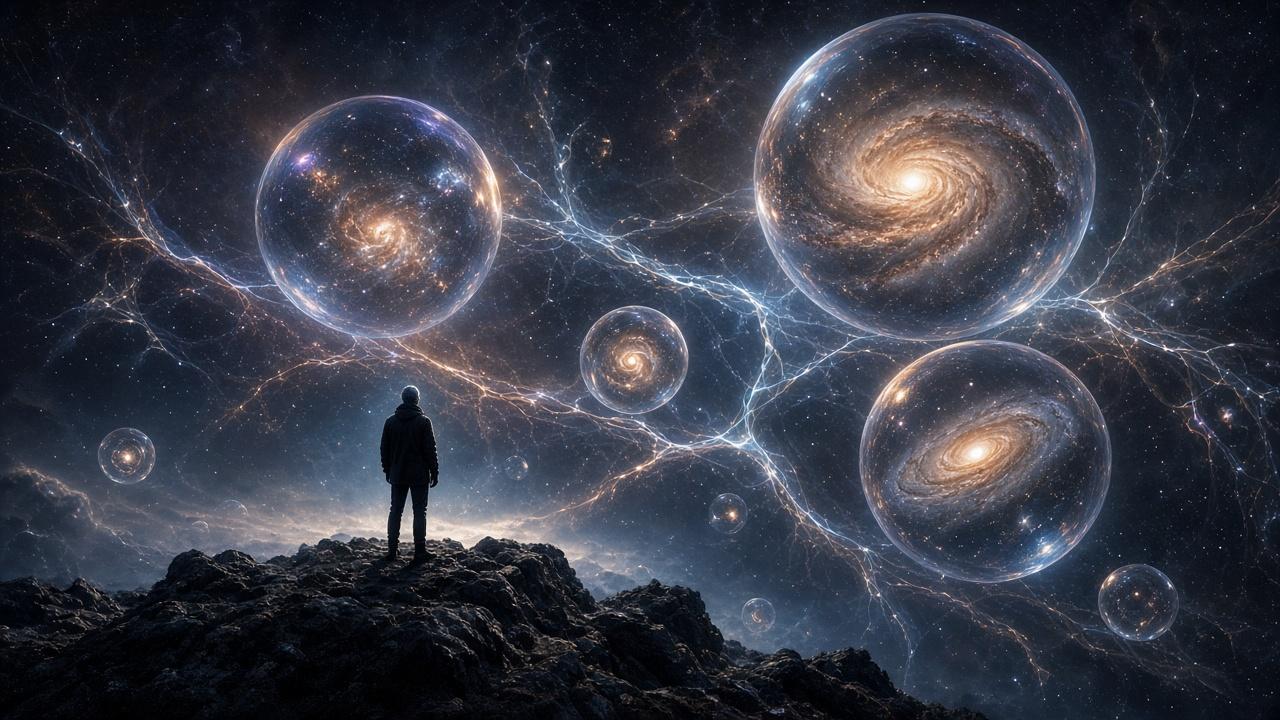
Cosmic inflation is the idea that the very early universe underwent a period of extremely rapid expansion. Some versions of inflation suggest that this process could continue in different regions, producing separate bubble-like cosmic domains.
In certain models, these regions could have different physical conditions or effective constants. The details depend on the inflationary model and the underlying physics. Eternal inflation and its bubble universes remain theoretical and face difficult questions about how to test or assign probabilities to the proposal.
This is the quantum version discussed earlier. In the Many-Worlds Interpretation, the universal quantum state evolves without collapse. Decoherence makes different outcome branches effectively unable to interfere in ordinary circumstances.
These branches are not necessarily distant places in space. They are different components of the quantum description of reality. Calling them parallel universes is useful shorthand, but it can make the picture sound more like science fiction than the mathematics warrants.
Tegmark's most abstract level proposes that other mathematical structures could correspond to other physical realities, potentially with very different fundamental rules. This is a philosophical and mathematical proposal far removed from anything we can currently observe.
| Level | Basic idea | What makes it different? |
|---|---|---|
| I | Distant regions beyond our observable horizon | Potentially the same physical laws, but different arrangements of matter. |
| II | Bubble universes associated with inflation | Some models allow different physical conditions or constants. |
| III | Branches of the quantum state | Different quantum outcomes become effectively separate through decoherence. |
| IV | Other mathematical structures | A highly abstract proposal involving different underlying mathematical descriptions. |
One of the most unsettling ideas associated with Many-Worlds is sometimes called quantum immortality. It begins with a thought experiment: if a quantum event has outcomes that correspond to survival in one branch and death in another, what would an observer experience?
A speculative argument suggests that an observer might only ever find themselves in branches where they remain alive. This is sometimes described as subjective survival across branches. It is not a result established by quantum mechanics, and it depends on controversial assumptions about probability, identity and consciousness.
Even in the Many-Worlds picture, branches contain distinct observer histories. A surviving counterpart in another branch would not mean that the consciousness or memories of the person who died are transferred there. The idea raises philosophical questions about personal identity; it does not demonstrate personal immortality.
The analogy of an identical twin can help: a counterpart may share an earlier history, but that does not make two later individuals one continuous person. The existence of a possible counterpart is not the same as surviving through that counterpart.
This is perhaps the most emotionally powerful part of the parallel-universe idea. What if another version of you chose a different subject, accepted a different job, moved to another city or met someone you never met?
In popular descriptions of Many-Worlds, such possibilities are often presented as separate life stories. But the interpretation does not guarantee that every imaginable scenario occurs. Quantum branches arise from the structure and evolution of quantum states, not from every human fantasy or logically possible event.
Nor does Many-Worlds say that every ordinary decision creates a neat new universe. Human decisions involve enormous numbers of physical processes, and the relationship between everyday choices and quantum branching is far more complicated than a simple fork-in-the-road diagram.
The idea can still be a powerful metaphor. We live with the consequences of the choices we make in this world. An imagined alternative life cannot make a decision for us, and a hypothetical counterpart cannot live our experiences.
In the standard Many-Worlds account, decoherence makes branches effectively independent for all practical purposes. Once information about different outcomes spreads into the environment, reversing the process and recovering interference between macroscopic branches becomes extraordinarily difficult.
There is no known technology or established physical method for sending a message to another branch, visiting an alternate Earth or meeting another version of yourself. Speculations involving black holes, wormholes or extra dimensions do not currently provide a demonstrated route between universes.
Some cosmological models have considered whether a collision between bubble universes could leave a detectable imprint in the CMB. That is a search for possible indirect traces, not a communication channel—and no confirmed signal of such a collision has been found.
Researchers investigate the physics that motivates multiverse proposals, rather than simply looking through a telescope for another Earth. Different ideas suggest different possible tests, and some versions may be difficult or impossible to test with current methods.
- Cosmologists study the CMB and the large-scale structure of the universe to test models of the early cosmos.
- Particle physicists test theories beyond the Standard Model, including models that may involve extra dimensions. Such searches do not automatically test parallel universes.
- Quantum physicists perform increasingly precise experiments on superposition, entanglement and decoherence.
- Quantum computing experiments test the control and usefulness of quantum states, not the existence of alternate universes as separate computational locations.
- Gravitational-wave observatories test predictions about compact objects and space-time. A gravitational-wave signal from another universe has not been confirmed.
The Large Hadron Collider is sometimes mentioned in popular discussions of hidden dimensions or other universes. Experiments there search for deviations from known particle physics, including possible signatures predicted by particular extra-dimension models. No confirmed evidence of a parallel universe leaking energy into our world has emerged.
The answer depends on which multiverse proposal is being discussed. Many-Worlds is an interpretation of an established quantum framework. Inflation is a family of cosmological models, some versions of which motivate a multiverse. Tegmark's Level IV is a much more speculative proposal.
A theory can be mathematically serious without every implication being experimentally confirmed. For a proposal to become strongly established as a description of nature, it needs to connect with observations and survive attempts to rule it out.
The central challenge is that other universes, if they exist, may be outside our observable region or may not interact with our branch in a measurable way. That makes it difficult to design decisive tests. Scientists disagree about how much explanatory value should be assigned to ideas that are hard to test.
The multiverse is compelling because it challenges the assumption that the reality we experience is the only possible description of existence. But its greatest scientific value may be the questions it forces us to ask about quantum mechanics, measurement, probability and the structure of space-time.
The Many-Worlds Interpretation offers one consistent way to think about quantum evolution without a special collapse process. Inflationary cosmology opens the possibility that our observable region is not the whole story. Yet neither idea gives us a confirmed map of other universes.
It is also worth resisting the temptation to turn every unexplained observation into evidence for a multiverse. A mysterious cold region in the CMB is not automatically a collision scar. Entanglement is not a message from another world. Dark matter is not known to be hidden matter from a parallel reality. Good science keeps the mystery alive without pretending the answer is already known.
Perhaps future experiments will reveal a clue. Perhaps the multiverse will remain beyond direct observation. For now, the most accurate position is both open-minded and cautious: these ideas are worth exploring, but they have not been proven.
The possibility of other universes expands our questions. It does not yet expand the list of things we know to be real.
The journey from the double-slit experiment to the Many-Worlds Interpretation shows how deeply quantum mechanics challenges our everyday intuition. A particle can be described by a superposition of possibilities. A measurement entangles a system with its surroundings. And one interpretation says that the universal wave function never collapses.
Cosmology adds another layer. Inflationary models raise the possibility of bubble universes, while the observable universe may be only a limited region of a much larger space. These ideas make the multiverse a fascinating subject at the edge of physics.
But fascination is not proof. We have not confirmed a collision with another universe, detected a message from another branch or found a way to visit an alternate version of Earth. Even the most mind-bending idea in this story—quantum immortality—remains a speculative thought experiment, not a scientific fact.
Perhaps one day new observations will reveal that our universe is part of something much larger. Perhaps the answer will be more subtle than the parallel worlds imagined in films. Until then, the multiverse remains one of the most extraordinary questions in modern science.
And that is what makes the search worthwhile. Science does not need to turn every mystery into a certainty. Sometimes its greatest achievement is showing us just how much there is left to discover.
Parallel Universes FAQ
Do parallel universes really exist?
What is the difference between a multiverse and a parallel universe?
Who proposed the Many-Worlds Interpretation?
Does Schrödinger's cat prove parallel universes exist?
Does the double-slit experiment prove that consciousness creates reality?
Is the CMB Cold Spot evidence of another universe?
Do quantum computers use parallel universes to calculate?
What are the four levels of the multiverse?
Can we travel to a parallel universe?
Is quantum immortality real?
Could another version of me exist?
What this idea offers — and where it falls short
What works
- The multiverse provides a framework for exploring difficult questions raised by quantum mechanics and cosmology.
- Many-Worlds offers an interpretation in which the universal quantum state evolves without a special collapse rule.
- Inflationary models and quantum experiments motivate precise theoretical questions that can be investigated.
- The subject encourages useful discussion about what counts as evidence and how scientific theories are tested.
What doesn't
- No other universe has been directly and conclusively observed.
- Different multiverse proposals describe very different things and should not be treated as one unified theory.
- Some versions are difficult to test or may not currently offer unique observable predictions.
- Popular explanations often exaggerate the meaning of the CMB Cold Spot, quantum entanglement, dark matter and quantum computing.
- Quantum immortality and alternate-life stories are speculative extrapolations, not established consequences that can be applied to real life.