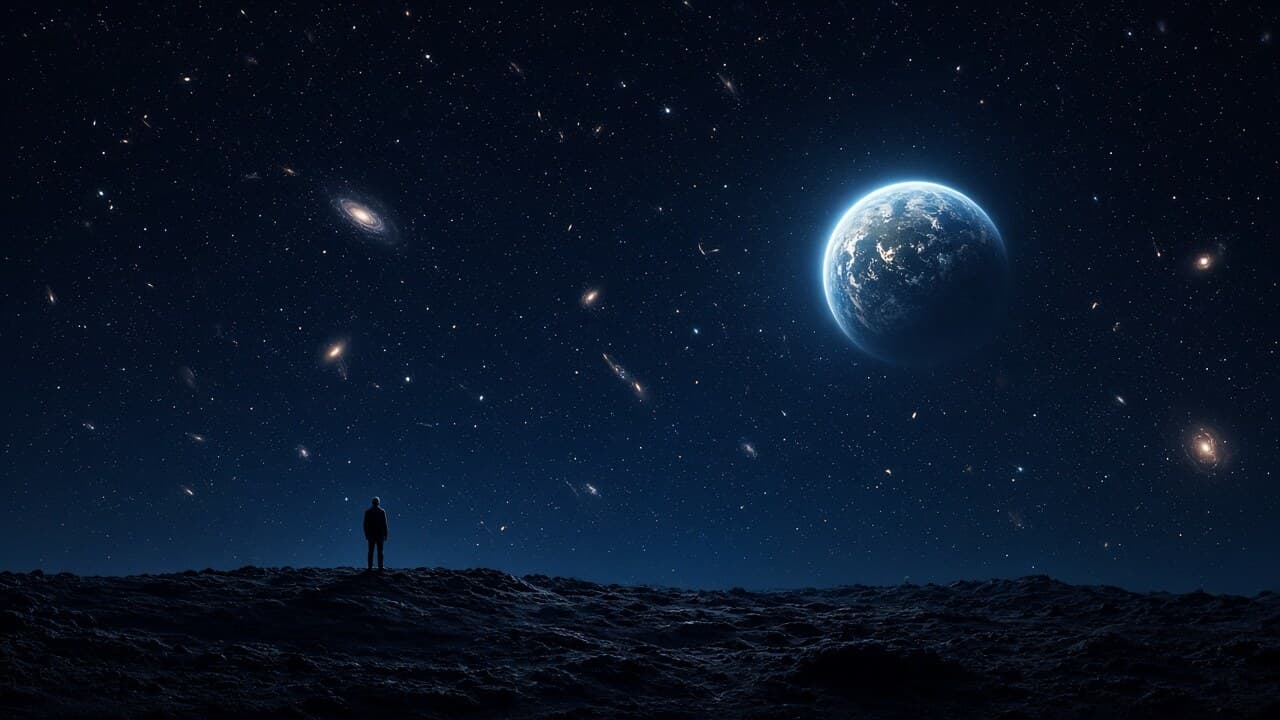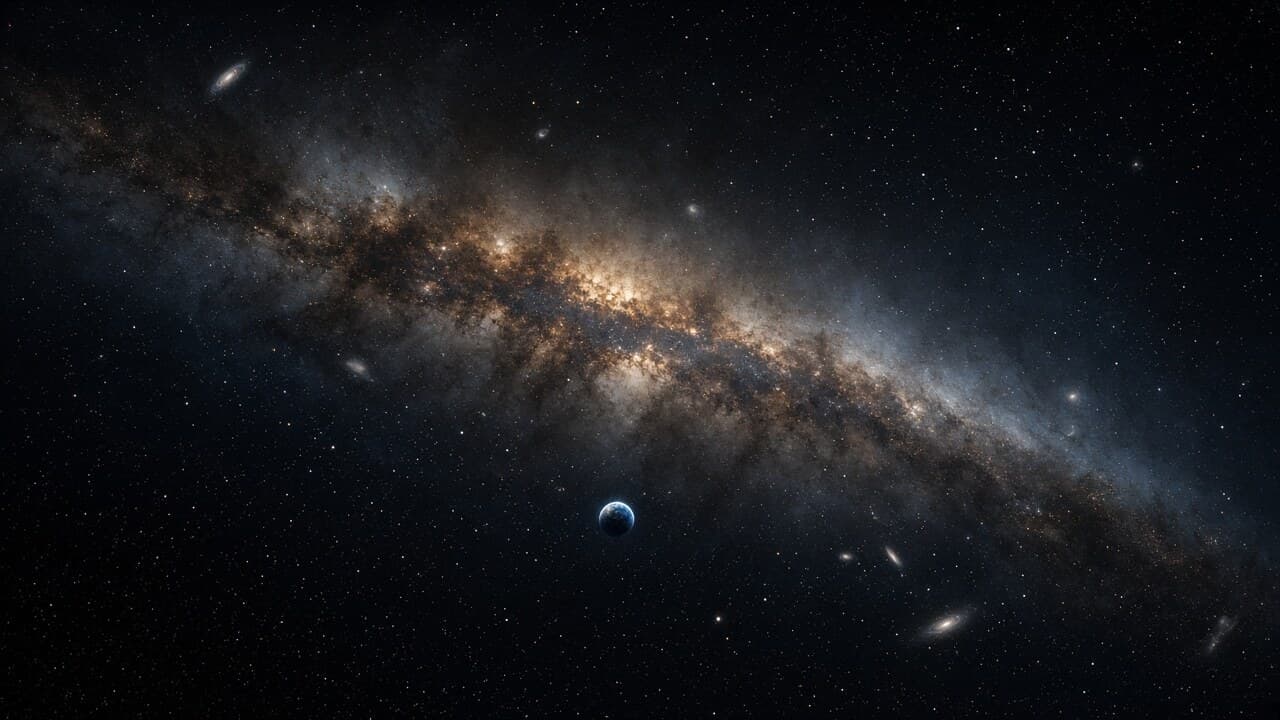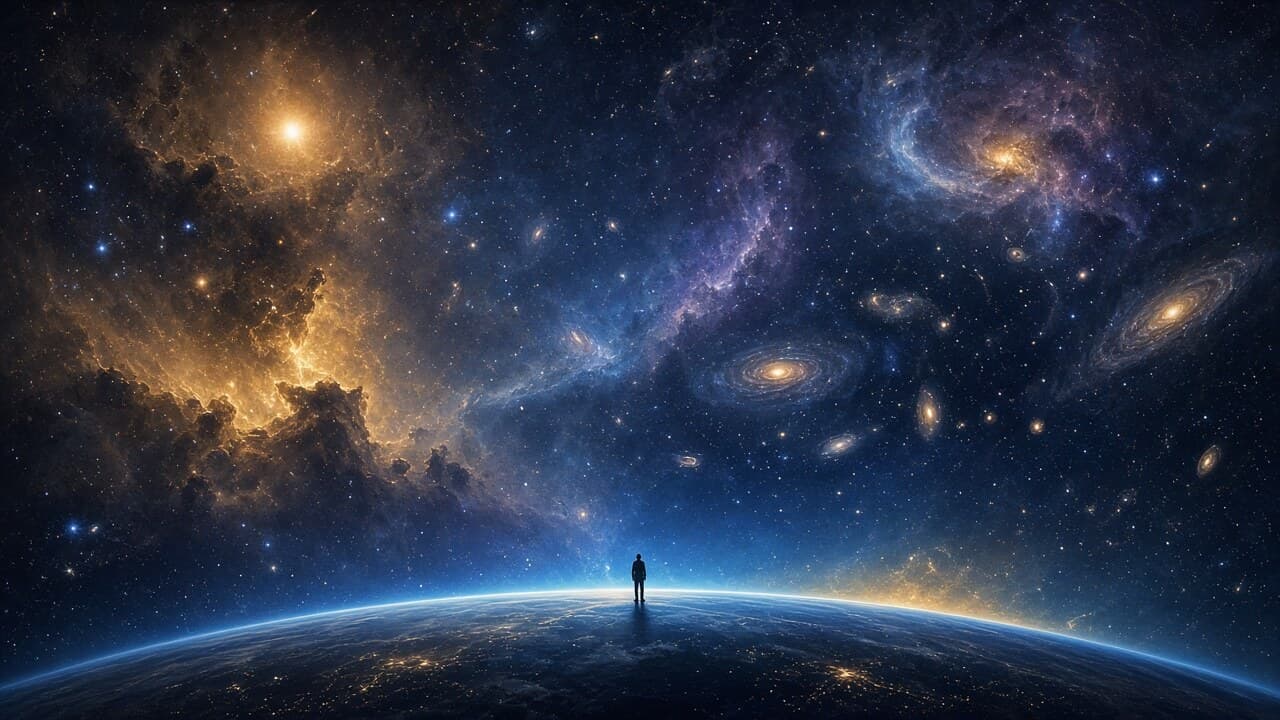
The universe was already billions of years old before Earth existed. Ancient stars had lived and died. Galaxies had formed and changed. The elements inside your body had been forged through generations of cosmic events. And then, after an almost unimaginable stretch of time, a species appeared on one small planet and began asking a question: Why are we here now?
Look at your hand for a moment. The carbon in your skin, the oxygen you breathe, and the calcium in your bones are connected to a cosmic history far older than humanity. The universe did not begin with people, planets, or even the familiar elements that make up our world.
According to current scientific estimates, the universe is about 13.8 billion years old. Earth formed approximately 4.54 billion years ago, and Homo sapiens appeared only a few hundred thousand years ago. By cosmic standards, our species is extraordinarily young.
That raises a fascinating question. If the universe is so ancient, why did intelligent humans emerge at this particular stage? Why not one billion years earlier? Why not ten billion years later? And is there something special about this moment in cosmic history?
Science offers part of the answer. The universe had to evolve before the ingredients for planets and life could exist. Earth needed time to form, life needed time to evolve, and intelligence emerged through a long sequence of biological changes.
But one deeper puzzle remains: why do we find ourselves in a universe with the conditions necessary for our existence? This leads to a fascinating intersection of cosmology, evolution, probability, and philosophy.
Let's travel through cosmic history and explore whether our arrival was inevitable, a remarkable coincidence, or simply the only kind of cosmic moment in which beings like us could ask the question.
To understand how late humanity arrived, imagine compressing the entire 13.8-billion-year history of the universe into a single calendar year. The Big Bang takes place at midnight on January 1. The first stars form early in the cosmic story. Galaxies develop, generations of stars produce heavier elements, and planetary systems eventually emerge.
Earth would not appear until late in the year. Life would follow, evolve, and diversify. Dinosaurs would arrive near the very end of December, and modern humans would appear only in the final moments before midnight on December 31.
The analogy is approximate, but the message is powerful. Almost the entire history of the universe unfolded before our species existed.
NASA estimates the universe's age at about 13.8 billion years using evidence including the expansion of the universe and measurements of the cosmic microwave background, the ancient radiation left over from the early universe. Earth's age is estimated independently through radioactive dating of ancient materials, including meteorites.
These are not simply numbers chosen to tell an interesting story. They come from different lines of scientific evidence that help reconstruct the history of the cosmos and our planet.
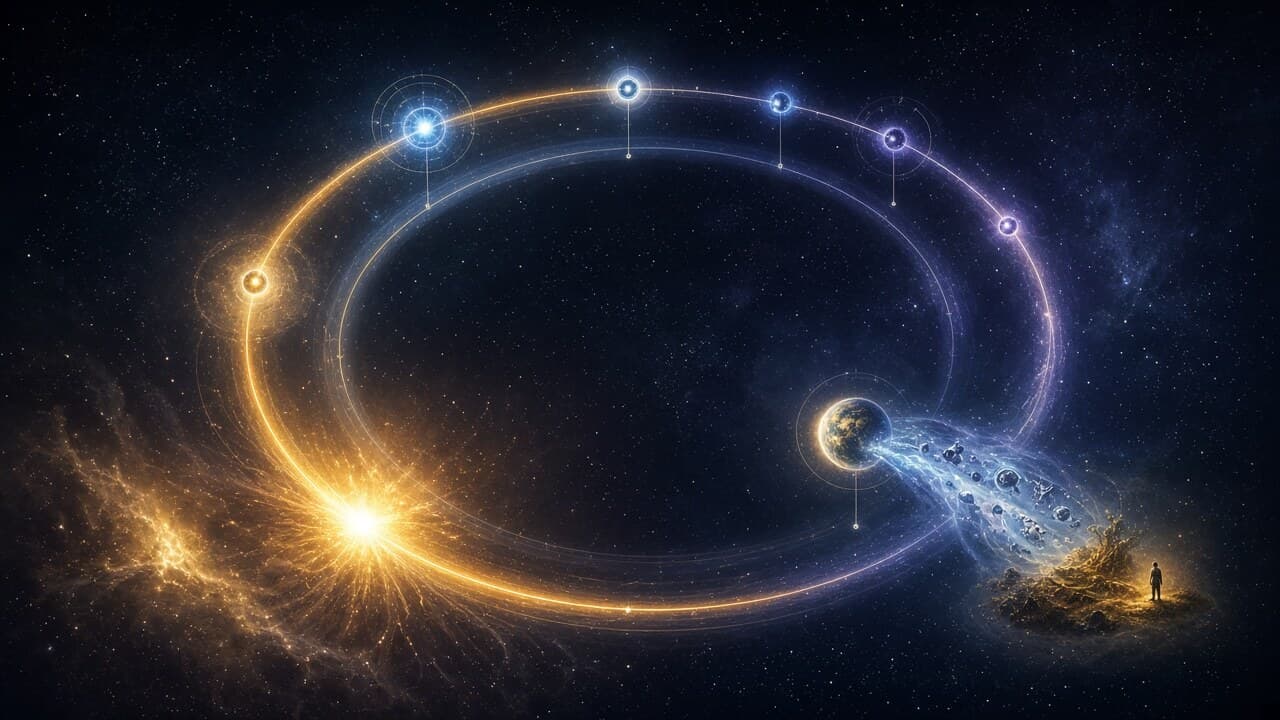
But here is the first twist: being late does not necessarily mean being unusual. Before asking why we appeared now, we need to understand what had to happen before a planet could produce beings like us.
The early universe was not a place where humans, oceans, forests, or Earth-like planets could simply appear. It was extremely hot and dense. As the universe expanded and cooled, the earliest ordinary matter formed primarily light elements, especially hydrogen and helium.
The first stars eventually formed from clouds of gas. Inside stars, nuclear reactions produced heavier elements. When stars reached the end of their lives, some expelled material into space, enriching the gas from which later stars and planetary systems could form.
The carbon in living organisms, much of the oxygen around us, and the iron found in our planet are part of this long history of cosmic element formation. Different elements have different origins, but many of the heavier elements essential to rocky planets and life were produced through stellar processes and stellar explosions.
This means the universe needed generations of stars before it could build a planet with the chemistry familiar to us. The first stars could not have produced a world exactly like Earth from the material available at the beginning.
Over time, galaxies developed more complex structures. New stars formed from enriched clouds of gas and dust. Around some of these stars, solid planets assembled from the same material.
Our Sun and its planetary system formed roughly 4.6 billion years ago, after a substantial portion of cosmic history had already passed.
Earth did not form at the beginning of the universe because its ingredients had to be assembled through earlier cosmic processes. A cloud of gas and dust collapsed under gravity, forming the young Sun and a rotating disk of material around it. Dust grains collided, stuck together, and gradually helped build larger bodies, eventually producing planets.
The young Earth was not immediately a comfortable home for life. Its surface changed dramatically as the planet cooled, its atmosphere evolved, water accumulated, and geological processes shaped its environment.
Scientists have evidence that life existed on Earth billions of years ago, but the precise pathway from non-living chemistry to the first living systems remains unresolved. Researchers study possible environments, chemical reactions, and early biological evidence to understand how this transition might have occurred.
Once life emerged, it did not immediately produce forests, animals, or intelligent observers. Early life was microbial. Over immense spans of time, biological evolution generated a diversity of organisms, including complex multicellular life.
This history matters because the appearance of modern humans depended on a long chain of events. A different planetary history could have produced a different biosphere, or no life at all.
We know that this particular chain eventually produced humans on Earth. We do not know how often a comparable chain occurs elsewhere in the universe.
Earth has existed for about 4.54 billion years, but modern humans have been around for only a tiny fraction of that time. Why did intelligence capable of science and technology emerge so late?
Evolution does not work toward a predetermined goal. Natural selection favors traits that help organisms survive and reproduce in their environments. It does not aim to create humans, civilization, or a species that can build telescopes.
Life on Earth spent an enormous amount of time as microscopic organisms. Complex cells, multicellular organisms, animals, and many other forms of life appeared through different stages of evolutionary history. Each stage depended on a combination of biological innovations, environmental conditions, and historical events.
The emergence of humans required its own sequence of changes. Our ancestors evolved traits associated with walking upright, manipulating objects, social learning, language, and complex thought. These characteristics did not arise in one sudden leap, and they were not guaranteed outcomes of evolution.
If Earth's history were replayed with small differences, evolution might produce a very different set of organisms. Dinosaurs might not disappear when they did. Mammals might follow another path. The particular chain of events that led to modern humans could fail to occur.
That does not mean evolution is random in every respect. Natural selection has consistent mechanisms, and scientists can study how traits change over generations. But the full history of life also depends on contingencies that cannot be predicted with certainty.
Humanity's appearance may therefore be understood as a product of a long evolutionary history, not as a scheduled appointment in the universe's calendar.
Now we reach the deeper question. Why do we find ourselves in a universe with the conditions that allow us to exist? Why can matter form stable structures? Why are there stars, planets, chemistry, and environments in which life can emerge?
One idea used in cosmology and philosophy is the anthropic principle. In its simplest observer-selection form, it reminds us that our observations are necessarily made from a place and time compatible with our existence.
Imagine a fish asking why it lives in water. The fish can only exist in an environment that supports its biology. If it were somewhere completely incompatible with life as a fish, it could not be there asking the question.
In a similar way, humans cannot observe a universe in which the conditions make human observers impossible. Our existence selects the kinds of conditions we could possibly experience.
This may help explain why we observe ourselves in a life-compatible environment, but it does not explain everything. It does not, by itself, tell us why the laws of physics have their particular form, whether different laws were possible, or whether other universes exist.
The anthropic principle is not proof that the universe was designed for humans. It is a way of recognizing a selection effect that can otherwise make our situation seem more surprising than it necessarily is.
There is another surprising possibility: our time in the universe might be neither uniquely early nor uniquely late. It could simply be one era in which several conditions for our existence overlap.
The universe needed time to produce heavier elements, form planets, and allow biological evolution. It also needed stable sources of energy for life as we know it. Earth emerged after billions of years of cosmic development, and humans appeared after billions of years of biological history.
That makes our arrival understandable in a broad sense. But it does not tell us whether other technological civilizations appeared before us or will emerge long after us.
Some stars, especially lower-mass stars, can shine for extraordinarily long periods. That means potentially life-supporting environments may exist in the distant future, depending on the properties of their planets and the other requirements for life.
It is tempting to conclude that intelligent life must therefore be far more common in the future. But long-lived stars do not guarantee life, and life does not guarantee intelligence. We do not yet know how likely those transitions are.
We also need to be careful when comparing cosmic time with the history of observers. A universe can exist for billions of years without containing beings capable of measuring its age. Our position in time is partly a consequence of the physical and biological history that made our existence possible.
Suppose someone asks why humans did not appear one billion years earlier. There is no evidence that human beings were destined to emerge at a particular date. Our arrival depended on Earth's environmental history and the evolutionary paths taken by earlier organisms.
A billion years earlier, Earth was a very different world. Life already existed, but the biosphere and the lineages leading to humans had not followed the history that eventually produced our species. The necessary chain of events had not occurred.
The same logic applies to the early universe. Before generations of stars had produced enough heavier elements and before planetary systems formed, Earth-like environments could not have existed in their current form.
This does not mean that no kind of life could have existed anywhere earlier than Earth. We do not know that. It means only that the specific conditions required for our own history took time to develop.
Our question therefore has two parts. Why did humanity emerge when it did? Evolutionary history gives us a partial answer. Why does the universe have laws and properties that permit stars, planets, and life? That is a much deeper question, and scientists and philosophers continue to debate how far it can be answered.
Humanity has existed for a remarkably short time compared with the universe. That creates an intriguing possibility: intelligent civilizations, if they exist elsewhere, may be distributed across enormous stretches of cosmic history.
A civilization might have appeared in the Milky Way millions of years before humans evolved. Another might emerge millions of years from now. Their existence would not necessarily mean that they could communicate with us, especially if they were separated by great distances or if their technological eras did not overlap.
Astronomers have discovered thousands of exoplanets, showing that planets are common. But we have not confirmed extraterrestrial life, and we do not know how frequently life develops intelligence or technology.
The absence of confirmed alien signals does not prove that humanity is alone. Our searches cover limited regions, signal types, and periods of time. Equally, the sheer size of the universe does not guarantee that intelligent life exists elsewhere.
If we eventually discover an independent form of life, it will help answer whether biology emerged more than once. If we discover an intelligent civilization, we will learn that technological intelligence is not unique to Earth. Either discovery would reshape our understanding of cosmic history.
For now, we know that humans appeared late in the history of the universe. We do not know whether we are early, late, or typical among technological civilizations, if others exist.
The question becomes even more striking when we look toward the future. The universe is ancient, but it is still evolving. Stars continue to form, planets continue to orbit them, and many low-mass stars can remain stable for periods longer than the universe has existed so far.
Our own Sun is about 4.6 billion years old and is roughly halfway through its main-sequence lifetime. In about five billion years, it is expected to expand into a red giant. Long before or during that distant transition, increasing solar brightness will make Earth increasingly difficult to inhabit, although the exact timing of particular changes remains uncertain.
This does not mean humanity has five billion years of guaranteed survival. Civilization could face challenges much sooner, and the long-term future depends on factors ranging from planetary conditions to human decisions and technologies.
If humans or our descendants survive over very long timescales, we may eventually explore other environments or settle beyond Earth. That remains a possibility rather than a guaranteed future. Interstellar travel presents formidable engineering, biological, and social challenges.
The important point is that the universe's future is not over. If intelligent life is rare, humanity's long-term choices could be especially consequential. If intelligent life is common, our future could eventually become part of a much larger story of life in the cosmos.
When we consider how many conditions had to come together for humans to exist, it is natural to wonder whether the universe was made for us. The question touches science, religion, philosophy, and personal beliefs.
Science can investigate the laws of physics, the formation of stars and planets, the development of life, and the evolutionary history of our species. It can test models against observations and reject explanations that fail to match the evidence.
The claim that the universe was intentionally created for humanity is a different kind of claim. The scientific evidence described here does not establish that conclusion, and the anthropic principle does not prove it.
There is also a danger in reasoning backward from our existence. Because we are here, we know the conditions in our history allowed us to emerge. But that does not automatically mean every stage of the universe was directed toward producing humans.
At the same time, acknowledging what science cannot yet answer is not a reason to assume that any particular supernatural or philosophical explanation must be true. Uncertainty is an invitation to investigate, not permission to treat speculation as established fact.
Perhaps the most intellectually honest position is to distinguish what we know, what we can reasonably infer, and what remains an open question.
Here is the most human part of the question. If the universe existed for billions of years before us and may continue for billions or trillions of years afterward, what does our brief existence mean?
The scientific answer and the personal answer are not necessarily the same. Science can explain many of the processes that produced our bodies and minds. It can describe our place in cosmic history. It cannot, by itself, assign a single universal meaning to every human life.
Our short time in the universe does not make our experiences unreal. The love people feel, the knowledge they create, the suffering they try to reduce, and the worlds they build matter to the beings who experience them.
There is something remarkable about a species that evolved on one planet and learned to calculate the age of the universe. We have developed instruments to observe galaxies billions of light-years away, reconstructed ancient events from faint radiation, and discovered that the atoms in our bodies have cosmic histories.
We are not outside the universe looking in. We are part of it. The matter that forms our bodies belongs to the same physical world we study with telescopes and experiments.
That idea does not prove that humans have a predetermined cosmic purpose. But it offers a powerful perspective: through us, at least one part of the universe has developed the ability to investigate its own history and ask questions about its future.
The universe is about 13.8 billion years old. Earth formed billions of years later, and modern humans appeared only recently in comparison. Our existence depends on a long history of cosmic evolution, planetary formation, biological change, and events that could not have been fully predicted in advance.
The universe needed time to produce heavier elements and planets. Earth needed time to develop a biosphere. Evolution needed time to produce the extraordinary diversity of life, including our own species.
The anthropic principle adds another insight: we can only observe a universe compatible with our existence. That helps explain why our observations come from a life-supporting environment, but it does not settle every question about the laws of physics or the ultimate nature of reality.
So why are we here now? Part of the answer lies in the long history that made our existence possible. The deeper question of whether that history is unique, whether intelligent life exists elsewhere, and why the universe has its particular properties remains open.
Maybe we are one of countless civilizations scattered across space and time. Maybe technological intelligence is rare. Maybe our descendants will someday look back at our era as the beginning of a much longer journey. We do not know which future is waiting.
But tonight, somewhere on Earth, someone will look at the stars and ask why the universe exists and why we appeared when we did. That simple act connects our brief human lives to a cosmic story billions of years in the making.
We arrived late in the universe's history. Yet we have reached a moment when we can begin to understand how the story unfolded. And perhaps the next chapter will teach us that there is far more to discover than we can imagine today.
Continue with what if Earth were alone, how big the universe is, and what if the future already exists.
Cosmic Timing FAQ
How old is the universe?
Why did humans appear so late in the universe?
How old is Earth compared with the universe?
What is the anthropic principle?
Could intelligent life have existed before humans?
Was the universe created for humans?
How much longer will the universe exist?
Why is the universe suitable for life?
What this question clarifies — and what remains open
What works
- Separates established cosmic ages from philosophical claims about purpose.
- Explains the anthropic principle as an observer-selection effect, not proof of design.
- Shows why stars, elements, planets, and evolution all needed time before humans could appear.
What doesn't
- Science has not established whether intelligent life is common elsewhere.
- The deeper origins of physical laws remain unresolved.
- We cannot yet know whether our cosmic era is typical among technological observers.