You remember yesterday. You are experiencing today. And tomorrow feels like something that has not happened yet. But what if that description of reality is only how the human brain experiences time?
Imagine being able to look at the entire history of your life from outside time. Your childhood would be there. This exact moment would be there. So would the final day of your life. From that strange perspective, none of those moments would need to be 'waiting' for the others to happen.
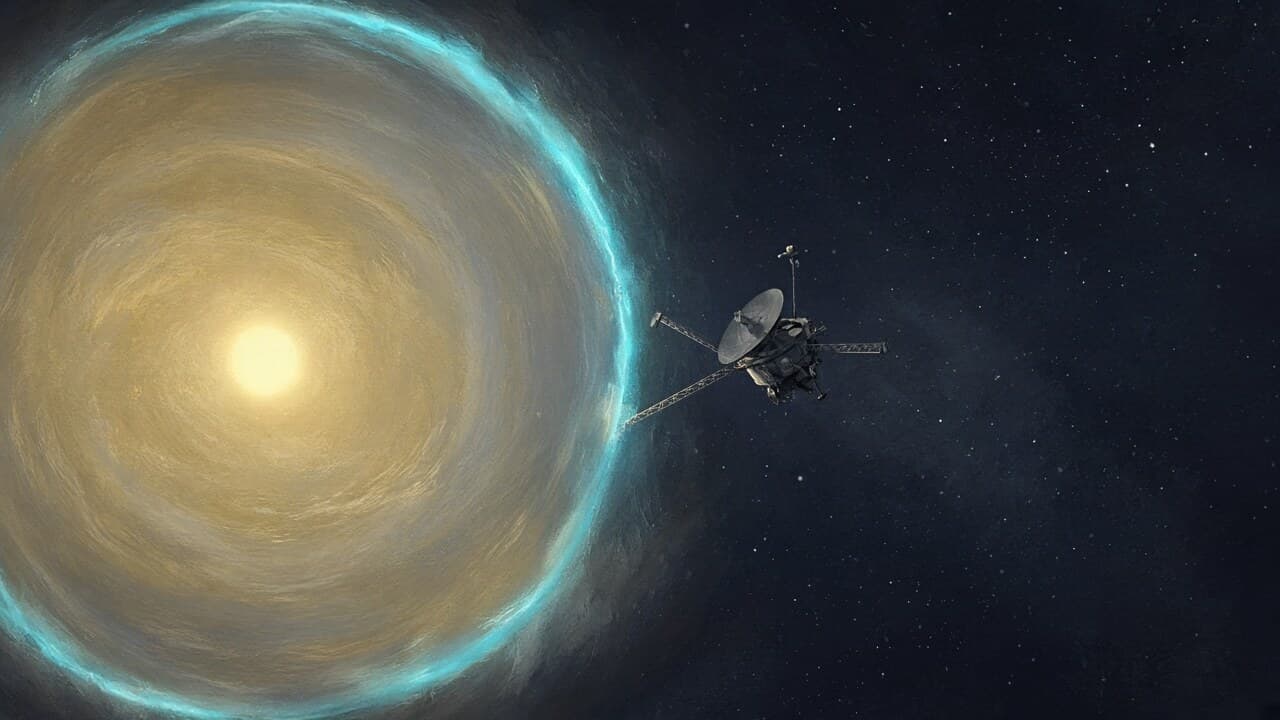
This is where one of the strangest ideas in modern physics begins. Einstein's theory of relativity does not give the universe a single clock that ticks identically everywhere. Space and time are connected, and different observers can disagree about which distant events belong to their present.
That does not prove that the future is already written. But it creates a deep question: is time something that flows through the universe, or are past, present and future different parts of a larger spacetime structure?
Human experience gives us a very convincing picture of time. Memories point backward. Plans point forward. The present feels like a narrow window between two things that are no longer here and are not here yet.
Everyday life works perfectly well with this picture. You wake up, have breakfast, go to work, remember yesterday and plan tomorrow. Nothing seems mysterious.
The problem begins when physics asks a deceptively simple question: if the universe contains enormous numbers of observers moving in different ways, which moment is the universal present?

Before relativity, it was natural to imagine that the universe shared one universal present. Somewhere in the cosmos, according to this intuition, everything happening at this exact moment would belong to the same cosmic 'now.'
Special relativity changed that picture. Space and time are not independent backgrounds. They form a combined structure called spacetime, and measurements of time depend partly on how observers move relative to one another.
- Spacetime
- The four-dimensional framework used in relativity to describe three dimensions of space together with time.
This produces a consequence that feels deeply unnatural: two observers moving differently can disagree about whether two distant events happen at the same time.
Consider two events happening extremely far apart. For one observer, they might be simultaneous. For another observer moving relative to the first, the same events may not share the same time coordinate.
Neither observer has necessarily made a mistake. Relativity says their measurements can both be valid within their respective reference frames.
This is known as the relativity of simultaneity, and it creates a philosophical problem much larger than its name suggests.
If the universe has no single objective present shared by everyone, then perhaps the distinction between past, present and future is not a fundamental feature of the entire cosmos.
Imagine two distant spacecraft moving relative to one another. Each crew can construct a valid description of spacetime, but their definitions of which distant events are simultaneous will not necessarily match.
The disagreement becomes more dramatic as the distances grow. At everyday speeds, these effects are far too small to notice. Across astronomical distances and relativistic velocities, however, they become fundamental.
| View | What It Suggests | Main Question |
|---|---|---|
| Presentism | Only the present is fully real | What exactly defines the universal present? |
| Block universe | Past, present and future are parts of one spacetime structure | If future events exist, what does that mean for free choice? |
| Growing block | The past and present exist while the future remains open | How does an objective present emerge without contradicting relativity? |
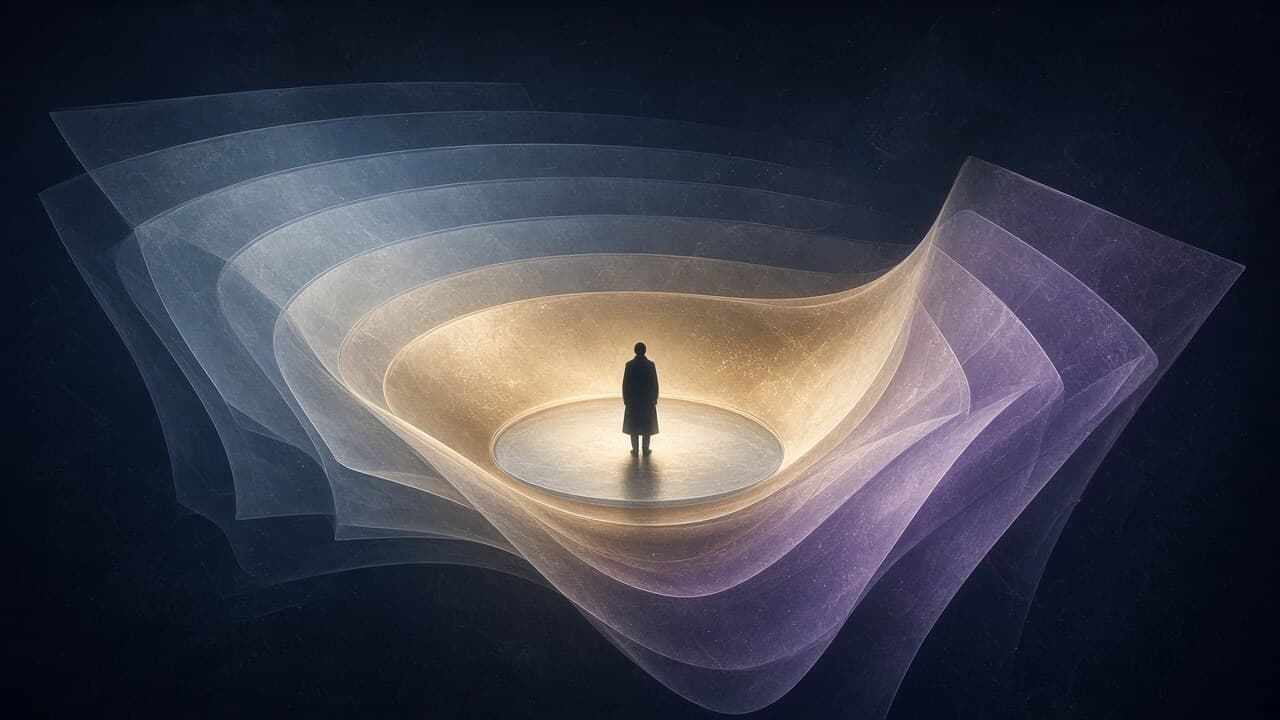
One interpretation inspired by relativity is called the block universe. Instead of imagining reality as a movie being generated frame by frame, imagine the entire spacetime history as a four-dimensional structure.
Your birth would correspond to one region of that structure. This moment would correspond to another. Events later in your life would occupy other locations along your worldline.
- Block Universe
- A philosophical interpretation of spacetime in which events at different times are treated as parts of one four-dimensional spacetime structure rather than reality being limited to a single moving present.
The crucial point is that the block universe is an interpretation, not a simple experimental result declaring that the future definitely exists.
This is where the discussion becomes personal.
If future events are part of spacetime, it is tempting to conclude that every decision you will ever make has already been fixed. Maybe your choices are simply events waiting to be encountered.
But that conclusion goes beyond what relativity itself establishes.
Physics does not provide a simple experiment showing that human decisions are predetermined because spacetime can be represented four-dimensionally. Questions about free will depend on deeper assumptions about causality, determinism, consciousness and what it means for a choice to be free.
There is also another complication: quantum mechanics.
Classical physics encouraged a deterministic picture of nature. If you knew the state of a system and all relevant laws perfectly, you could in principle calculate what happens next.
Quantum mechanics changed that intuition. Quantum theory predicts probabilities for the outcomes of many measurements rather than assigning a single definite outcome in advance.
Radioactive decay is a familiar example. Physics can predict the probability that a particular unstable atom will decay within a given period, but standard quantum mechanics does not provide a deterministic schedule for exactly when that individual decay will occur.
Probability
How quantum theory often predicts individual outcomes
Standard quantum mechanics
This matters because tiny quantum events can sometimes influence much larger systems. A microscopic event can become amplified through biological, chemical or physical processes.
So now we have a strange tension. Relativity gives us a spacetime structure that can be described as a whole, while quantum physics introduces fundamental uncertainty into physical predictions.
One way to respond to this tension is the growing-block idea.
Imagine reality as a structure that grows. The past is already part of it. The present is the newest region. The future is not yet part of the completed structure.
This preserves something close to our ordinary intuition: events genuinely happen, uncertainty resolves into definite outcomes, and the future remains open.
But there is a major challenge. Relativity does not naturally provide the universe with one privileged cosmic present. So turning the growing-block picture into a fully compatible physical theory is not straightforward.

There is an even stranger possibility: perhaps time is not one of the universe's deepest ingredients.
In some approaches to fundamental physics, researchers investigate whether familiar concepts such as time and space could emerge from a deeper description of reality.
This would be similar in spirit to how temperature emerges from the collective behavior of enormous numbers of particles. A single molecule does not have a temperature in the everyday thermodynamic sense, but a huge collection of molecules can.
If time were emergent, the sensation that the universe is continuously moving from one moment to another might be a large-scale feature rather than a fundamental property.
There is another mystery hiding inside the word 'time': why does it seem to move in one direction?
You remember the past but not the future. A glass can fall and shatter, but you never watch the fragments spontaneously assemble into the glass again.
This everyday direction of time is closely connected to the concept of entropy and the thermodynamic arrow of time. The microscopic laws governing many physical processes can be compatible with reversibility, yet macroscopic systems overwhelmingly evolve toward states with greater entropy.
Entropy gives us one of the strongest physical clues about why the past and future feel fundamentally different. The universe began in a remarkably low-entropy state, and the growth of entropy provides a direction that helps distinguish what we call the past from what we call the future.
That still does not completely explain why consciousness experiences time as a flowing present. It explains an important physical asymmetry, but the subjective experience of time remains a deeper problem.
The mystery becomes easier to see when we stop asking which idea sounds intuitive and instead compare the major possibilities.
- Only the present is real, while the past no longer exists and the future has not yet arrived.
- Past, present and future are all parts of a four-dimensional spacetime structure.
- The past and present are real while reality continually grows into an open future.
These are not simply three competing versions of the same established scientific fact. They involve different philosophical interpretations of what physical theories mean.
It is easy to turn the mystery of time into a sensational claim: 'Scientists proved the future already exists.' That would go too far.
What modern physics has firmly established is already extraordinary. Time is not universal in the Newtonian sense. Clocks can tick at different rates depending on relative motion and gravitational conditions. Space and time are connected. Simultaneity for distant events depends on the observer's frame.
What physics has not settled is whether one philosophical interpretation of those facts gives us the ultimate nature of reality.
| Question | What We Know | What Remains Open |
|---|---|---|
| Does time pass at the same rate everywhere? | No. Relativity predicts measurable differences. | How should the passage of time be interpreted philosophically? |
| Is there one universal 'now'? | Relativity does not provide a universal simultaneity for distant events. | What does this imply about the existence of past and future? |
| Is the future predetermined? | Relativity alone does not establish this. | How determinism, quantum theory and causality fit together. |
| Is time fundamental? | Current physics does not provide a final answer. | Whether time emerges from a deeper theory. |
There is a beautiful contradiction at the heart of the problem.
On cosmic scales, there may be no single universal present. But locally, your experience of now is perfectly meaningful. Your birth comes before your current moment. Your current moment comes before events later along your life. Your worldline has an ordered structure.
So perhaps the mystery is not that time is broken. Perhaps our intuition was simply designed for a small region of spacetime and becomes unreliable when we apply it to the entire universe.
From Absolute Time to Spacetime
1600s
Absolute Time
Classical mechanics develops a picture in which time can be treated as universal and independent of space.
1905
Special Relativity
Einstein shows that measurements of space and time depend on the observer's state of motion.
1915
General Relativity
Gravity is described through the geometry of spacetime.
20th Century
Quantum Mechanics
Nature at microscopic scales reveals probabilistic outcomes and challenges classical intuitions about determinism.
Today
The Time Problem Remains
Researchers continue investigating how relativity, quantum theory and the nature of time fit together.
The deepest part of this mystery may not be mathematical.
You experience your life as a sequence. You remember things that happened yesterday. You anticipate things that might happen tomorrow. Decisions feel open while you are making them.
A spacetime diagram does not erase that experience. Even if the universe can be represented as a four-dimensional structure, you still experience events along your own path through it.
And perhaps that is why the question is so difficult. Physics describes reality from the outside. Consciousness experiences it from within.
We started with an ordinary assumption: the past is gone, the present is happening and the future does not exist yet.
Relativity complicates that picture. There is no universal cosmic clock, and distant observers can disagree about which events are simultaneous.
From there, the block universe becomes possible: reality could be understood as a four-dimensional structure containing events at different times. But that interpretation does not automatically prove that every future event is predetermined.
Quantum mechanics adds another layer of uncertainty, while theories about the emergence of time suggest that our familiar experience of temporal flow might arise from something deeper.
So, does the future already exist?
Physics has not given us a final yes or no.
And perhaps that is what makes time one of the most fascinating mysteries in science. We spend every second inside it, yet we still do not completely understand what the thing we call 'time' actually is.
Maybe the universe is a completed structure. Maybe reality is constantly growing. Maybe time emerges from a deeper layer of physics that we have not discovered yet.
For now, there is only one moment you can directly experience: this one.
The most unsettling possibility is not that scientists have discovered a hidden future waiting somewhere in the universe. It is that our everyday concept of time may simply be too limited to describe reality at its deepest level.
Einstein showed us that time depends on motion and that space and time form one connected structure. Quantum physics then challenged our classical ideas about certainty. Together, they leave us with a universe that is much stranger than the clock on your wall suggests.
Maybe the future is already part of spacetime. Maybe it is genuinely open. Maybe both ideas are incomplete because we are missing a deeper theory.
Whatever the answer turns out to be, there is something wonderfully strange about the question itself: every second you spend reading this article becomes part of your past while the next second remains, for you, unknown.
What this picture clarifies — and what it cannot
What works
- Relativity provides a mathematically tested framework in which space and time are interconnected.
- The block universe offers an intuitive way to visualize spacetime and the relativity of simultaneity.
- Quantum theory provides a powerful framework for describing uncertainty at microscopic scales.
- Different philosophical models of time help clarify what is established by physics versus what remains interpretation.
What doesn't
- The block universe is an interpretation rather than a standalone experimental proof that the future exists.
- Relativity does not by itself settle the question of free will.
- Quantum interpretations disagree about how fundamental randomness is.
- There is currently no universally accepted theory explaining the ultimate nature of time.