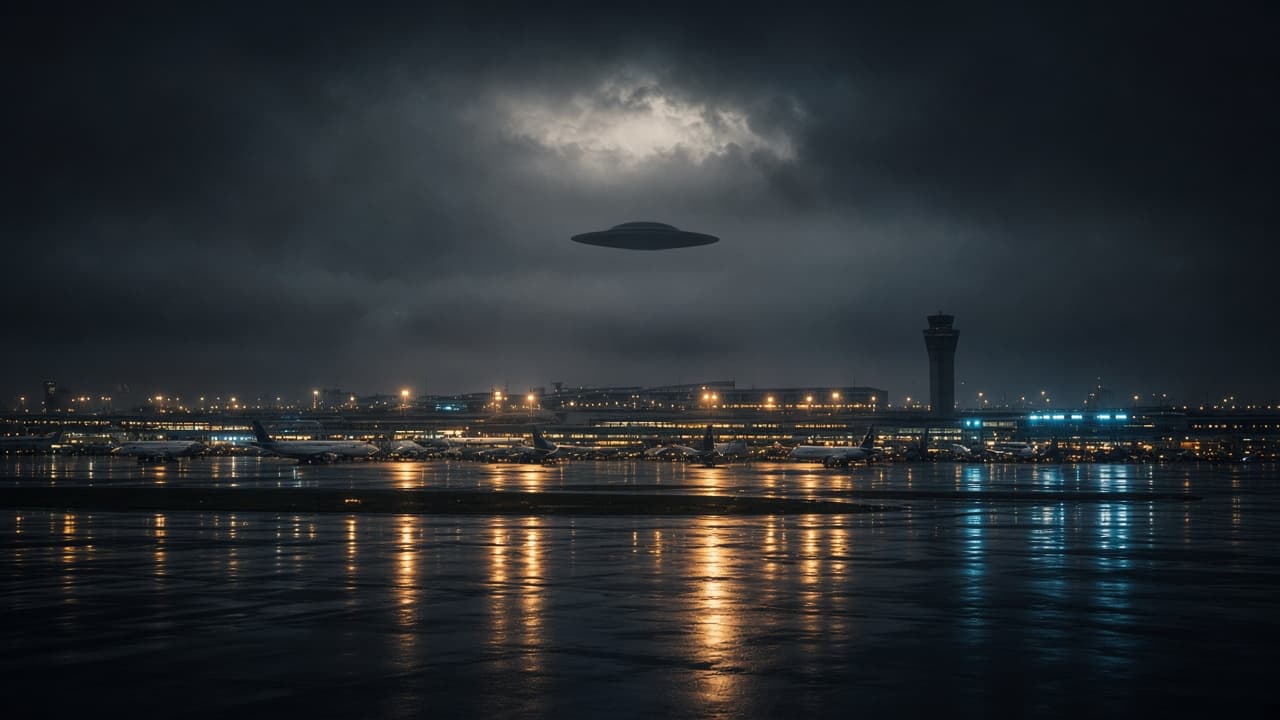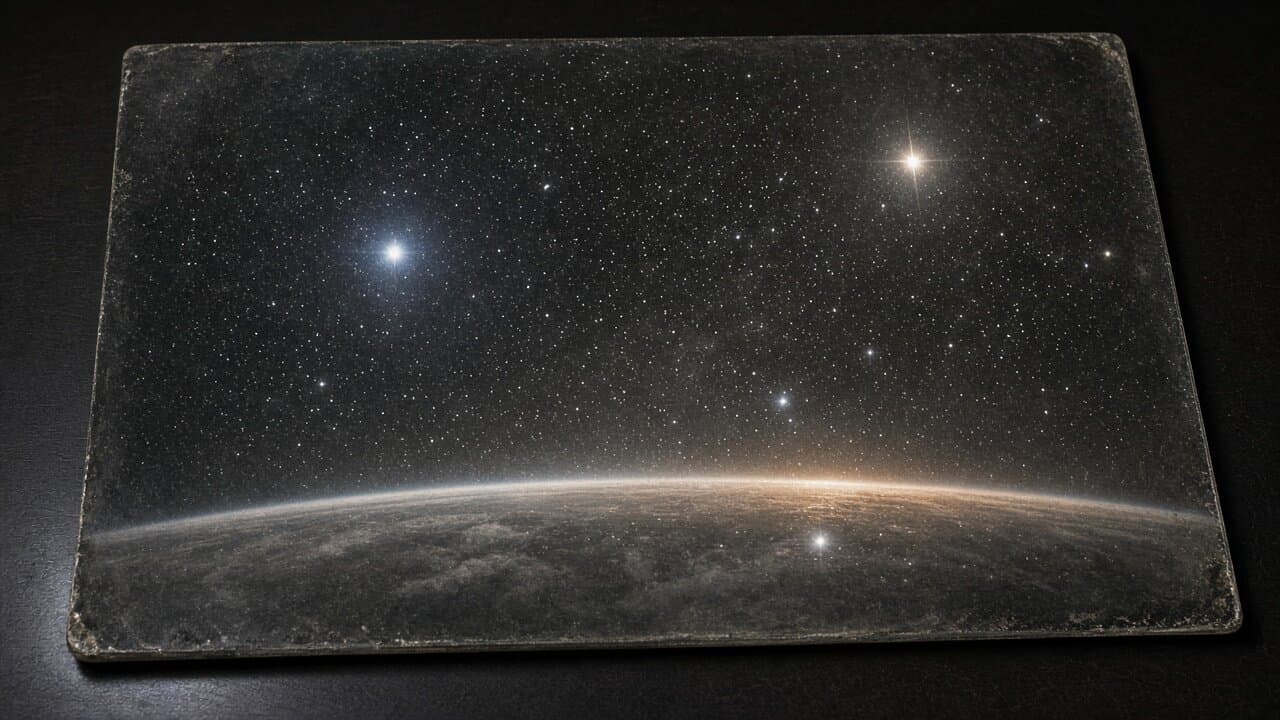
Imagine finding a photograph of something in Earth's sky that should not have been there.
The photograph was not taken by a smartphone, a military satellite or the James Webb Space Telescope. It came from an era when humans had not yet placed a single artificial satellite into orbit.
That is what makes a group of mysterious astronomical images from the middle of the 20th century so intriguing. Researchers studying historical photographic plates have identified points of light that appear in one observation and then disappear from later images.
The obvious question is unsettling: if some of these flashes were real objects reflecting sunlight near Earth, what were they?
The exciting answer would be something built by an intelligence that was not human.
But science has a rule that is even more interesting than the alien hypothesis: before accepting an extraordinary explanation, try as hard as possible to destroy it.
And that is where this story gets much more fascinating.
On October 4, 1957, Sputnik 1 became the first artificial satellite to orbit Earth. It was the beginning of the human space age.
But astronomers had been photographing the sky for decades before that moment.
Long before satellites filled low Earth orbit, observatories were exposing large photographic plates to the night sky. These plates became historical records of what the universe looked like at particular moments.
Today, those old images are more than astronomical history. Modern researchers can digitize them and compare them with much newer surveys made using sensitive electronic detectors.
That creates an unusual scientific time machine: we can ask whether something visible in the sky decades ago still exists today.

One of the projects exploring this idea is VASCO—the Vanishing & Appearing Sources during a Century of Observations project.
Its broader goal is to search historical astronomical observations for sources that appear, disappear or behave in unusual ways. The motivation is not simply aliens. Vanishing astronomical sources can potentially reveal unusual stellar explosions, stellar activity or other poorly understood astrophysical events.
But there is another possibility researchers have considered: technosignatures.
- Technosignature
- An observable feature that could indicate the presence of technology produced by an extraterrestrial civilization. Examples might include artificial radio signals, unusual atmospheric chemicals, engineered structures or other detectable technological effects.
This changes the question from 'Did someone see a UFO?' to something much more scientific: 'Can we find a measurable signature that is difficult to explain naturally?'
In 2021, Beatriz Villarroel and collaborators examined an especially strange photographic event from April 1950.
Nine point-like sources appeared within roughly a 10-arcminute region of a photographic plate. They were not visible on earlier or later images of the same area and were not found in modern, deeper surveys.
That sounds like an alien spacecraft story—but the researchers did not immediately make that leap.
They considered contamination and astronomical explanations first. The study also explored whether extremely brief flashes caused by sunlight reflecting from objects near geosynchronous orbit could produce similar signatures.
The authors themselves described an unknown contamination mechanism as one possible explanation and emphasized that additional observations would be needed.
If sunlight reflecting from an artificial object can create a brief flash in an astronomical image, then modern satellites provide an obvious explanation for some transient flashes.
But there was a problem with the historical images.
The photographic plates being investigated included observations from years before Sputnik.
Humanity had not yet launched an artificial satellite.
So if some of those flashes really were reflections from objects orbiting Earth, the objects would have to be something other than the satellites we know were launched during the Space Age.
The investigation did not stop with nine strange points of light.
Researchers studying the Palomar Observatory Sky Survey expanded the analysis to enormous collections of historical photographic data. Hundreds of thousands of candidate features were identified in some datasets, although a candidate feature is not automatically a genuine astronomical object.
This distinction matters enormously.
A photographic plate is not a perfect representation of reality. It can contain scratches, chemical defects, dust, scanning artifacts, cosmic-ray effects, processing irregularities and other false signals.
The larger the dataset becomes, the more important that problem gets.
One of the most interesting ideas in the research was surprisingly simple.
Suppose some mysterious points were actually reflective objects orbiting Earth.
They would need sunlight to shine.
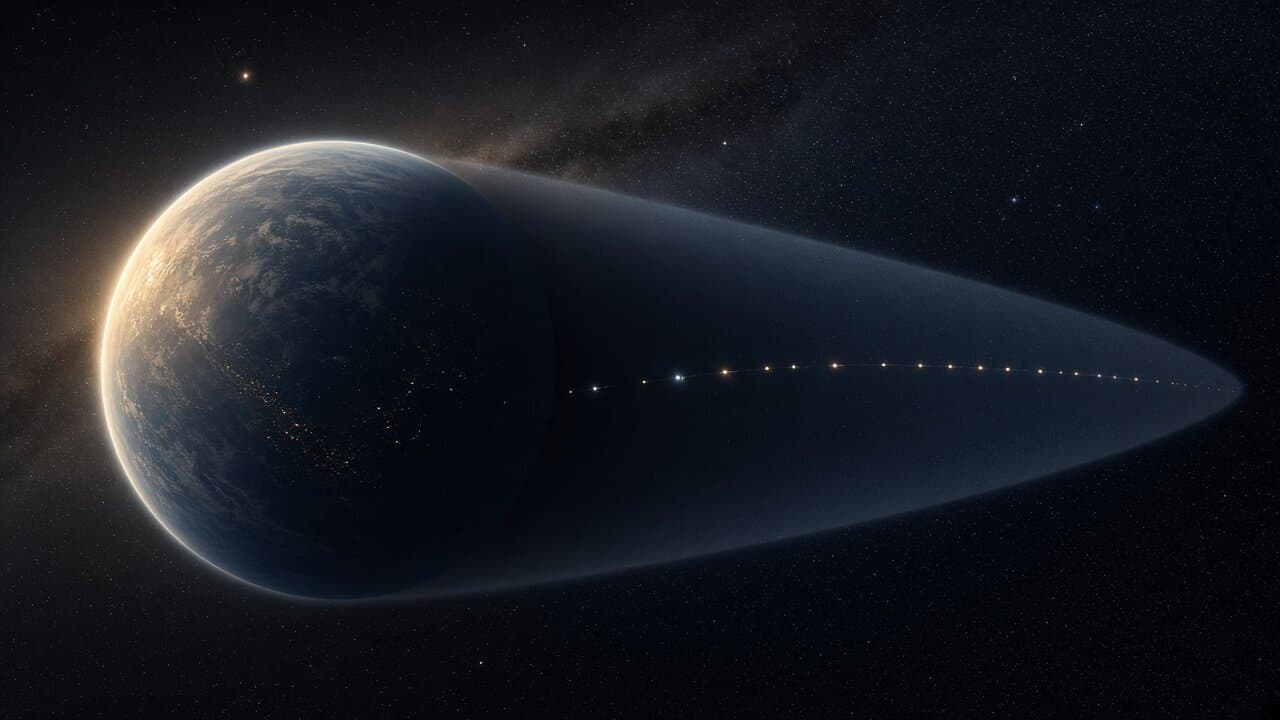
When an object moved into Earth's shadow, it should stop reflecting sunlight toward an observer.
So researchers could examine whether candidate flashes became less common in the region of sky corresponding to Earth's shadow at certain orbital distances.
The Basic Idea
Sunlight hits an object
A reflective surface can redirect sunlight toward Earth.
The object enters Earth's shadow
The Sun is blocked by Earth, removing the illumination source.
The reflection disappears
A sunlight-driven glint should become invisible.
Compare the statistics
If candidate flashes systematically avoid the expected shadow region, researchers can test whether that pattern is consistent with reflective objects.
It is a clever hypothesis because it tries to turn an unknown object into a measurable physical prediction.
Another reported pattern attracted even more attention: the timing of some candidate transients appeared to correlate with atmospheric nuclear tests conducted during the era covered by the photographic archive.
That immediately created a compelling story. If something technologically advanced had been monitoring Earth, perhaps nuclear weapons testing would be exactly the kind of event that would attract its attention.
But there is a major problem with that interpretation.
A statistical correlation does not reveal the mechanism causing it.
Even if two events occur more often together than expected, researchers still have to establish that the relationship is real, that the dataset is unbiased and that alternative explanations have been eliminated.
This is where the story becomes much more interesting than a simple alien claim.
In January 2026, Wesley Andrés Watters and collaborators published a detailed critical analysis of the claims involving POSS1-E photographic plates. The work was subsequently published online by Cambridge University Press in July 2026 in the Publications of the Astronomical Society of Australia.
Their conclusion was substantially more skeptical.
- They found no statistically significant Earth-shadow deficit in the datasets they analyzed.
- They argued that some reported features could be catalog stars, scan artifacts or photographic plate defects.
- They found that the nuclear-test correlation became insignificant after accounting properly for the number of observation days.
- They identified inconsistencies in how datasets were defined and selected.
- They argued that it had not been demonstrated that the features were genuine optical transients in the first place.
That is a devastating challenge to the strongest version of the extraterrestrial interpretation.
Villarroel and collaborators responded to the criticism.
Their response argued that the critique used a heavily reduced and differently filtered dataset and that reducing the sample so aggressively could make it statistically unsuitable for testing the original hypothesis.
They also disputed the claim that their original sample was simply contaminated with enough artifacts to explain the findings.
In other words, the scientific debate has not produced a dramatic 'aliens confirmed' moment. Instead, it has produced something scientists actually value: competing analyses that can be tested against the underlying data.
| Question | Research Supporting the Anomaly | Critical Research |
|---|---|---|
| Unusual features exist in historical scans | Yes | Yes |
| Some may represent genuine transient events | Possible | Not demonstrated |
| Objects were orbiting Earth | Possible interpretation | Evidence insufficient |
| Nuclear-test correlation | Reported correlation | Becomes insignificant after normalization |
| Extraterrestrial origin | Hypothesis worth investigating | No evidence establishes it |
There is a lesson here that applies far beyond UFO research.
The photograph itself can lie.
Not intentionally, of course. But every scientific instrument has limitations.
A camera can produce a reflection. A telescope can introduce optical distortions. A detector can generate noise. A photographic plate can develop blemishes. A digitization process can create artifacts. And a statistical analysis can accidentally discover patterns that disappear when the data are processed differently.
That is why the strongest scientific discoveries are rarely based on one strange image.
Finding an unexplained dot is not enough.
Even finding thousands of unexplained dots would not automatically prove aliens.
To make a compelling case for extraterrestrial technology, researchers would want multiple independent lines of evidence.
- The observation should be independently reproducible.
- The object should be confirmed as physically real rather than a detector or photographic artifact.
- Its distance and motion should be measurable.
- Its physical properties should be consistent with an artificial object.
- Natural explanations should be quantitatively tested and ruled out.
- Independent instruments should observe the same phenomenon.
- Ideally, researchers should recover additional information such as a spectrum, radio emission, resolved structure or repeatable behavior.
- The conclusion should survive attempts by independent scientists to falsify it.
This distinction is often lost in popular discussions about UFOs.
UAP simply describes something observed that has not yet been satisfactorily identified. It does not describe where the object came from.
The U.S. government's All-domain Anomaly Resolution Office has repeatedly stated that it has found no verifiable evidence that UAP sightings represent extraterrestrial activity. Its historical review also concluded that many investigated cases ultimately involved ordinary objects or phenomena and misidentification.
That does not mean every unexplained observation has been solved. It means 'unexplained' and 'alien' are two very different scientific categories.
Because the question of extraterrestrial intelligence is completely legitimate.
The universe contains an enormous number of stars and planets. Scientists are already searching for biosignatures and technosignatures using radio astronomy, optical observations, atmospheric spectroscopy and other techniques.
The scientific mistake would not be searching for aliens.
The mistake would be deciding that we found them before the evidence can survive serious scrutiny.
There is something remarkable about this entire investigation.
Humanity has accumulated decades of astronomical observations without fully knowing what questions future scientists would ask of them.
A photographic plate created simply to map the sky can eventually become evidence in a completely different scientific investigation.
That means the night sky has effectively been recording an enormous archive for us.
We just have to learn how to read it.
This is where the story becomes genuinely mind-bending.
Suppose future researchers examine the original plates with better instruments, reconstruct the observing geometry and determine that at least one of these pre-Sputnik flashes was produced by a physical object orbiting Earth.
That would already be extraordinary.
If independent evidence then showed that the object could not have been human-made, the implications would be enormous.
It would mean something technologically capable existed around Earth before humanity entered space.
And suddenly the question would change from 'Are aliens real?' to something much stranger:
If someone was already watching Earth before we reached orbit, how long had they been watching?
The Mystery in Context
1920s–1950s
The photographic sky archive grows
Astronomical observatories record large portions of the sky using photographic plates.
1950
Nine unusual transient sources
A Palomar photographic plate later becomes the subject of detailed investigation because multiple point-like sources appear and disappear from the record.
1957
Sputnik changes the problem
The launch of Sputnik 1 begins the human satellite era, providing an obvious modern source of sunlight-reflecting orbital objects.
2019
VASCO research expands
Researchers compare historical catalogs with modern surveys to search for vanishing and appearing astronomical sources.
2021
The 1950 transient event is examined
Researchers investigate nine simultaneous point-like sources and discuss contamination and possible near-Earth reflective objects.
2025
Large-scale transient analyses
Researchers report much larger analyses of transient features in pre-Sputnik photographic data and explore statistical links to Earth's shadow and nuclear-test timing.
2026
The scientific challenge intensifies
A peer-reviewed critical study argues that key statistical effects disappear after improved data validation and normalization, while the original researchers respond and defend their methodology.
Maybe these mysterious points are evidence of ancient objects orbiting Earth.
Maybe they are photographic defects.
Maybe they are a mixture of several ordinary astronomical and instrumental effects.
And there is a fourth possibility that is scientifically more interesting than either extreme: we simply do not have enough information yet.
That is not a disappointing conclusion.
It is where science begins.
The most exciting part of this story is not that old photographs supposedly prove aliens were here. They do not.
The exciting part is that humanity is learning to interrogate its own historical observations with tools that did not exist when those observations were made.
A tiny unexplained point on a piece of photographic film from 1950 can now become a scientific question involving orbital mechanics, image processing, statistics, astronomy and the search for extraterrestrial technology.
And perhaps someday, one of those old dots—or a completely new one—will survive every attempt to explain it away.
That is when the story would truly begin.
Pre-Sputnik Lights FAQ
Did scientists discover alien satellites before Sputnik?
What were the mysterious objects in the Palomar photographs?
What is the VASCO project?
Why is the 1950 photographic plate important?
Could satellites explain the old flashes?
Did the 2026 research prove the objects were not alien?
Is there confirmed evidence that aliens have visited Earth?
For decades, humanity looked at old astronomical photographs as historical records. Now we are beginning to treat them as evidence that can still be questioned.
Perhaps the mysterious flashes will eventually turn out to be nothing more than defects, contamination and statistical noise.
Perhaps one of them will turn out to be a rare natural phenomenon that nobody had recognized.
Or perhaps, buried inside an archive created before humanity ever reached orbit, there really is something we have not yet understood.
For now, we should resist both easy answers: 'aliens' and 'nothing.'
Because the most interesting mysteries are the ones where the evidence is strong enough to make us curious—but not strong enough to let us stop asking questions.
What this research opens — and where caution is essential
What works
- Uses historical astronomical observations that can be independently reanalyzed
- Provides a testable scientific hypothesis
- Encourages searches for genuine technosignatures
- Connects astronomy, statistics and space science
- Could reveal previously overlooked astronomical phenomena
What doesn't
- Historical photographic plates contain many possible artifacts
- Some datasets have disputed definitions and selection methods
- Statistical correlations can arise from observational biases
- Many candidate objects cannot be independently confirmed
- There is currently no demonstrated extraterrestrial explanation