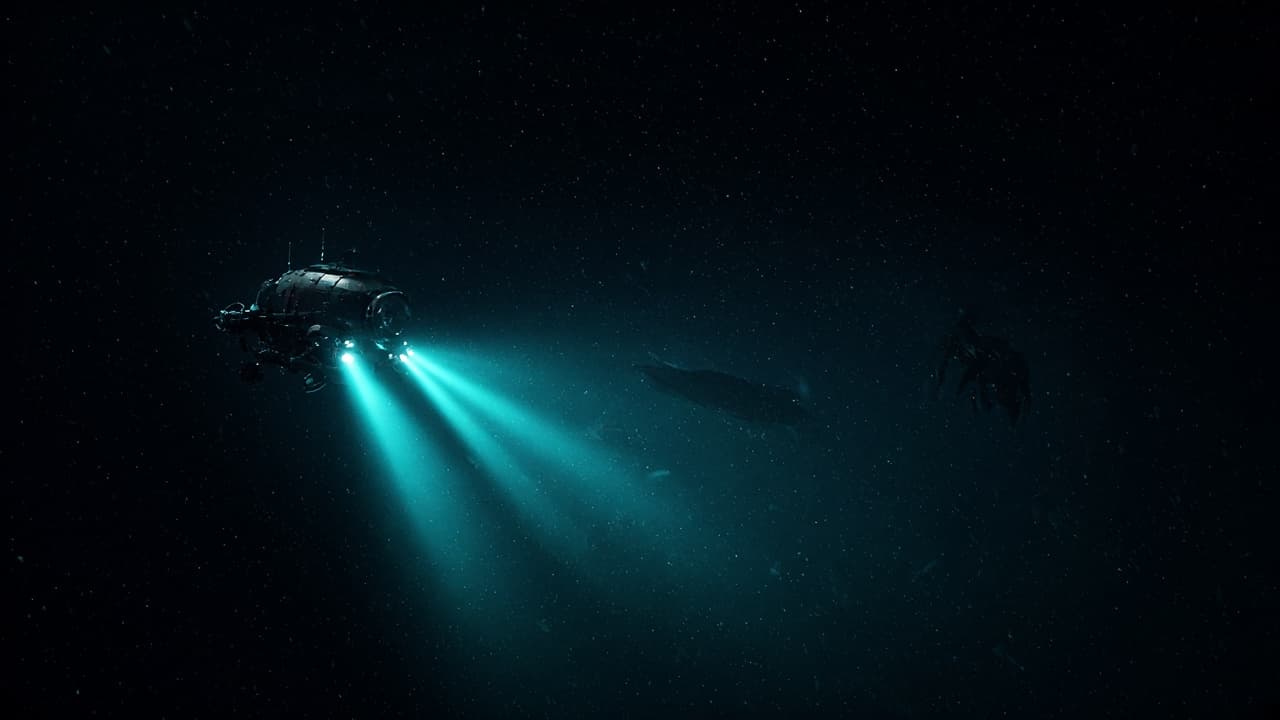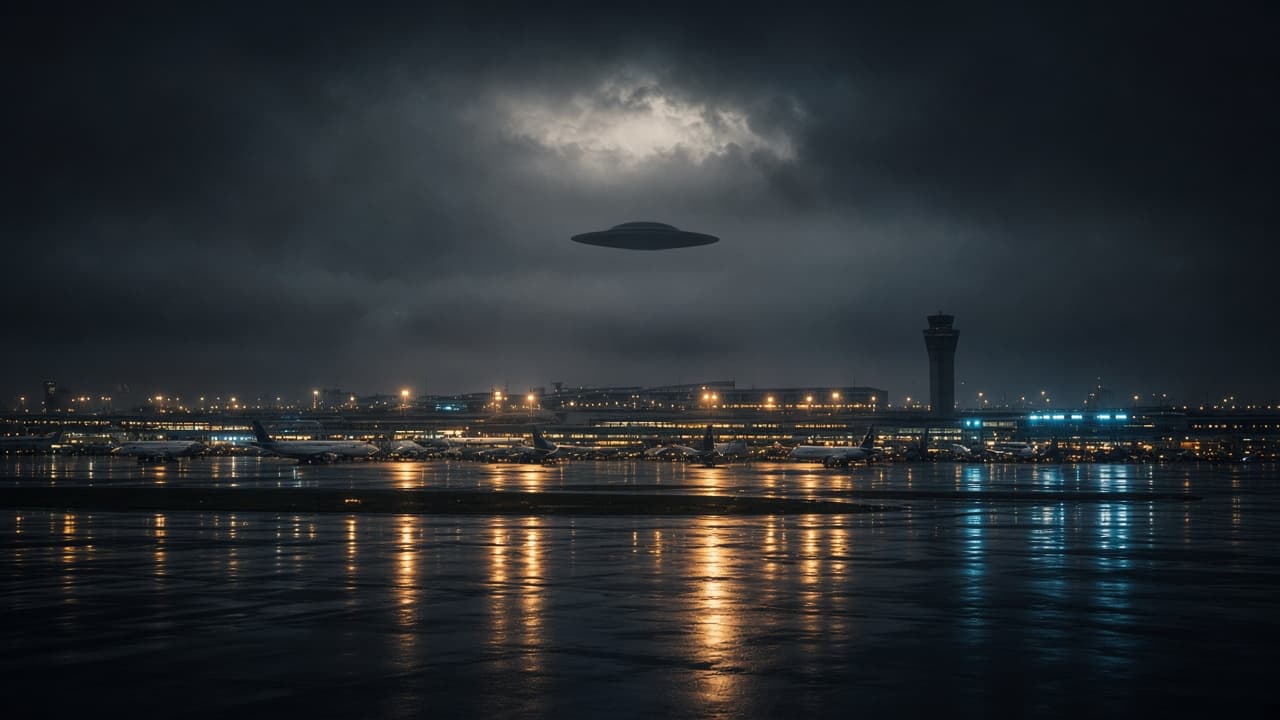
Something appears in the sky. Pilots see it. Radar detects something unusual. Witnesses describe the same strange object. Then the question begins: what was it?
For much of the twentieth century, UFOs were treated as a strange mixture of science fiction, conspiracy theories and unexplained sightings. But behind the jokes was a much more practical problem: pilots and other aviation professionals were sometimes reporting objects they could not identify.
The documentary behind this article follows investigators, journalists, pilots and military personnel who spent years examining some of these cases. Their central argument is not necessarily that every UFO is an alien spacecraft. Instead, they ask a simpler question: if something unknown is operating in our airspace, shouldn't we understand what it is?
That question has become increasingly relevant. NASA has conducted an independent scientific study of UAP, while the U.S. Department of Defense operates the All-domain Anomaly Resolution Office, or AARO, to investigate reports of anomalous phenomena.
The phrase UFO stands for Unidentified Flying Object. More recently, governments and researchers increasingly use UAP, or Unidentified Anomalous Phenomena.
The most important word is unidentified. It does not mean extraterrestrial. It means that, based on the available information, observers have not established exactly what they saw.
- UAP
- An observation of an event or object that cannot currently be identified as a known aircraft, natural phenomenon or other conventional explanation using the available information.
A pilot looking through a cockpit window is not using a laboratory instrument. Human perception can be affected by distance, lighting, weather, motion and expectations. But pilots also spend years learning how to recognize aircraft, weather conditions and unusual situations.
That is why aviation encounters deserve a different kind of attention. Even if an unexplained object turns out to be a balloon, drone, atmospheric phenomenon or sensor artifact, an unidentified object near an aircraft can still represent a practical safety question.
One of the documentary's most detailed cases involves Japan Airlines Flight 1628 while flying toward Anchorage, Alaska, in November 1986.
According to the accounts presented in the documentary, the crew reported seeing a large bright object that appeared to accompany the aircraft. The event became particularly interesting because communications with ground control and radar-related information were also part of the subsequent investigation.
The case has remained controversial because different interpretations have been offered for what the radar information represented. The documentary presents former FAA investigator John Callahan's account of reviewing radar material and other records, while also noting that the FAA publicly offered a different interpretation of the radar return.
| Evidence Type | What Was Reported | Why It Matters |
|---|---|---|
| Pilot testimony | Crew described a large unidentified object | Provides a first-person account |
| Radio communications | Communications with ground control were recorded | Creates a contemporaneous record |
| Radar information | Radar-related data was examined | Potential independent corroboration |
| Official interpretation | Different interpretations of the radar return were reported | Shows why the case remains disputed |
Imagine being a commercial pilot and seeing an unidentified object close to your aircraft. Even if you have no reason to believe it is extraterrestrial, you still have a problem.
Is it another aircraft? A drone? A balloon? A military platform? A weather phenomenon? A reflection? A sensor error? Or something genuinely unusual?
The documentary's aviation investigators argue that the identity of the object is less important initially than understanding whether it creates a hazard.
2006
Year of the reported disc-shaped object near Chicago O'Hare Airport
Documentary case chronology
On November 7, 2006, airline personnel at Chicago O'Hare reported seeing an unusual disc-shaped object above the airport complex. The documentary describes reports from pilots, mechanics and ramp workers.
Witnesses described an object appearing stationary above the airport before reportedly moving upward rapidly and disappearing through the cloud layer.
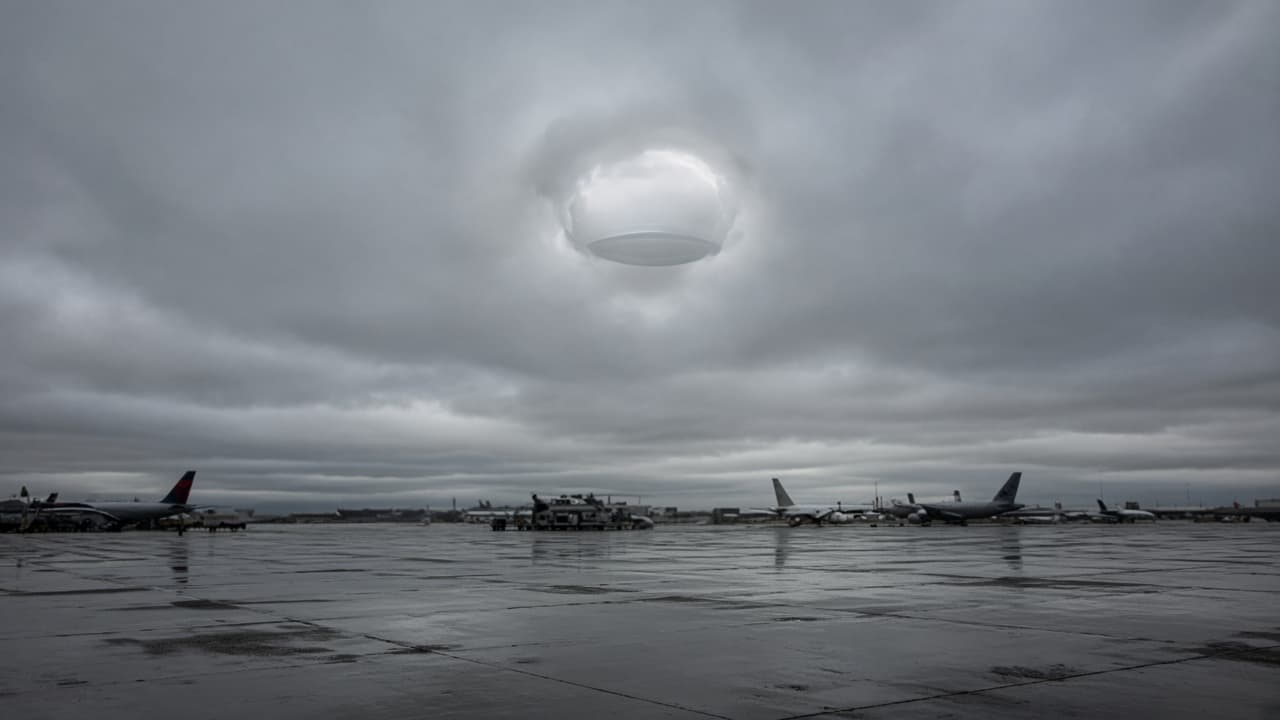
Journalist John H. Hooper investigated the story and sought records and testimony from people working at the airport. The documentary describes how initial statements from United Airlines and the FAA were followed by later acknowledgment that reports had been received.
The case is particularly interesting because it demonstrates a recurring problem in UFO investigations: eyewitnesses can agree that they saw something unusual while disagreeing—or lacking enough information—to establish what the object actually was.
The documentary discusses an explanation involving a hole-punch cloud, an atmospheric phenomenon that can create circular or unusual openings in cloud layers. The journalist interviewed cloud experts and argued that the reported weather conditions did not match what would normally be required.
Few American UFO cases became as culturally famous as the Phoenix Lights.
On March 13, 1997, large numbers of people across Arizona reported seeing unusual lights or objects in the night sky. The documentary focuses on witnesses who described a large formation moving across the landscape.
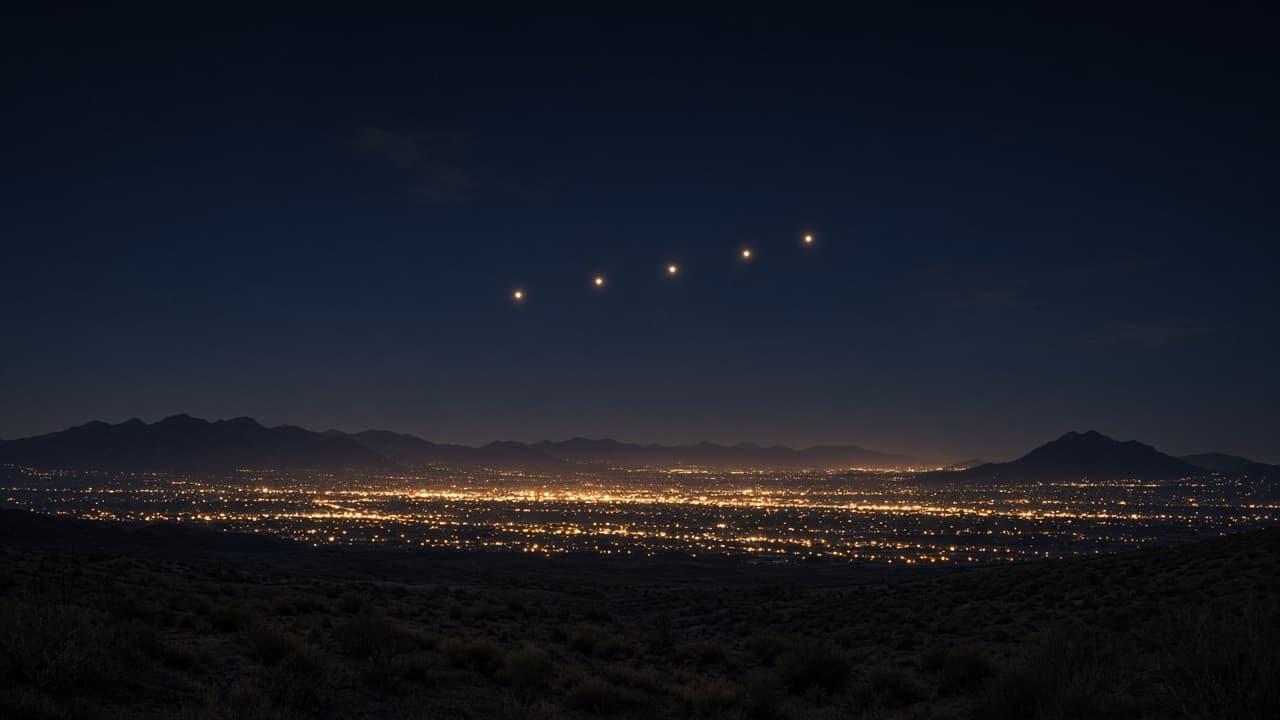
The number of witnesses made the event especially difficult to dismiss as a single person's mistaken observation. But multiple witnesses do not automatically establish what the object was. Different people can observe the same event while interpreting its size, distance, shape and speed differently.
The documentary describes an interview with former Arizona Governor Fife Symington, who had previously participated in a humorous public response to the Phoenix Lights controversy. Years later, he acknowledged that he had personally witnessed the event and described it as an occurrence of unknown origin.
That does not establish an extraterrestrial explanation. It does, however, illustrate how the social treatment of UFO reports can change over time.
The documentary repeatedly returns to one theme: professional stigma.
Investigative journalists describe worrying that their careers could be damaged by reporting on UFOs. Pilots and aviation professionals had concerns about how their reports might be perceived. Researchers operated largely outside mainstream scientific institutions.
There is an understandable reason for skepticism. UFO culture has historically mixed legitimate reports with hoaxes, exaggerated claims, poor-quality photographs and speculative theories.
But skepticism and dismissal are not the same thing. A scientific approach does not require believing every report. It requires collecting enough information to determine what can and cannot be explained.
The documentary describes investigations in countries including France, Chile, Peru and other nations, where some agencies approached UFO reports as aviation or scientific questions rather than purely as cultural curiosities.
France is particularly important to the documentary's argument. Its space agency, CNES, has maintained GEIPAN, an office dedicated to collecting and analyzing reports of unidentified aerospace phenomena.
The basic philosophy is useful even outside the UFO debate: bring together specialists who can examine weather, astronomy, psychology, aviation, photography and other relevant evidence.
Another case featured in the documentary occurred over Tehran in 1976. Iranian Air Force pilot Parviz Jafari reported encountering an unidentified object and attempting to engage it.
According to his account, the object appeared to move rapidly and his aircraft experienced problems during the encounter. The documentary presents the case as an example of why military pilot reports have attracted attention from investigators.
However, decades-old testimony remains difficult to evaluate without complete sensor data and independently reproducible observations.
One of the biggest developments described in the documentary is the shift from UFOs being treated largely as a fringe subject toward formal government attention.
The documentary discusses reporting about a Pentagon program that began in 2007 to investigate anomalous aerospace observations. Today, the U.S. government has a formal office called the All-domain Anomaly Resolution Office, or AARO.
AARO's current public materials show that investigations continue. Its database includes cases that remain unresolved as well as cases that have been attributed to ordinary objects or phenomena.
This is perhaps the most important lesson in modern UAP research.
A case can remain unresolved because the available video is too short, the sensor lacks calibration data, the object's distance is uncertain, the viewing angle creates an illusion of unusual movement, or investigators simply do not have enough information.
NASA's independent UAP study reached a similar conclusion: many observations lack the high-quality data and metadata needed to determine exactly what happened. NASA also noted that some apparent anomalous behavior can result from sensor motion or other measurement effects.
| Possibility | Example | What Investigation Needs |
|---|---|---|
| Ordinary object | Balloon, bird, aircraft or drone | Visual and contextual identification |
| Atmospheric phenomenon | Weather or optical effect | Weather data and atmospheric conditions |
| Sensor artifact | Camera or radar effect | Calibrated sensor and telemetry data |
| Unknown technology | Object not matching known systems | Independent multi-sensor evidence |
| Extraterrestrial technology | Technology originating beyond Earth | Extraordinary, independently verified evidence of non-human origin |
NASA's position is deliberately cautious. Its UAP FAQ states that there is currently no evidence supporting the idea that UAP are evidence of alien technologies, while emphasizing that the limited quality of many observations makes firm conclusions difficult.
This distinction matters. NASA is not saying that every reported observation has been explained. It is saying that the evidence currently available does not justify concluding that the unexplained observations are extraterrestrial.
AARO's 2024 Historical Record Report reviewed decades of U.S. government involvement with UAP. Its report states that aggregate U.S. government investigations had not found a case demonstrating off-world technology. It also addressed claims about secret reverse-engineering programs and said AARO found no evidence supporting the alleged extraterrestrial reverse-engineering narrative examined in the report.
At the same time, AARO continues to publish unresolved cases. Being unresolved means investigators do not currently have enough information for a conclusive attribution; it does not mean the case has been confirmed as extraterrestrial.
Military sensor data can be classified for reasons that have nothing to do with aliens. A video might reveal the capabilities, resolution, location or limitations of a military sensor. Releasing it could therefore expose information about national-security systems.
NASA's UAP report specifically noted that classified military observations can make scientific investigation more difficult because the underlying data may not be publicly available.
A Better UAP Investigation
Capture the Event
Record the object using calibrated optical, infrared, radar or other appropriate sensors whenever possible.
Preserve the Metadata
Record exact time, location, weather, sensor settings, aircraft position and other contextual information.
Compare Independent Sensors
Determine whether multiple independent instruments observed the same object and movement.
Test Conventional Explanations
Check aircraft, satellites, balloons, birds, drones, atmospheric effects, optical illusions and sensor artifacts.
Publish What Can Be Verified
Make enough evidence available for independent researchers to reproduce or challenge the analysis.
Some people believe that at least some UAP represent extraterrestrial technology. The documentary features investigators and witnesses who consider that possibility seriously.
But the current public scientific evidence does not establish that conclusion. NASA says there is no data supporting UAP as evidence of alien technologies, and AARO's historical review says U.S. government investigations have not established a case involving off-world technology.
That leaves an interesting middle ground: some observations genuinely remain unidentified, while their ultimate explanation remains unknown.
The biggest mistake in the UFO debate is assuming there are only two possibilities: 'ordinary aircraft' or 'alien spacecraft.' Reality has many more possibilities.
- Unknown military technology
- Commercial or experimental drones
- Balloons and other high-altitude objects
- Satellites and astronomical objects
- Rare atmospheric phenomena
- Optical illusions
- Sensor limitations and artifacts
- Human perception errors
- Events for which the available evidence is simply insufficient
The fascinating part is that the investigation does not become less interesting when aliens are removed from the equation. Understanding how radar, cameras, human perception, atmospheric physics and advanced aircraft interact can reveal things about technology that are genuinely worth knowing.
The future of UAP research may depend less on finding one spectacular photograph and more on building a reliable scientific observation system.
NASA recommended improving data collection, developing better observation strategies and using scientific tools to investigate UAP. AARO is also continuing to publish imagery and case assessments, including both resolved and unresolved incidents.
If an extraordinary object really does appear in our skies, the strongest evidence will not be a blurry photograph or one dramatic testimony. It will be multiple independent measurements that survive serious attempts to explain them conventionally.
For decades, the UFO debate has been trapped between belief and disbelief. One side sees unexplained observations as evidence that something extraordinary is happening. The other points to the enormous number of ordinary things that can look extraordinary under the wrong conditions.
A better approach is more uncomfortable: investigate without deciding the answer first.
If an object is a balloon, identify the balloon. If it is a drone, identify the drone. If it is a sensor artifact, understand the sensor. If it is a rare atmospheric phenomenon, document the physics.
And if one day the evidence genuinely demonstrates something that cannot be explained by anything made on Earth, then the scientific world will have an extraordinary discovery to investigate.
Until then, perhaps the most honest answer to the UFO mystery is also the most scientifically useful one: some things remain unidentified—and that is exactly why we should keep looking.
What UAP investigations can and cannot easily do
What works
- UAP investigations can improve aviation safety and awareness of unknown objects in controlled airspace.
- Better data collection can help distinguish genuine anomalies from ordinary objects and sensor effects.
- The subject connects aviation, astronomy, atmospheric science, psychology, engineering and national security.
- Publicly available government and scientific research is increasing compared with earlier decades.
What doesn't
- Many historical cases lack complete sensor data and metadata.
- Some reports rely heavily on human eyewitness testimony.
- Classified military information can prevent independent verification.
- An unresolved case should not automatically be interpreted as evidence of extraterrestrial technology.
The UFO mystery does not need an alien spacecraft to be fascinating. Pilots have reported unusual encounters. Governments have investigated anomalous observations. Scientists are now asking how better data could transform the subject.
The evidence available today does not establish that extraterrestrial civilizations are visiting Earth. But it also does not mean every unidentified observation has already been explained.
Perhaps the most important shift is that we no longer have to choose between blind belief and automatic dismissal. We can investigate the unknown, demand better evidence and remain willing to change our minds when the data changes.