Imagine looking through a telescope and discovering that the universe may not have begun where we thought it did. Not because astronomers have found a crack in the sky, but because the equations that describe gravity become incomplete when pushed to the extreme conditions of the earliest moments. What if the Big Bang was not the absolute beginning? What if our expanding cosmos emerged from a cosmic bounce—and what if that bounce happened inside a black hole in a much larger universe?
It is an extraordinary possibility explored in a family of theoretical models known as black-hole cosmology. One version, developed by physicist Nikodem Popławski using Einstein–Cartan gravity, proposes that the collapse of matter could be halted by an effect associated with particle spin and spacetime torsion. Instead of ending in a singularity, collapse could turn into a bounce, creating an expanding region of spacetime on the other side of a black-hole horizon.
But there is a crucial distinction: this is not a discovery that has replaced the Big Bang model. The hot Big Bang remains the best-supported account of the universe's early evolution. The black-hole universe is a fascinating, mathematically motivated possibility whose key claims have not been observationally confirmed. To understand why anyone takes it seriously—and what evidence would be needed—we first need to separate what the Big Bang actually says from the popular story told about it.
The phrase Big Bang can create the wrong mental picture: a tiny ball exploding into a pre-existing darkness, with galaxies flying outward from a central point. That is not what modern cosmology describes. In the standard picture, space itself expands. On large scales, distant galaxies become farther apart because the distance between points in space grows.
Run the expansion backward and the observable universe becomes hotter, denser and more compressed. About 13.8 billion years ago, it was in an extremely hot, dense state. The Big Bang model describes how the universe expanded and cooled from that early phase, allowing particles, atoms, stars and galaxies to form over time.
This picture is supported by several independent lines of evidence: galaxies' redshifts, the cosmic microwave background, the abundance of light elements created in the early universe, and the large-scale distribution of galaxies. These are not merely details that fit one dramatic story; they are measurements that converge on a coherent history.
Einstein's general theory of relativity describes gravity as the curvature of spacetime. It has passed demanding tests, from the bending of starlight to the timing of GPS satellites and the detection of gravitational waves. Yet when classical general relativity is extrapolated to the very beginning of the universe, its equations can lead to a state called a cosmological singularity.
A singularity is not a tiny object that astronomers have photographed. In the mathematical description, quantities such as density or spacetime curvature can become infinite, signalling that the theory is being pushed beyond its domain of reliability. Physicists generally interpret this as a warning: a more complete theory—likely involving quantum aspects of gravity—is needed to describe that regime.
This is why saying 'the Big Bang theory proves the universe came from a point of infinite density' is too strong. The well-tested hot Big Bang framework describes the universe back to an extremely early state. The singularity is what appears in a classical extrapolation, not an experimentally observed moment at which physics literally stops working.
The standard cosmological model is commonly called Lambda-CDM. Lambda (Λ) represents the component associated with the universe's accelerated expansion, usually modelled as a cosmological constant. CDM stands for cold dark matter: matter that interacts gravitationally but does not emit, absorb or reflect light in the ordinary way.
In the model's approximate cosmic inventory, ordinary matter—the atoms that make stars, planets, oceans and people—accounts for about five percent of the universe's total energy content. Dark matter contributes roughly a quarter, while dark energy makes up around two-thirds. The exact fitted values depend on the dataset and model assumptions, but the broad picture is that most of the cosmic energy budget is not ordinary atomic matter.
That does not mean dark matter and dark energy are imaginary placeholders invented to rescue a failing theory. Their physical nature remains unknown, but the evidence for the effects they are used to describe is substantial. Dark matter is inferred from galaxy rotation, gravitational lensing, galaxy clusters and the growth of cosmic structure. Dark energy is the name given to whatever is driving the observed accelerated expansion in the simplest interpretation.
What the “dark” labels mean
- Dark matter: an inferred form of matter whose gravity helps explain how galaxies and large-scale structures behave. Its particle identity has not been confirmed.
- Dark energy: a name for the component or mechanism associated with the accelerating expansion of the universe. Its underlying nature is still unknown.
- Ordinary matter: atoms and their components—the familiar matter that forms stars, planets, gas and life.
A key scientific nuance is that cosmologists have detected gravitational and expansion-related effects, not directly identified the dark matter particle or the microscopic nature of dark energy. The distinction between evidence for an effect and knowledge of its cause is essential.
Light from many distant galaxies is stretched to longer wavelengths as the universe expands. This phenomenon is called cosmological redshift. The farther away a galaxy is, the faster its recession appears to be on average, described by the Hubble–Lemaître law. This relationship tells us that the universe is expanding today—and that it was denser in the past.
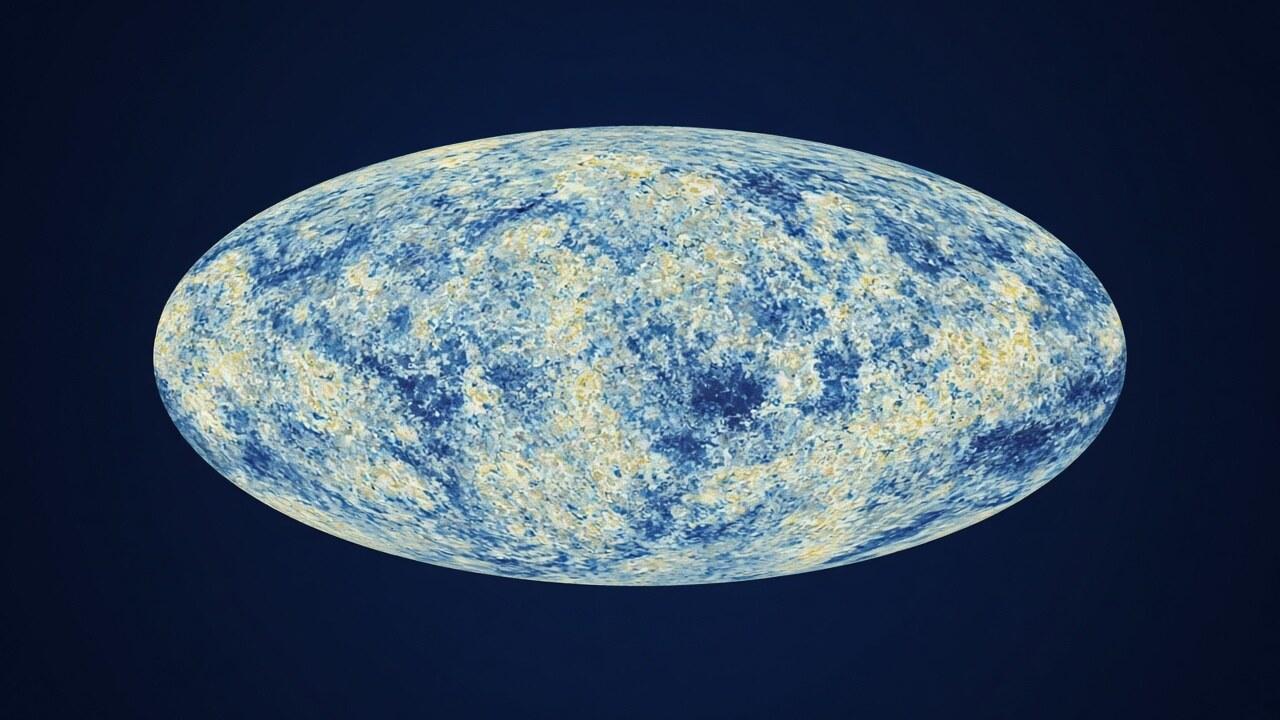
The cosmic microwave background (CMB) is faint microwave radiation arriving from every direction in the sky. It was released when the universe became cool enough for electrons and protons to combine into neutral atoms, allowing light to travel freely. This happened roughly 380,000 years after the hot early phase began.
The CMB is not a photograph of the instant of creation. It is a snapshot of the universe when it was about 380,000 years old. Tiny temperature variations across it preserve clues about the early density fluctuations that later grew into galaxies and clusters. Space missions such as COBE, WMAP and Planck measured these patterns with increasing precision.
The hot early universe produced light nuclei, mainly hydrogen and helium, with small amounts of deuterium and lithium. The predicted abundances depend on early-universe physics and can be compared with astronomical measurements. This process is called Big Bang nucleosynthesis. The broad agreement between prediction and observation is another major success of the hot Big Bang framework.
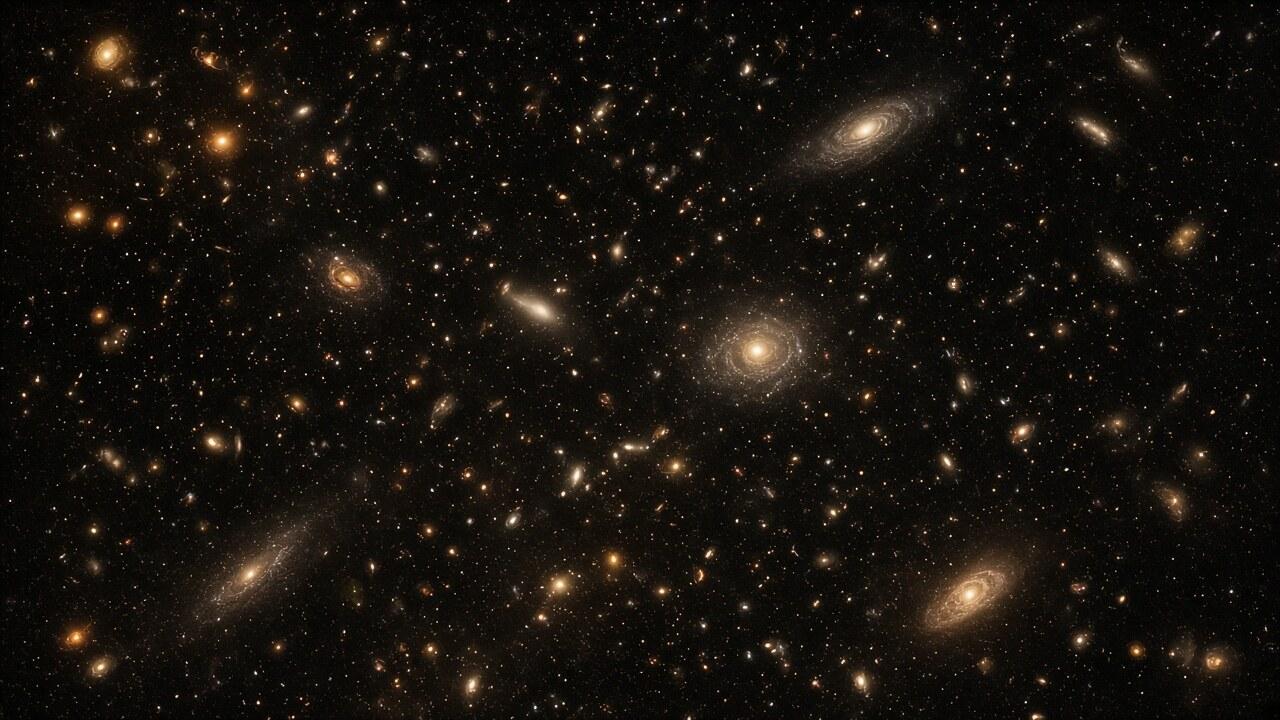
One of the most exciting developments in recent cosmology came from the James Webb Space Telescope (JWST). By observing infrared light, Webb can study galaxies whose light has travelled for more than 13 billion years. Because the universe expands while the light is travelling, that light is stretched toward infrared wavelengths—a process astronomers use to measure redshift and estimate how early the galaxy existed.
A striking example is JADES-GS-z14-0. JWST observations identified it as an extremely distant galaxy, seen when the universe was less than 300 million years old. Follow-up observations with the Atacama Large Millimeter/submillimeter Array (ALMA) measured a redshift of about 14.18 and detected oxygen. Oxygen is a heavier element than hydrogen or helium and is made inside stars, then spread into space by stellar winds and stellar deaths.
That finding is remarkable because it suggests that stars had already formed, evolved and enriched the galaxy with heavier elements very early in cosmic history. It is like finding evidence of a chemically developed neighbourhood when astronomers expected a much younger one.
Does this prove the Big Bang model is wrong? No. It challenges models of how quickly the first stars and galaxies assembled, and it puts pressure on assumptions about star-formation efficiency, stellar populations, dust and early galaxy growth. The standard cosmological framework is being tested and refined; a surprising early galaxy is not, by itself, evidence that the universe formed inside a black hole.
Another major puzzle is the Hubble tension. The Hubble constant, usually written H₀, describes the present-day expansion rate of the universe. Scientists can estimate it in different ways. One approach uses observations of the early universe, especially the CMB, interpreted through the standard cosmological model. Another uses a local distance ladder built from objects such as Cepheid variable stars and Type Ia supernovae.
These approaches have historically produced values that do not comfortably agree. Early-universe inferences are around 67 kilometres per second per megaparsec, while several local distance-ladder measurements have been around 73. A megaparsec is about 3.26 million light-years. The difference is not simply that the universe expands at one speed in one direction and another speed nearby; it is a disagreement between methods of estimating the same present-day parameter.
The tension has motivated intense work on calibration errors, astrophysical systematics and possible new physics. Its statistical significance depends on the datasets, analysis choices and how correlated uncertainties are treated. It is a serious open problem, but it does not uniquely point to a black-hole universe or a Big Bounce.
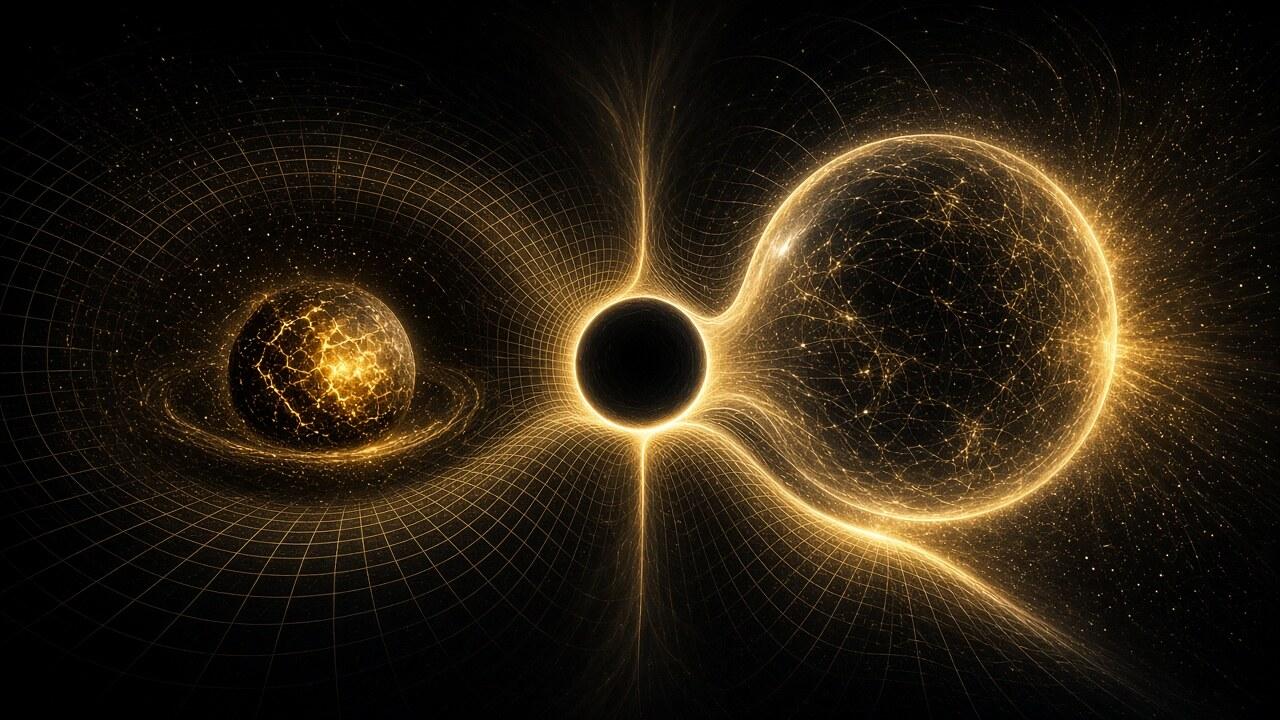
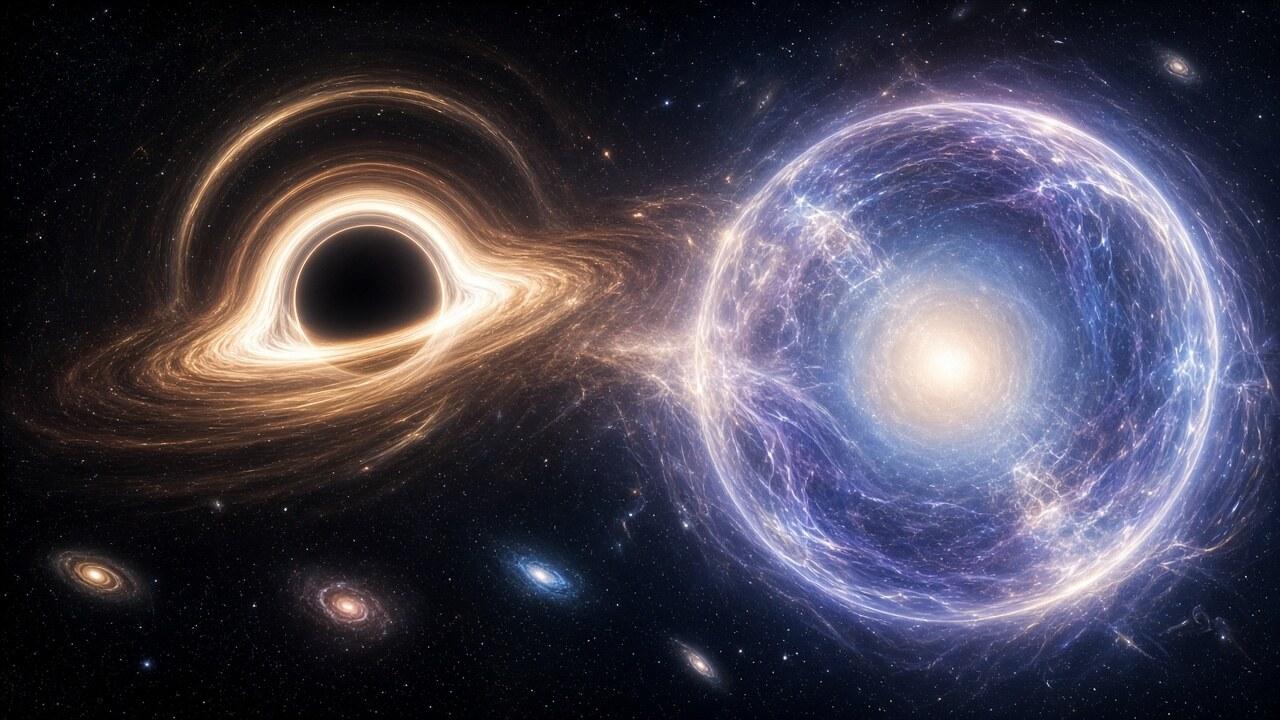
Now comes the idea that makes this story so captivating. In some theoretical models, the interior of a black hole need not end in a singularity. Under particular assumptions, extreme gravitational collapse could lead to a new expanding region of spacetime. From the inside, observers in that region might describe its early expansion as a Big Bang.
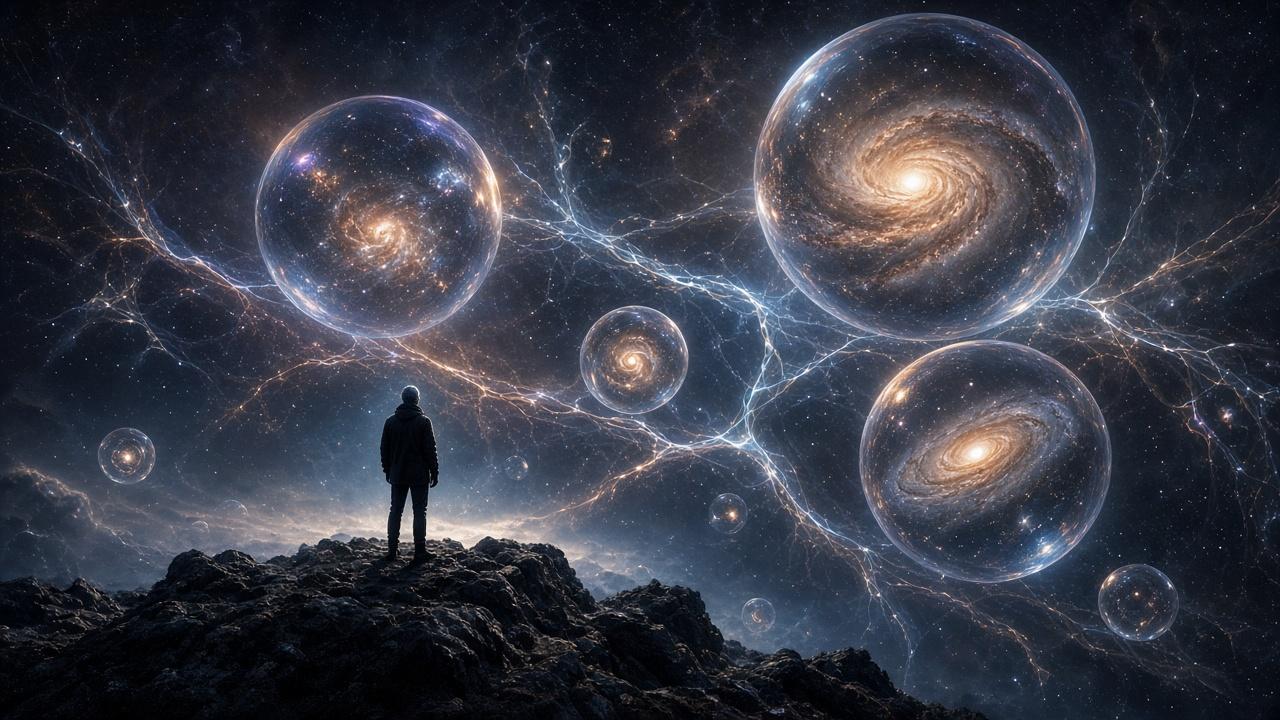
In this picture, the black hole belongs to a larger 'parent' universe. The expanding region inside its horizon would be a 'child' universe. The event horizon is the boundary beyond which signals cannot escape to the outside universe in the usual classical description. The proposal does not mean we could look through a black hole and see another universe like a room behind a door.
Several different ideas are sometimes grouped under the labels black-hole cosmology and baby universes. They are not all the same model, and they should not be treated as a single confirmed theory. One well-known version uses Einstein–Cartan–Sciama–Kibble gravity, often abbreviated ECSK, to introduce spacetime torsion connected with the intrinsic spin of matter.
General relativity describes spacetime using geometry. Its familiar feature is curvature: mass and energy affect the geometry, and that geometry guides the motion of matter and light. Einstein–Cartan theory extends this geometric description by allowing another property called torsion.
In this framework, torsion is related to the intrinsic angular momentum—or spin—of matter. Spin is a quantum property of particles such as electrons and quarks. It is not simply a tiny ball physically spinning like a planet. The theory connects the distribution of intrinsic spin to the geometry of spacetime.
At ordinary densities, the torsion contribution is expected to be extremely small, so Einstein–Cartan theory can closely reproduce the successful predictions of general relativity. At extraordinarily high densities, however, spin-related effects may become important. In certain idealized cosmological calculations, these effects can act like an effective repulsion and prevent a collapse from reaching a classical singularity.
Imagine rewinding the expansion of the universe. In the classical picture, the scale of the universe shrinks and the density rises toward the singularity. In a bouncing model, the contraction does not continue without limit. At an extremely high density, new physics changes the behaviour of the system. The universe reaches a minimum size and begins expanding again.
This is the Big Bounce: a transition from contraction to expansion. It offers a possible way for the universe to have a history before the hot expanding phase we call the Big Bang. The bounce is not an explosion into empty space; it is a change in the evolution of spacetime itself.
In Popławski's ECSK-based proposal, spin and torsion can generate an effective gravitational repulsion at extreme densities. The collapsing matter may avoid a singularity and produce an expanding universe inside a black hole. The idea has been developed in peer-reviewed theoretical papers, including work published in Physical Review D and The Astrophysical Journal.
However, a mathematically possible solution is not the same as an observed event. There is no telescope image of a cosmic bounce, no confirmed signal from a parent universe, and no experimental measurement showing that our universe sits inside a black hole. The proposal is a candidate framework, not an established account of cosmic history.
A successful bounce model aims to address the singularity problem and may offer ways to account for some large-scale properties of the universe. In particular, some versions have been studied as alternatives to cosmic inflation or as mechanisms that could help explain why widely separated regions have similar temperatures.
But it would be misleading to say that the Big Bounce has solved every difficulty in cosmology. Different bounce models make different assumptions and predictions. They must still reproduce the observed CMB temperature and polarization patterns, the abundance of light elements, the distribution of galaxies, and the universe's measured expansion history. A proposal that removes one mathematical problem can create new questions that also need answers.
If a black hole can produce a new expanding spacetime region, an astonishing possibility follows: perhaps black holes in our universe could each give rise to child universes. Those universes might contain their own black holes, which could in turn give rise to further universes. The result would resemble a cosmic family tree, with universes nested through generations of gravitational collapse.
Some speculative versions go further and imagine that physical constants could vary slightly from one generation to another. If so, universes that form many black holes might produce more descendants than universes that form few. This has been compared to a form of cosmological natural selection.
It is a fascinating thought, but it is not an established evolutionary process. We do not know whether black holes create baby universes, whether constants are inherited, or whether such a process could be tested. The idea is a theoretical extension, not a census of hidden universes.
Cosmology is not tested by building a laboratory black hole or watching a universe form. Instead, researchers look for measurable consequences that competing models predict differently. A viable alternative must make predictions precise enough that observations could support it, constrain it or rule it out.
Potential tests researchers discuss
- Cosmic microwave background: look for distinctive patterns in temperature and polarization that a specific bounce model predicts and that standard inflationary models do not naturally produce.
- Primordial gravitational waves: search for a background of gravitational waves from the very early universe. Its spectrum could constrain models of inflation or a pre-Big-Bang phase.
- Large-scale structure: compare predictions for how tiny early density fluctuations grew into galaxies, clusters and cosmic voids.
- Expansion history: test whether the model can reproduce measurements from supernovae, baryon acoustic oscillations, the CMB and other distance indicators.
- Black-hole physics: seek a consistent theory that connects realistic gravitational collapse, quantum matter and the interior spacetime without relying on oversimplified assumptions.
None of these observations has yet established that our universe was born inside a black hole. A pattern in the CMB or an unusual galaxy would need to be shown to be a distinctive prediction of the model, not merely something the model can be adjusted to accommodate.
| Idea | What it says | Scientific status |
|---|---|---|
| Hot Big Bang model | The observable universe evolved from an early hot, dense state and has expanded and cooled. | Strongly supported by multiple independent observations. |
| Cosmological singularity | A classical extrapolation of general relativity reaches a breakdown where quantities can diverge. | A sign that classical theory is incomplete in this regime; not an observed physical object. |
| Big Bounce | A contracting universe reaches a minimum size and expands again. | A family of theoretical models; no confirmed observational evidence for a prior contraction. |
| Black-hole universe | Our expanding universe may be associated with the interior of a black hole in a parent universe. | Speculative theoretical proposal; not observationally established. |
| ECSK torsion bounce | Spin-related spacetime torsion may prevent singular collapse under certain conditions. | Mathematically studied in peer-reviewed work; key cosmological consequences remain unconfirmed. |
The most accurate answer is no—not in the way the video's dramatic title suggests. The hot Big Bang model is supported by a remarkable range of observations. It explains the expansion of the universe, the CMB, the early production of light elements and the broad growth of cosmic structure. The fact that scientists still debate the earliest instant does not erase the evidence for the universe's hot, dense past.
What may be incomplete is the extrapolation of classical general relativity all the way to a singularity. The Big Bang model does not provide a final, experimentally verified explanation of why the universe exists, whether time had a beginning, or what—if anything—came before the earliest era we can describe confidently.
JWST's early galaxies and the Hubble tension are important clues that our models of galaxy formation and cosmic expansion deserve close scrutiny. They do not independently prove that dark matter and dark energy are fictional, nor do they demonstrate that the universe is inside a black hole. Science advances by testing explanations against the full body of evidence, not by replacing one certainty with another unsupported certainty.
The black-hole universe idea turns a familiar question inside out. Instead of asking only how everything emerged from the Big Bang, it asks whether the Big Bang was a transition in a much longer cosmic story. Could our universe be one region in a chain of universes? Could a black hole's interior be more than a one-way destination? Could the laws of gravity change their behaviour at densities far beyond anything we can recreate on Earth?
At present, these questions sit at the frontier of theoretical physics. The Big Bounce is not a confirmed replacement for the standard model, but it illustrates why scientists continue to explore extensions of general relativity and possible quantum-gravity effects. A good scientific idea must be imaginative enough to open a new possibility—and disciplined enough to face the evidence that might prove it wrong.
The evidence for a hot, dense early universe is powerful. The cosmic microwave background, the expansion of galaxies and the abundance of light elements all point toward a universe that has expanded and cooled for roughly 13.8 billion years. That achievement should not be confused with a complete explanation of the ultimate beginning.
The singularity problem leaves a profound gap in our understanding. Einstein–Cartan gravity and the Big Bounce offer one possible way to explore that gap: perhaps spin and torsion prevent a final collapse and allow a new expanding universe to emerge inside a black hole. If such a picture were correct, our cosmic history could extend beyond the beginning we currently observe.
But possibility is not proof. JWST discoveries and the Hubble tension are sharpening questions about early galaxy formation and cosmic expansion; they have not demonstrated that Lambda-CDM is false or that we live inside a black hole. The next step is not to declare the old model dead, but to find observations that distinguish competing explanations.
Perhaps the Big Bang was the beginning of our observable cosmic story, not the beginning of everything. That possibility is extraordinary enough. For now, the honest answer is that the Big Bounce remains an intriguing hypothesis—and the universe still has some of its deepest secrets to reveal.