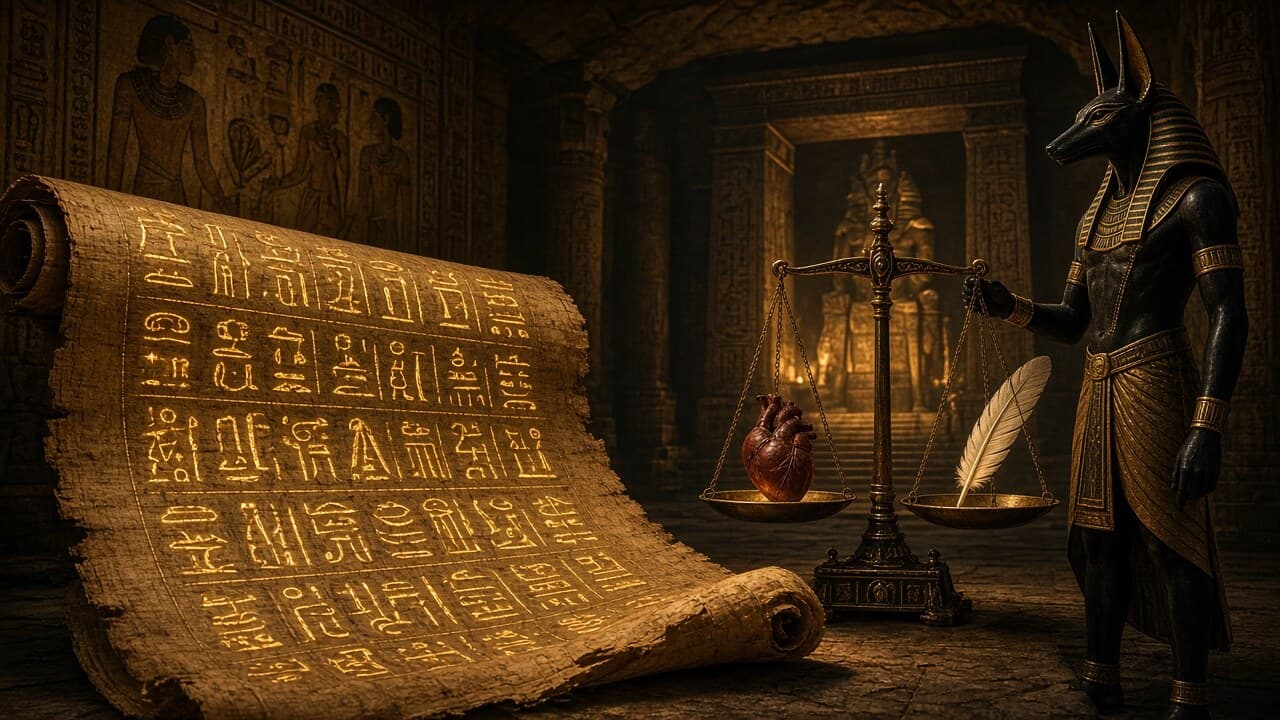
Imagine standing before a divine court after death. In front of you is a golden balance. On one side rests your heart, believed to hold the record of your life. On the other is a delicate feather representing truth and justice. Your future depends on the judgment that follows.
This was one of the most powerful ideas in ancient Egyptian religion. Death was not necessarily the end of existence. Instead, the deceased had to navigate a complex spiritual world, overcome obstacles, and become worthy of an eternal life beyond the grave.
To help them prepare for this journey, ancient Egyptians used funerary texts containing prayers, instructions, illustrations, and magical spells. The collection now known as the Egyptian Book of the Dead is among the most remarkable surviving records of these beliefs.
One famous example is the Papyrus of Ani, an illustrated funerary manuscript created around 1250 BCE. Today, it is held by the British Museum. Its vivid scenes reveal how ancient Egyptians imagined judgment after death, the role of the gods, and the possibility of reaching a blessed afterlife.
But was the Book of the Dead really a forbidden or cursed book, as some modern stories suggest? What did its spells actually do, and why did the ancient Egyptians believe the heart was so important?
The answers reveal something more fascinating than a supernatural horror story: a civilization's extraordinary attempt to understand death, morality, memory, and the possibility of life beyond it.
The Egyptian Book of the Dead is the modern name for a collection of ancient Egyptian funerary texts. These writings were intended to help deceased people navigate the afterlife and attain a favorable existence beyond death.
The ancient Egyptians did not produce one universal book with an identical set of pages for everyone. Instead, different spells and illustrations were selected and combined in manuscripts or placed on other funerary objects. The contents could vary according to the period, the individual, and the resources available.
The texts could appear on papyrus scrolls, coffins, mummy wrappings, and other objects placed in tombs. They included hymns to gods, protective formulas, declarations of innocence, instructions for passing supernatural obstacles, and descriptions of the next world.
Egyptologists commonly associate this tradition with the ancient Egyptian expression often translated as 'Book of Coming Forth by Day.' The phrase captures an important idea: the deceased hoped to emerge from the darkness of death and participate in a renewed existence.
The collection developed over centuries, especially during the New Kingdom, and continued to evolve into later periods. There are nearly 200 known spells associated with the Book of the Dead tradition, although an individual manuscript would not necessarily contain all of them.
That variety is essential to understanding the text. The Book of the Dead was not simply a story about the underworld. It was a practical religious resource intended to assist a deceased person through the challenges ancient Egyptians believed lay ahead.
| Aspect | Detail |
|---|---|
| Purpose | To assist the deceased in navigating the afterlife |
| Format | A changing collection of spells, prayers, and illustrations |
| Materials | Papyrus, linen, coffins, and other funerary objects |
| Historical span | Generally dated from around 1550 BCE to 50 BCE |
| Famous example | The Papyrus of Ani, created around 1250 BCE |
Among the most celebrated examples of the Egyptian Book of the Dead is the Papyrus of Ani, a beautifully illustrated manuscript associated with a man named Ani. The British Museum dates it to approximately 1250 BCE, during Egypt's Nineteenth Dynasty.
Ani is identified in the manuscript's historical record as a royal scribe and granary overseer. His papyrus offers a remarkable glimpse into the religious expectations and funerary practices of an individual who lived more than three millennia ago.
The manuscript is not merely a collection of mysterious symbols. Its illustrations and texts work together to show scenes from Egyptian religious belief, including the deceased's encounter with divine powers and the hope of entering the afterlife.
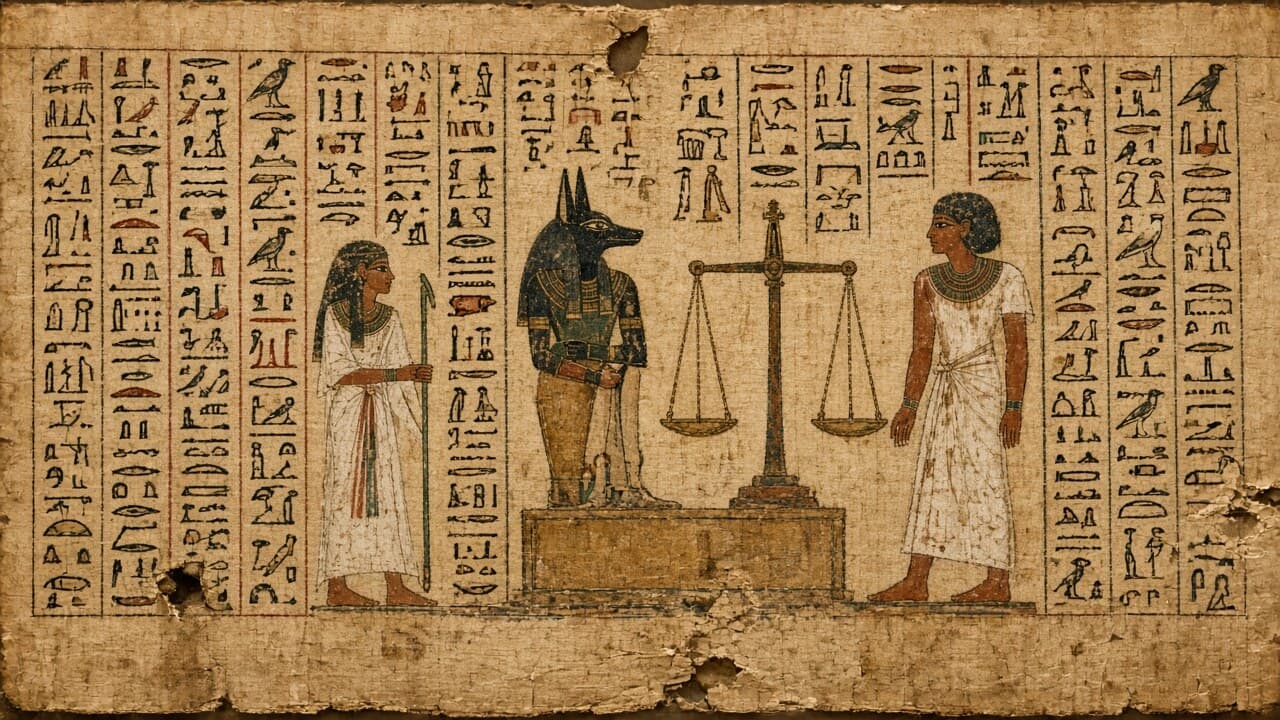
The Papyrus of Ani is particularly famous for its depiction of the weighing of the heart. This scene has become one of the most recognizable images associated with ancient Egyptian ideas about death and judgment.
The document was created for a specific person, but it belongs to a much broader tradition. Other Egyptians also had funerary texts prepared for them, with the selection and quality of materials depending partly on wealth, status, and historical period.
Its survival gives modern researchers a window into the past. The manuscript helps scholars investigate ancient writing, religious symbolism, artistic conventions, and how Egyptians imagined the relationship between the living, the dead, and the gods.
Although dramatic accounts sometimes describe the papyrus as a dangerous object guarded because of its supernatural powers, museum records identify it as an ancient funerary manuscript. There is no reliable historical evidence that it possesses a curse or supernatural danger.
To understand the Book of the Dead, we need to understand how ancient Egyptians viewed existence. For many Egyptians, death did not mean that a person's identity simply disappeared. Instead, it marked a transition into another stage of existence that required careful preparation.
Egyptian religion included several interconnected ideas about a person, including the body and spiritual aspects often described by terms such as ka, ba, and akh. These concepts changed in meaning and emphasis across different periods, so they should not be treated as exact equivalents of the modern idea of a single soul.
The body also mattered. Mummification and tomb preparation were connected to beliefs about preserving the deceased and enabling continued existence. Funerary offerings, rituals, names, images, and written formulas all played roles in this wider system.
The afterlife was not imagined only as an abstract spiritual realm. Some Egyptian depictions presented it as a renewed world with fields, waterways, food, divine protection, and familiar activities, but without the suffering and uncertainty of ordinary mortal life.
The Field of Reeds, a blessed realm associated with Egyptian afterlife beliefs, was often portrayed as an idealized landscape. In illustrations connected with the Book of the Dead, the deceased could be shown farming, traveling by boat, and enjoying abundance.
Reaching this state was not portrayed as automatic in every religious account. The deceased might need protection, knowledge of ritual formulas, and a favorable judgment before joining the blessed dead.
This is why the funerary texts mattered so much. They expressed the hope that death could be faced with preparation rather than helplessness.
Few scenes from ancient Egyptian religion are as striking as the weighing of the heart. In this judgment, the deceased's heart is placed on a balance opposite the feather associated with Ma'at, the divine principle of truth, justice, balance, and proper order.
The ceremony is prominently represented in Spell 125 of the Book of the Dead tradition. The deceased appears before Osiris and a divine tribunal, where the question of moral worth becomes central to the journey beyond death.
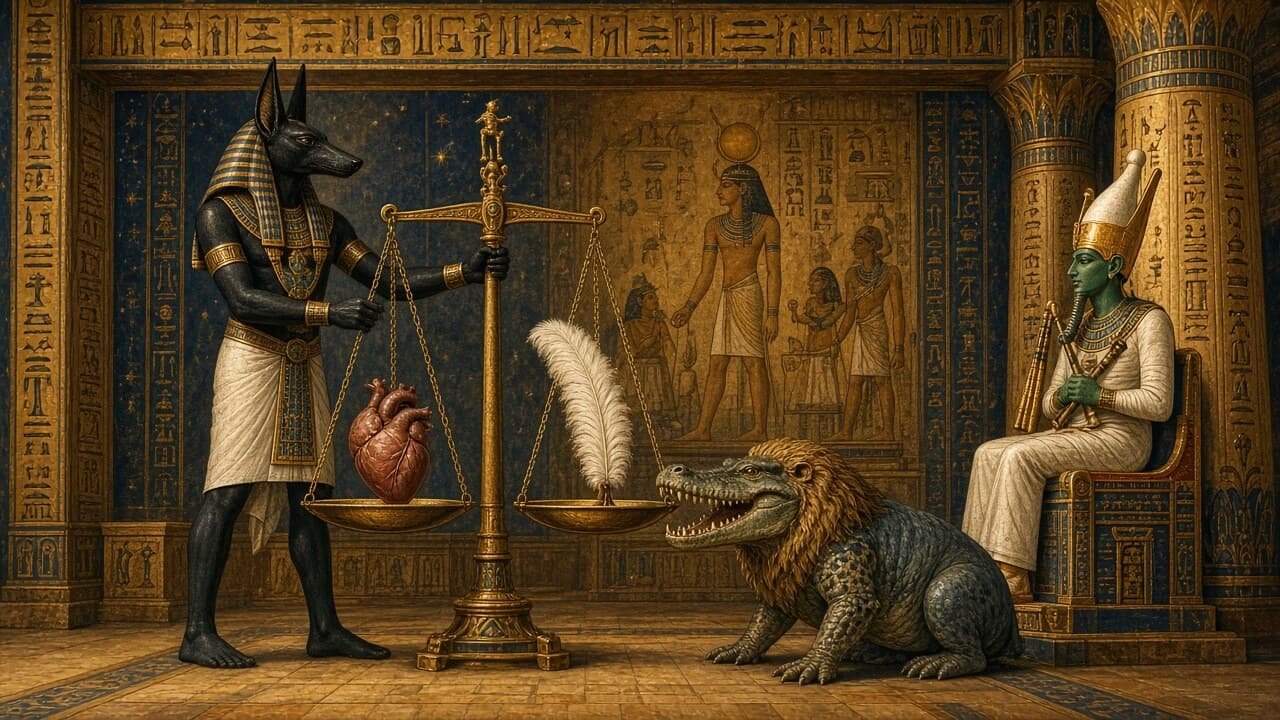
In many depictions, Anubis, the jackal-headed god associated with embalming and funerary rites, attends to the scales. Thoth, the god associated with writing and knowledge, may record the result. Osiris presides over the realm of the dead, while the fearsome creature Ammit waits to consume a heart that fails the test.
The feather is not simply a lightweight object. It symbolizes Ma’at, the order and truth by which the world and society were supposed to function. The judgment therefore connects the individual’s conduct with a larger moral and cosmic order.
The heart held special importance in Egyptian thought. It was associated with a person’s character, intentions, emotions, and understanding. In this religious framework, the heart could reveal what kind of person the deceased had been.
If the judgment was favorable, the deceased could continue toward a blessed afterlife. If the heart failed, Ammit could devour it, bringing the threat of a second death and the loss of the hoped-for eternal existence.
The image is often summarized as a test of whether the heart is heavier than the feather. That is a useful introduction, but the ancient scene is more than a literal measurement: it expresses the hope that the deceased’s life would remain in balance with Ma’at.
In popular retellings, the weighing of the heart is often described as a choice between paradise and a monster that devours the dead. The creature at the center of this fear is Ammit, whose name is commonly rendered as 'Devourer.'
Ammit is usually depicted as a composite creature combining features of dangerous animals, often a crocodile, a lion, and a hippopotamus. These animals were associated with formidable threats in the world known to the Egyptians, making the hybrid an especially powerful image.
Ammit was not simply a monster wandering through tombs. In the judgment scene, her role was tied to the failure of the deceased's heart to pass the test. She embodied the terrible consequence of being denied the afterlife the person hoped to attain.
This outcome is sometimes described as being erased forever. More precisely, the scene expresses the loss of the desired continued existence and the threat of a second death. Egyptian ideas about the afterlife were complex and varied, so reducing every belief to one universal formula can be misleading.
The scene is frightening because it makes moral failure a cosmic event. The deceased cannot rely only on wealth, status, or a preserved body; the judgment also concerns the person's relationship to truth and proper conduct.
For modern readers, Ammit can seem like a character from fantasy or horror. For ancient Egyptians, however, the image belonged to a religious system that connected the gods, moral order, funerary ritual, and hopes for eternity.
One of the most memorable ideas in the Book of the Dead tradition is the plea that the deceased's own heart should not speak against them during judgment. This theme is associated with Spell 30B and related heart-protection traditions.
The formula reflects the Egyptian belief that the heart could preserve or reveal essential truths about a person. In the judgment scene, the deceased's future depended partly on what the heart represented and whether it would weigh against them.
Heart scarabs were sometimes placed among a mummy's wrappings or near the chest. These amulets could be inscribed with protective texts intended to help the deceased in the judgment. Their shape drew on the scarab's powerful associations with renewal and regeneration.
This detail is often simplified in modern videos into a stone placed over Ani's chest with a warning to his heart. The more historically grounded account is that the Book of the Dead included spells designed to protect the heart from giving evidence against its owner, and heart scarabs were a related funerary practice.
The difference matters. A spell is a religious formula preserved in a text; a heart scarab is a physical amulet. They could be connected in purpose, but they are not the same object.
The idea also reveals something profound about ancient Egyptian morality. The heart was not merely a physical organ. Within this belief system, it represented a person's inner character and the record of their actions.
The image of a person asking their own heart not to betray them remains powerful today because it transforms judgment into an encounter with the self. The ultimate witness is not a stranger, but something the person carries within.
The Egyptian Book of the Dead contains many different kinds of texts. Some are prayers or hymns to gods; others are formulas for protection, declarations of innocence, or instructions for navigating the afterlife.
A spell could address a particular danger, help the deceased move through a guarded passage, protect an important part of their identity, or enable them to take on a form associated with a divine or natural power.
Spell 125 is particularly famous because it includes the judgment before Osiris and the weighing of the heart. In this context, the deceased also makes declarations denying wrongdoing before a group of divine judges.
Other spells address different concerns. Some relate to emerging into daylight, praising the sun god, preserving the ability to breathe or move, or gaining access to offerings and the blessed realm. Their purposes reflect the many challenges ancient Egyptians imagined the dead might face.
Illustrations were also important. The scenes helped communicate the ritual and religious meaning of the text, showing gods, protective beings, sacred objects, and the deceased in various stages of the journey.
It is tempting to read the manuscript as a single continuous story with one fixed beginning and ending. In reality, it is better understood as a collection whose contents could be arranged differently across manuscripts.
The spells were not simply written to frighten people. They were meant to provide assistance, protection, and ritual knowledge in a world where death was understood as a profound transition.
The phrase 'Book of the Dead' sounds ominous, and its references to death, divine judgment, supernatural beings, and protective spells make it easy to imagine a cursed manuscript. Modern documentaries and online stories sometimes intensify that atmosphere by describing it as one of the world's most dangerous books.
However, there is no reliable historical evidence that the Papyrus of Ani is cursed, that it is stored under extraordinary security because of supernatural danger, or that merely reading its spells causes harm.
Its historical purpose was funerary. The manuscript was created to accompany a deceased person and assist them according to ancient Egyptian religious beliefs. The spells were protective and supportive within that worldview, not proof of a secret system for harming the living.
The title itself can be misleading. The modern English name 'Book of the Dead' does not mean that the ancient Egyptians treated it as a forbidden volume. The texts formed part of a wider tradition of religious and funerary practices.
The difference between evidence and legend is important. Ancient Egyptian religion genuinely contains extraordinary imagery and complex ideas about the afterlife; it does not need invented curses to be fascinating.
The real mystery is how these texts were understood, produced, copied, illustrated, and used by people living thousands of years ago. Their survival gives us evidence of human beliefs and ritual practices that might otherwise have been lost.
Mummification was one of ancient Egypt's most distinctive funerary practices. It was connected to religious ideas about preserving the body and maintaining the conditions for continued existence after death.
In many elite mummification practices, the body was treated to remove moisture and slow decay. Natron, a naturally occurring salt mixture, played an important role in drying the body. The body was then prepared and wrapped, with amulets and other funerary materials sometimes placed among the wrappings.
The treatment of internal organs varied by period and individual practice. The liver, lungs, stomach, and intestines were often removed and preserved separately or placed in special containers. The brain was also commonly removed in many forms of elite mummification, although methods and practices were not identical across Egyptian history.
The heart had a special religious significance because it was associated with a person’s identity and moral character. It was often left in place, or a heart scarab could be used as part of the funerary preparations. However, it is inaccurate to claim that the heart was never removed from any Egyptian mummy.
These distinctions are important because ancient Egyptian burial practices changed over thousands of years. Social status, local customs, historical period, and the resources available to a family could influence how a body was prepared.
Mummification was not simply a technical method for preserving a corpse. It was one part of a larger process that included rituals, prayers, burial goods, and beliefs about the continued relationship between the deceased and the divine world.
The Papyrus of Ani preserves the name of a real person from ancient Egypt's Nineteenth Dynasty. The British Museum identifies Ani as a royal scribe and granary overseer, and dates the manuscript to around 1250 BCE.
The papyrus is valuable partly because it shows that funerary manuscripts were made through skilled work. Texts had to be written, and illustrations had to be planned and painted. Depending on the manuscript and production process, more than one specialist may have contributed.
Funerary papyri could be prepared with a particular owner in mind, and some manuscripts included spaces where a name could be added. This makes it plausible that some materials were prepared in advance or adapted to an individual buyer. It does not establish that every Book of the Dead was a hastily purchased, ready-made scroll.
The surviving papyrus is not a complete biography of Ani. It is a funerary manuscript designed for a religious purpose, so it tells us more directly about beliefs, ritual texts, and the desired afterlife than about the details of Ani's daily life or death.
Its illustrations nevertheless offer clues about the world in which Ani lived. They show the gods and religious scenes considered important for his journey beyond death, along with the hope that he would pass judgment and enter a blessed realm.
The papyrus is now preserved in the British Museum's collection. Its significance comes not from evidence of a curse, but from its extraordinary value as a surviving example of ancient Egyptian religious literature and art.
In many Egyptian funerary texts and illustrations, a successful afterlife was not imagined as an entirely unfamiliar universe. It could resemble an idealized version of earthly life, with fertile fields, abundant food, waterways, and the ability to move freely.
The Field of Reeds was one important image of this blessed destination. In scenes associated with the Book of the Dead, the deceased could appear in an ordered landscape, working fields, tending crops, or traveling by boat.
This vision connected the afterlife with the natural environment of Egypt. The Nile, agricultural cycles, fertile land, and the return of the sun were central to life in the region and influenced its religious imagination.
The afterlife was also linked to divine relationships, particularly with Osiris and the solar god Re. Different texts and periods expressed these relationships in different ways, showing that Egyptian religious ideas developed rather than remaining completely fixed.
The Book of the Dead's promise was therefore not simply escape from death. It was the possibility of renewal, protection, continued identity, and participation in a world governed by divine order.
These images reveal a human hope that remains familiar: that life, relationships, and meaningful existence might continue beyond the limits of mortality.
The Book of the Dead is valuable because it preserves more than a collection of ancient rituals. It shows people trying to make sense of uncertainty and to imagine what might happen when life ends.
Its judgment scene expresses the idea that actions matter beyond immediate consequences. Truth, justice, and balance were not only social ideals but part of the order that the deceased hoped to encounter after death.
Its protective spells reveal a desire to prepare for the unknown. Just as people today turn to religious traditions, philosophy, or personal reflection when facing uncertainty, ancient Egyptians used the knowledge and rituals available within their worldview.
The manuscript also reminds us that civilizations should not be reduced to their most spectacular monuments. The pyramids show extraordinary engineering and political organization, but funerary texts reveal something more personal: what people feared, valued, hoped for, and believed about their own future.
The image of the heart weighed against the feather remains especially compelling because it turns an abstract moral question into a scene that anyone can understand. What if your life could be measured not by wealth or power, but by whether you had lived in harmony with truth and justice?
We cannot use an ancient religious text to prove what happens after death. We can, however, study it to understand how a sophisticated civilization imagined that question and built rituals around its answer.
That is the lasting importance of the Egyptian Book of the Dead. It connects modern readers to the hopes and uncertainties of people who lived thousands of years ago.
The Egyptian Book of the Dead is not a single cursed volume hidden away from the world. It is a remarkable collection of funerary writings that helped ancient Egyptians prepare for the journey they believed followed death.
Through the Papyrus of Ani, we can explore a world filled with divine judges, protective spells, the weighing of the heart, and the hope of reaching the Field of Reeds. The manuscript reveals how closely ancient Egyptian beliefs about death were connected to identity, morality, ritual, and renewal.
The most unforgettable scene is the balance between the heart and the feather of Ma'at. In this ancient vision, a person's future depended on more than physical preservation or worldly status. The heart represented the person who had lived, and the judgment expressed the importance of truth and order.
There is no reliable evidence that the Book of the Dead is cursed or supernaturally dangerous. Its true power lies in what it allows us to understand about one of history’s most fascinating civilizations.
More than 3,000 years later, one question still resonates: if your life were placed on a scale against truth and justice, what would your heart reveal?
Explore more ancient mysteries in Mohenjo-daro, Dwarka underwater archaeology, and our Mysteries archive.