Imagine walking through a city built roughly 5,000 years ago and discovering streets laid out with geometric precision, standardized bricks, private wells, sophisticated drainage and monumental public architecture. You are not looking at a modern city. You are standing in Mohenjo-daro.
In the plains of Sindh, Pakistan, the ruins of Mohenjo-daro rise from the landscape as the remains of a civilization that flourished thousands of years before many of the world's most famous classical cities.
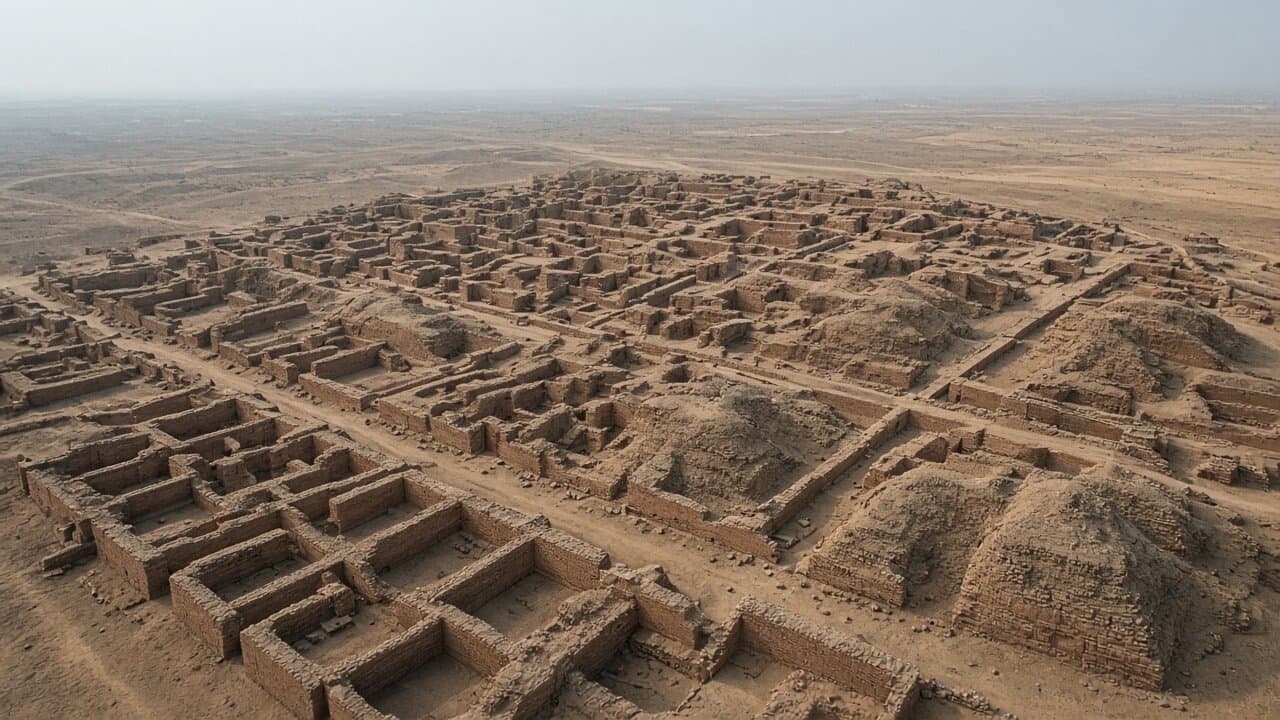
The city belonged to the Indus Civilization, one of the great urban traditions of the ancient world. Archaeological evidence shows an unusually organized settlement with carefully planned streets, wells, sanitation infrastructure, public buildings and extensive use of standardized baked bricks.
Yet the most fascinating part of Mohenjo-daro may not be what archaeologists have uncovered. UNESCO notes that only about one-third of the archaeological site has been excavated. Much of the ancient city remains underground.
And there is an extraordinary irony: water helped make this city possible, but water is now one of the greatest threats to what remains.
Today, Mohenjo-daro is an archaeological site in Sindh, Pakistan. But thousands of years ago, it was a major urban center of the Indus Civilization. UNESCO describes the ruins as one of the best-preserved urban settlements in South Asia from the beginning of the 3rd millennium BCE.
The modern name Mohenjo-daro is commonly translated from Sindhi as 'Mound of the Dead.' The name itself is not the ancient city's original name. In fact, we still do not know what the people who lived there called their city.
The mature urban phase associated with Mohenjo-daro dates to the third millennium BCE. Archaeological narratives place the major occupation broadly between about 2600 and 1900 BCE, while UNESCO describes the wider Indus Civilization represented by the site as flourishing across the 3rd millennium BCE.
This was an astonishingly early period for large-scale urban organization. Ancient Egypt and Mesopotamia were also developing major urban and state systems, yet the Indus cities followed their own distinctive pattern.
Mohenjo-daro Through Time
3rd millennium BCE
Urban Mohenjo-daro
The city develops as a major settlement within the Indus Civilization.
c. 2600–1900 BCE
Mature Urban Phase
Mohenjo-daro becomes an important, prosperous and highly organized city during this period.
1922
Archaeological Discovery
The site was identified during archaeological work associated with a later Buddhist stupa, helping reveal the existence of the ancient Indus city.
1920s–1960s
Major Excavations
Successive archaeological campaigns exposed streets, houses, wells, public structures, artifacts and other evidence of urban life.
1965
Last Major Excavation
George Dales's 1965 work is often identified as the last major excavation at the site.
1970s onward
Conservation Era
UNESCO-supported safeguarding efforts focused heavily on groundwater, flooding, salinity and structural preservation.
2022
Severe Flood Damage
UNESCO reports that exceptional rainfall and flooding caused significant damage to parts of the archaeological site.
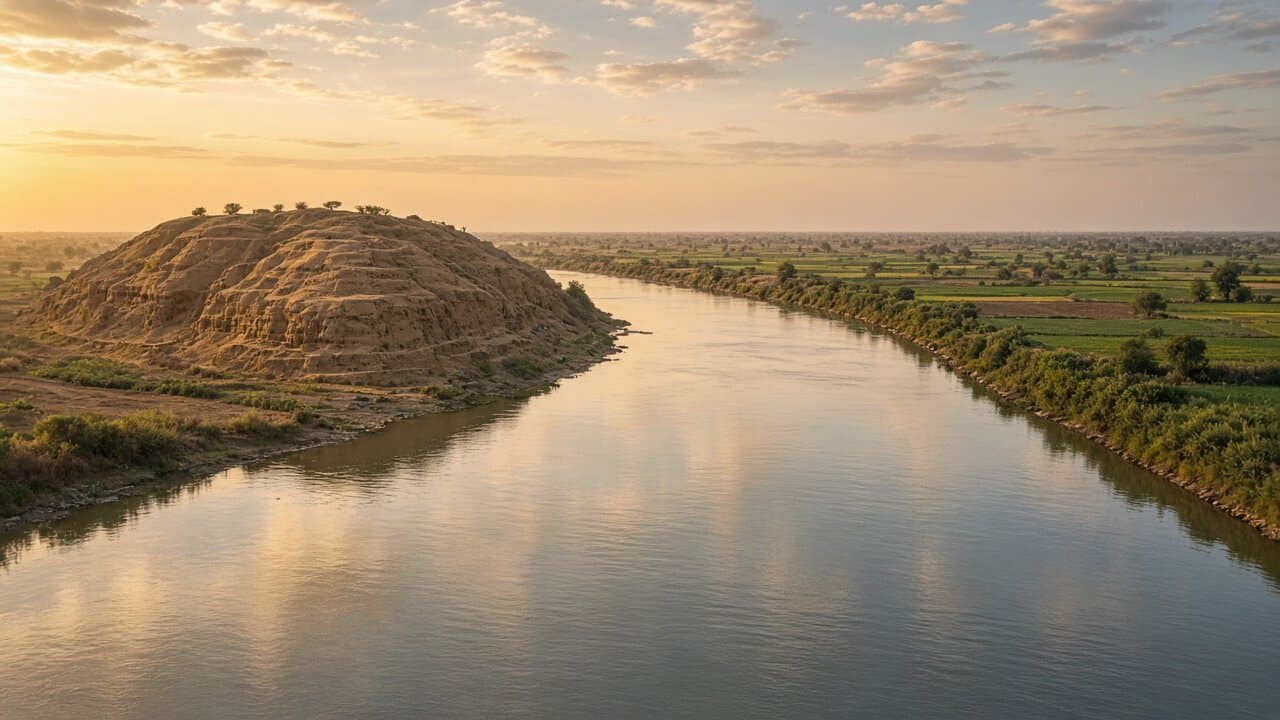
Geography was central to Mohenjo-daro's success. The city developed within the Indus River system, surrounded by an environment capable of supporting agriculture and movement of goods.
The river was more than a source of water. It was part of a transportation network. Agricultural products, raw materials and manufactured goods could move through regional routes and waterways toward the Arabian Sea, connecting the Indus world with broader trading networks.
Archaeological evidence also points to contacts between the Indus Civilization and regions farther west, including Mesopotamia. Seals and other objects are among the clues that archaeologists use to reconstruct these ancient connections.
Walk through the surviving ruins and one feature repeatedly appears: order.
Streets intersect at approximately right angles. Residential blocks follow organized layouts. Drainage channels run alongside streets. Wells are integrated into neighborhoods. Bricks show striking standardization.
This was not simply a collection of houses that grew randomly over generations. UNESCO identifies the city's layout as evidence of an early system of town planning.
- Straight and intersecting streets
- Organized residential blocks
- Brick-lined wells
- Covered and open drainage structures
- Public and monumental buildings
- Standardized brick construction
- Separate elevated and lower urban areas
- Infrastructure designed around water management
One of Mohenjo-daro's most remarkable features is its approach to water and waste.
Archaeologists found extensive drainage structures running through the city. Many houses were connected to systems for removing wastewater, while wells provided access to water within the settlement.
The important point is not that Mohenjo-daro had a modern sewer system—it did not. Rather, the archaeological remains show that sanitation and water management were deliberately incorporated into the urban design.
Streets crossed at right angles and a network of narrow streets spread across the residential district.
At the elevated citadel area stands one of the most recognizable structures of the site: the Great Bath.
The large rectangular tank was carefully constructed and waterproofed, with steps leading into it. Surrounding rooms and architectural features suggest that this was a significant public structure.
But exactly what happened here is less certain. The Great Bath is often associated with ritual or ceremonial activity, but archaeologists cannot simply reconstruct an entire belief system from one structure.
Mohenjo-daro is generally understood through two major urban components: the elevated citadel area and the extensive lower city.
The elevated area contains some of the city's most monumental remains, including the Great Bath. The lower city contains residential, commercial and other structures arranged along an organized street network.
There is also a striking reminder that the ruins contain more than one historical period. A Buddhist stupa from a much later era stands above the ancient Indus remains, creating a physical overlap between different chapters of South Asian history.
This is where archaeology becomes both fascinating and frustrating.
The ruins reveal houses, workshops, wells, pottery, ornaments, figurines, tools and other objects. Together, these materials suggest a city filled with farmers, craftspeople, traders and specialists.
Some houses had multiple rooms and staircases. Some contained private wells. Industrial areas contain features that archaeologists have interpreted as possible working spaces for activities such as textile dyeing or leather processing, although the exact function of individual installations can remain uncertain.
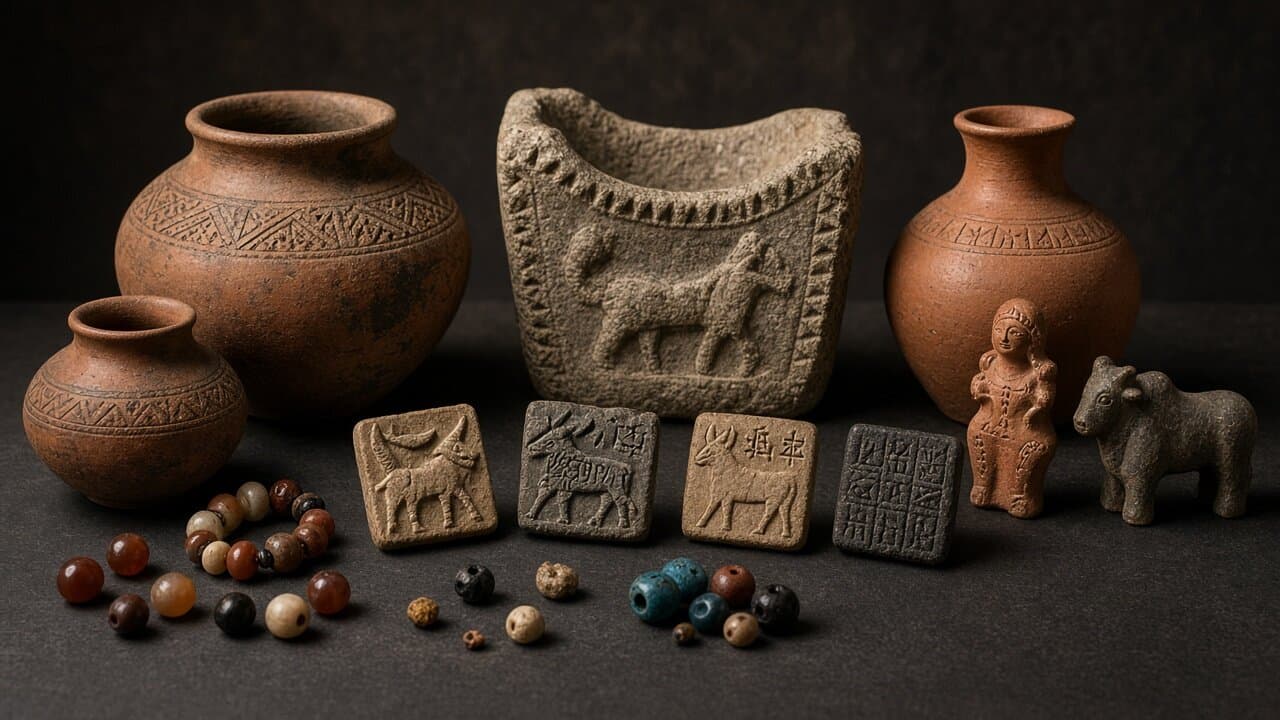
The artifacts also give us glimpses of creativity: beads, pottery, animal figurines, human figures, ornaments, toys and seals. These objects show that Mohenjo-daro was not simply an engineering project. It was a lived-in city.
This is one of the biggest unanswered questions.
We can see evidence of large-scale organization, standardized construction and coordinated infrastructure. But that does not tell us exactly how political authority worked.
Was Mohenjo-daro ruled by a king? A council? Religious authorities? A merchant elite? Some other form of administration? Archaeology has not produced a universally accepted answer.
Even apparently obvious labels such as 'priest-king' are modern interpretations of individual artifacts rather than confirmed titles from the city's own written records.
The city did not exist in isolation.
The Indus Civilization consisted of numerous settlements spread across a huge region. Mohenjo-daro appears to have been one important node within this interconnected world.
Goods and raw materials moved between settlements. River routes and overland transportation helped connect communities, while maritime routes linked the wider Indus region with the Arabian Sea and beyond.
UNESCO notes that seals found at Mohenjo-daro are believed to have played a role in identifying or marking goods associated with trade, including connections with distant Mesopotamia.
| Connection | Possible Role | Evidence Type |
|---|---|---|
| Indus River system | Movement of people and goods | Geography and archaeological context |
| Regional settlements | Exchange of raw materials and manufactured goods | Artifacts and settlement patterns |
| Arabian Sea routes | Long-distance maritime trade | Archaeological and historical reconstruction |
| Mesopotamia | Long-distance commercial connections | Seals, artifacts and comparative archaeology |
Some discoveries from Mohenjo-daro have become icons of the Indus Civilization.
Among them is the small bronze figure popularly known as the 'Dancing Girl,' along with the famous bearded stone sculpture traditionally called the 'Priest-King.' These names are convenient modern labels, not necessarily descriptions the ancient inhabitants themselves would have recognized.
The artifacts are important because they reveal the technical skill and artistic traditions of the people who created them. But they also demonstrate a larger archaeological truth: an object can survive while its original meaning disappears.
Mohenjo-daro's relationship with water may be the most dramatic thread running through its entire story.
The Indus system provided fertile environments and transportation opportunities, but rivers can also shift course, flood settlements and transform landscapes.
Multiple occupation layers at Mohenjo-daro have been interpreted as evidence consistent with episodes of flooding and displacement. This is an important interpretation, but the exact causes of the city's long-term transformation remain a subject of archaeological research.
What we can say with greater confidence is that water was an enduring environmental force in the region.
There is no single universally accepted explanation that closes the case.
Older narratives sometimes presented dramatic explanations such as invasion or sudden destruction. Modern archaeological interpretations are more cautious. Changes in river systems, flooding, environmental stress, economic transformation and broader changes across the Indus Civilization have all been considered in discussions of urban decline.
The evidence does not require a single catastrophic event to explain everything. Civilizations can transform gradually. Cities can lose importance even when their inhabitants do not disappear overnight.
UNESCO reports that the archaeological property covers roughly 240 hectares, while only about one-third has been excavated.
That means the ruins visible to visitors are only part of the story.
Archaeological investigations have encountered deeper occupation levels beneath the known remains. If further investigation becomes possible, buried layers could provide additional information about how the settlement developed before its mature urban form.
But there is a problem: excavation itself can expose fragile archaeological material to environmental damage.
The answer is surprisingly modern: preservation.
Groundwater, salinity, flooding and weathering all threaten the surviving brick architecture. Excavating more of the site would not automatically mean preserving it. Once buried structures are exposed, they can become vulnerable to conditions that were previously buffered by the soil.
UNESCO has documented the continuing threat from saline action associated with groundwater and has described decades of conservation work intended to control water and protect the remains.
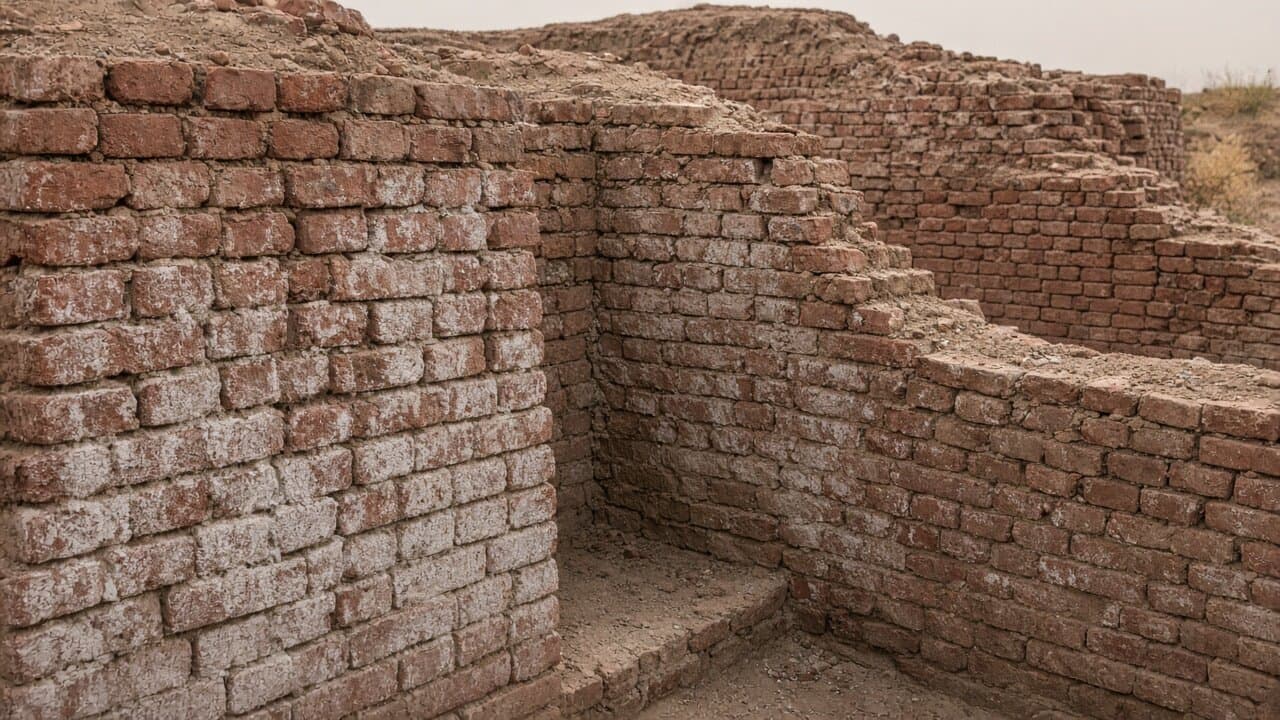
The ancient city has survived for thousands of years, but survival is not guaranteed.
UNESCO reports that the site has faced severe salinity problems, groundwater-related deterioration and flooding. In 2022, exceptional rainfall caused serious damage, and UNESCO and ICOMOS later assessed restoration and conservation needs.
This creates a remarkable historical loop. Water once helped support agriculture, transportation and urban life around Mohenjo-daro. Today, water—along with salt and extreme weather—is one of the major forces threatening the physical remains of that civilization.
240 ha
Approximate World Heritage property area
UNESCO
≈ 1/3
Of the site excavated
UNESCO
1922
Year identified archaeologically
UNESCO
Before systematic archaeological investigation, the mounds did not preserve a clear local memory of the ancient metropolis that once occupied them.
The discovery in the 1920s transformed the understanding of South Asian prehistory. Excavations revealed that the mounds were not simply ruins of an unknown settlement but part of a much larger urban civilization.
Later archaeological teams continued to document the city and its artifacts. Accounts from researchers such as Parveen Talpur, who participated in cataloging material recovered from later excavations, provide a rare human perspective on what it meant to handle artifacts thousands of years old.
5000 years old artifacts from Mohenjo-daro are passing from my hands.
That image captures something archaeology can sometimes make difficult to appreciate. These are not merely dates, maps and pottery classifications. Every artifact once belonged to somebody's world.
Mohenjo-daro challenges the simplistic idea that ancient cities were primitive versions of modern settlements.
Its builders coordinated architecture, water access, streets, drainage, manufacturing and public spaces on a scale that required substantial organization.
At the same time, the city reminds us how much can disappear. We do not know the ancient name of Mohenjo-daro. We cannot confidently reconstruct its political system. We cannot read its script with certainty. We cannot hear the voices of its inhabitants describing their own lives.
Archaeology therefore gives us something unusual: a detailed picture of a civilization without a complete written explanation of itself.
| What We Can See | What It Suggests | What Remains Uncertain |
|---|---|---|
| Planned streets | Coordinated urban design | Exactly how planning decisions were made |
| Drainage and wells | Advanced water management | The precise rules governing sanitation |
| Standardized bricks | Shared construction conventions | Who enforced the standards |
| Seals and trade objects | Long-distance exchange | The complete structure of the trading system |
| Public monumental structures | Organized communal activity | Their exact social and religious functions |
| Indus inscriptions | A system of writing or symbols | Their language and full meaning |
Mohenjo-daro FAQ
Where is Mohenjo-daro located?
How old is Mohenjo-daro?
What is Mohenjo-daro famous for?
What was the Great Bath used for?
Why did Mohenjo-daro disappear?
Has all of Mohenjo-daro been excavated?
Can we read the writing of the Indus Civilization?
Is Mohenjo-daro still threatened today?
It is tempting to describe Mohenjo-daro as an impossible ancient city or to turn its engineering achievements into evidence of some lost technology. The archaeology does not require either explanation.
The more interesting story is already extraordinary: thousands of years ago, human communities built a large, organized urban world with sophisticated construction, water management, craftsmanship and long-distance exchange.
They did it without modern machines, computers or written engineering manuals that we can read today.
And then history became silent.
Mohenjo-daro has been buried, excavated, studied, damaged and preserved for nearly a century of modern archaeology. Yet the city still refuses to give up all of its secrets.
We can walk along its ancient streets. We can see the wells and drainage channels. We can stand beside the Great Bath and examine objects made by people who lived thousands of years ago. But we still cannot hear those people explain who they were.
Perhaps that is what makes Mohenjo-daro so compelling. It does not need aliens, lost supertechnology or a sensational mystery to be extraordinary. Its real story is human.
A civilization learned how to organize a city, move goods across enormous distances, manage water, build with remarkable consistency and create objects that survived thousands of years. Then the river systems changed, the urban world transformed, and the city faded from living memory.
And beneath the ground, much of that story may still be waiting.
The bigger question is not simply what happened to Mohenjo-daro. It is this: how many other chapters of human history are still buried beneath our feet, waiting for us to learn how to read them?
What archaeology makes clear — and what it cannot
What works
- Exceptional evidence of early urban planning
- Sophisticated water and drainage infrastructure
- Extensive archaeological record of crafts and daily life
- Evidence of participation in long-distance exchange networks
- Large portions of the site remain available for future research
What doesn't
- The original name of the city is unknown
- The Indus script remains undeciphered
- The political structure of the civilization is uncertain
- Many archaeological structures have uncertain functions
- Groundwater, salinity, flooding and extreme weather threaten preservation