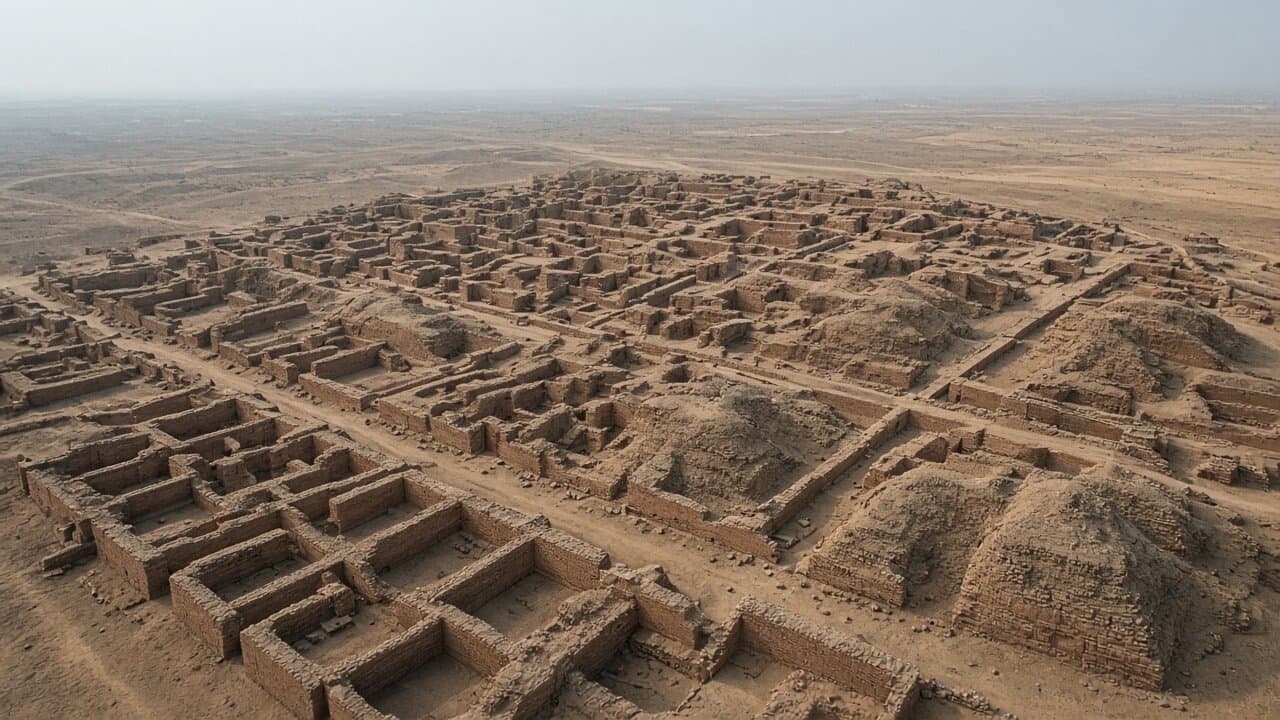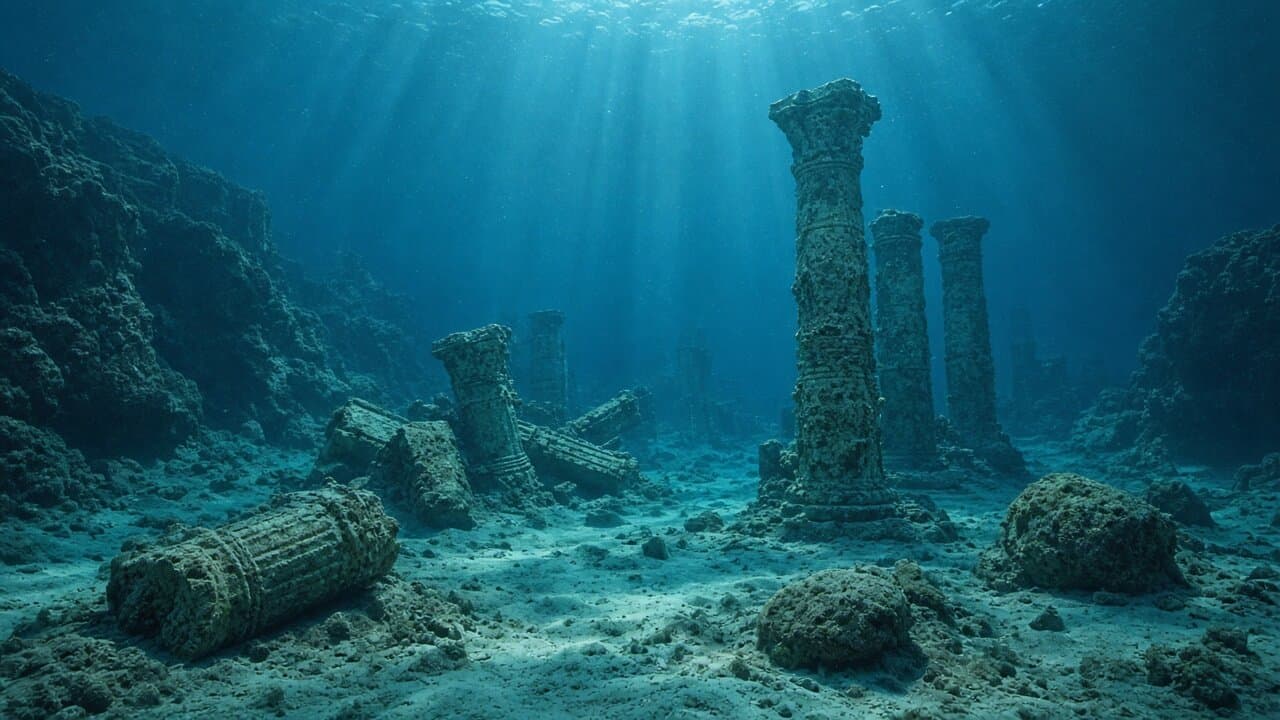
What if one of India's most famous sacred cities is also hiding an archaeological story beneath the sea?
Along the western coast of Gujarat, where the land meets the Arabian Sea, lies a city surrounded by one of India's most enduring legends: Dwarka, the legendary city associated with Lord Krishna.
According to Hindu traditions, Krishna established Dwarka after leaving Mathura. The city was described as magnificent, carefully planned and eventually swallowed by the sea. For centuries, that story existed primarily in sacred literature. Then archaeologists began searching beneath the waters.
What they found was real archaeological material: submerged structural remains, stone blocks, sculptures, anchors and evidence of ancient coastal activity. But there is an important distinction. Finding an ancient settlement underwater does not automatically prove that every detail of the scriptural story happened exactly as described.
And that distinction is what makes Dwarka even more fascinating.
Imagine descending beneath the Arabian Sea and discovering stone structures where you expected nothing but sand, rock and marine life. That is the image that has made underwater Dwarka one of India's most famous archaeological mysteries.
The modern city of Dwarka stands on the western coast of Gujarat and remains an important pilgrimage destination associated with Krishna. Nearby Bet Dwarka, an island off the coast, has also produced archaeological remains and has played an important role in investigations of the region's ancient maritime history.
In Hindu tradition, Krishna's story begins in Mathura. After repeated conflicts involving Jarasandha, Krishna is said to have moved his people westward and established a new city near the sea.
The Bhagavata Purana describes a city of extraordinary scale and grandeur. Traditional accounts associate its construction with Vishvakarma and describe impressive gates, buildings, gardens, reservoirs and organized urban spaces.
The story becomes even more dramatic after the Mahabharata. Following the destruction of the Yadava dynasty and Krishna's departure from the world, Dwarka is described as being reclaimed by the sea.
The tradition of a city associated with Krishna being submerged by the sea is deeply embedded in Hindu literature.
The modern archaeological search for submerged Dwarka did not begin with a single spectacular discovery. Investigations developed over decades, involving onshore excavation, marine surveys and underwater archaeology.
The Archaeological Search for Dwarka
1930s
Early searches
Archaeological interest in the remains around Dwarka and Bet Dwarka begins to develop.
1963
Early excavation at Bet Dwarka
Archaeological excavation at Bet Dwarka produced ancient artefacts and helped establish the area's archaeological importance.
1983–1990
Major underwater investigations
Underwater archaeologist S. R. Rao and his team conducted extensive marine archaeological investigations around Dwarka.
2005–2007
Further offshore and onshore work
The Archaeological Survey of India's underwater archaeology programme continued investigations in the region.
2025
New investigations resume
ASI renewed underwater exploration around Dwarka and Bet Dwarka using systematic archaeological and modern survey techniques.
2026
Research continues
Government information indicates that underwater cultural-heritage research and exploration at Dwarka and Bet Dwarka remain active.
This is where the story becomes much more interesting than the simple claim that a complete ancient city was discovered beneath the ocean.
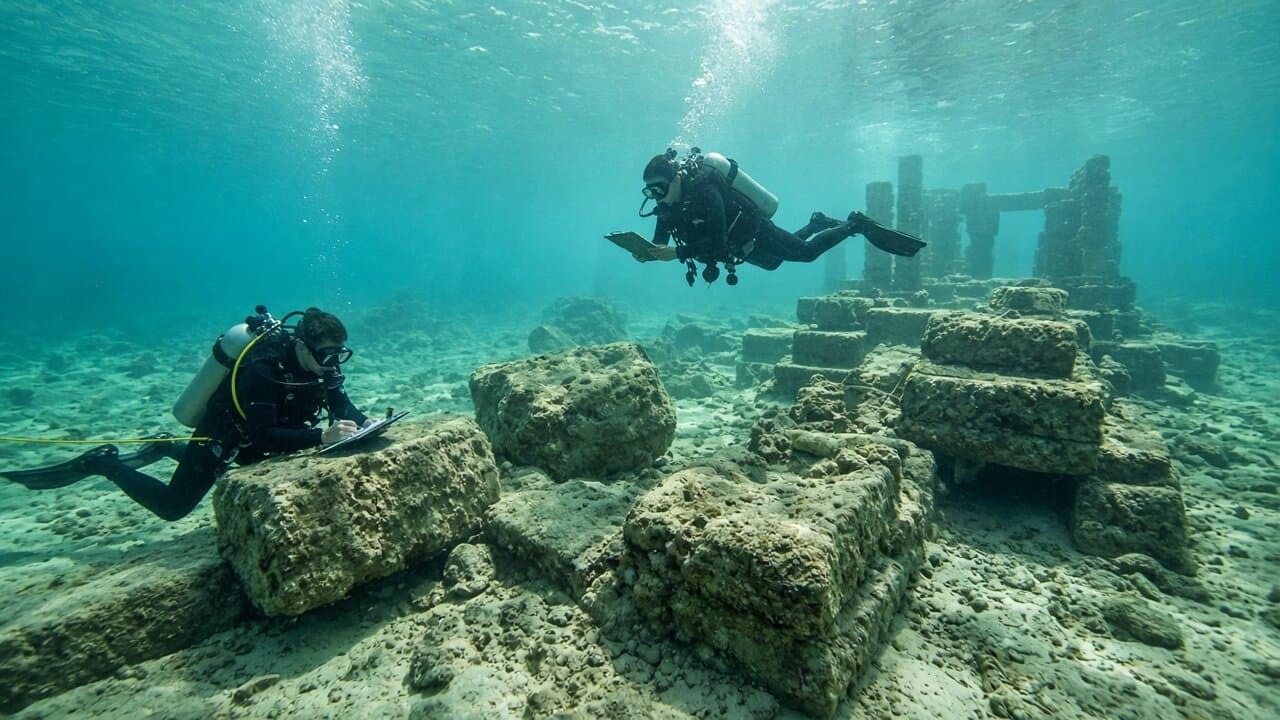
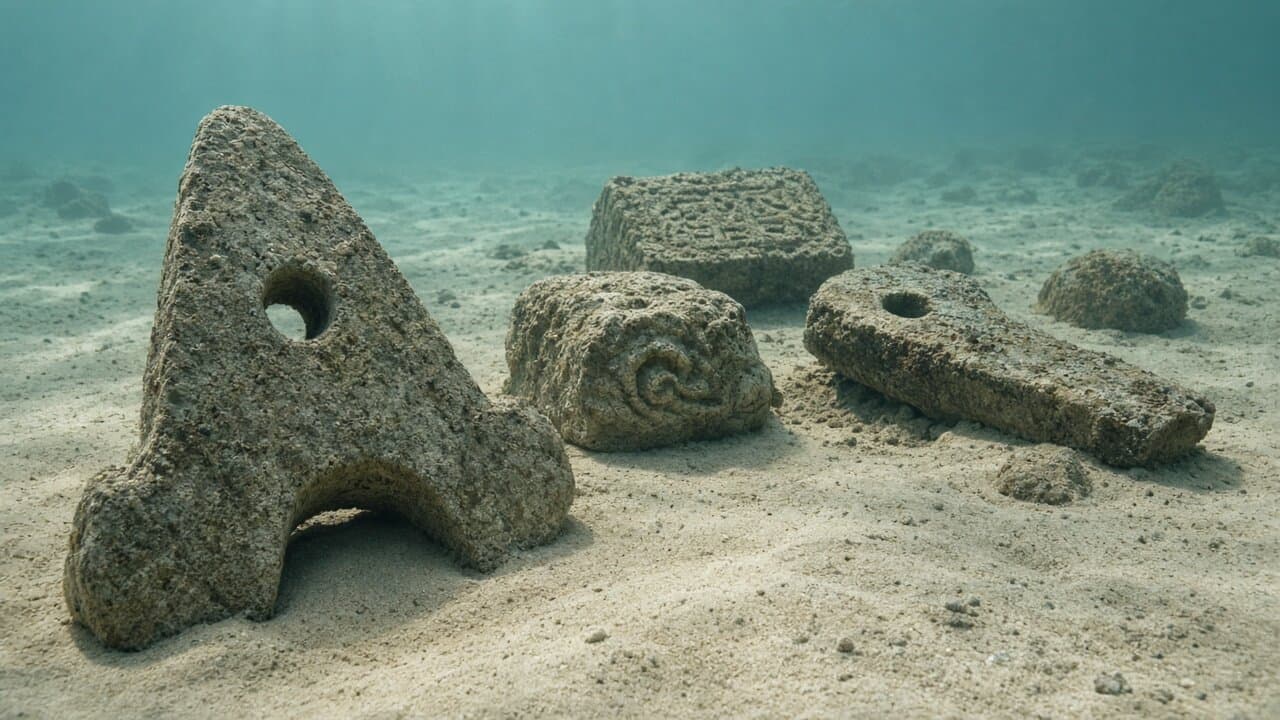
Investigations around Dwarka have reported submerged structural remains, stone blocks, architectural elements and stone anchors. These discoveries demonstrate that the coastal region was connected to substantial human activity and maritime use in the past.
- Submerged structural remains
- Large stone blocks and architectural fragments
- Stone anchors
- Sculptural and archaeological artefacts
- Evidence associated with ancient maritime activity
- Coastal archaeological deposits requiring further scientific analysis
The stone anchors are particularly interesting because they point toward maritime activity. Their presence supports the idea that the Dwarka region functioned as an important coastal and trading environment.
Popular accounts highlight a striking comparison between the traditional description of Dwarka occupying 12 yojanas of land and claims that the archaeological area corresponds to a similar measurement.
It sounds like a perfect archaeological match. But measurements in ancient texts are difficult to convert into modern units with certainty, and matching approximate dimensions does not establish identity by itself.
One claim commonly repeated in popular discussions of Dwarka is that the stones themselves were carbon-dated to establish their age. That explanation is scientifically misleading.
Radiocarbon dating is primarily used to determine the age of once-living organic material, such as charcoal, wood, bone and other carbon-bearing remains. A stone structure itself cannot simply be carbon-dated in the same way.
Archaeologists instead use combinations of dating techniques, stratigraphy, associated artefacts, sediment analysis and geological evidence to establish the chronology of an archaeological site.
This is one of the strongest and most interesting parts of the archaeological story.
Large numbers of stone anchors have been recovered from the Dwarka region. Anchors are not merely decorative objects: they are direct clues about ships, navigation and maritime activity.
The evidence therefore supports the idea that the broader Dwarka region had an important maritime role. UNESCO's Silk Roads programme also notes the significance of the area's submerged archaeological remains and stone anchors, while emphasizing that the dating and interpretation of the remains remain subjects of debate.
Hundreds
Stone anchors and related finds documented around Dwarka
Marine archaeological investigations
This question may be even more important than the legend itself.
Coastal landscapes are constantly changing. Sea-level fluctuations, coastal erosion, sediment movement, tectonic processes and shoreline changes can transform settlements over long periods of time.
A city does not necessarily need to disappear during one dramatic event. Different parts of a coastal settlement can be abandoned, eroded, inundated or buried at different times.
How a Coastal Settlement Can Disappear
Coastal occupation
People establish settlements close to the sea because the coast provides transportation, fishing and trading opportunities.
Environmental change
Sea level, sediment movement, shoreline position or other environmental factors gradually alter the coastline.
Settlement decline
Parts of the settlement may be abandoned, damaged or relocated.
Marine inundation
Rising water or changing coastal conditions can place archaeological structures beneath the sea.
Burial and preservation
Sediments can cover structures and artefacts, sometimes preserving them for centuries or millennia.
There is a temptation to connect every underwater stone directly to Krishna's legendary city. Archaeology requires more caution.
The submerged remains prove that people occupied and used this coastal region in the past. They also demonstrate significant maritime activity. But archaeology must still determine exactly when individual structures were built, how they were used, whether different occupation phases belong to the same settlement and how they relate to the literary descriptions of Dwarka.
| Question | Traditional Account | What Archaeology Can Establish |
|---|---|---|
| Dwarka existed | Described extensively in Hindu literature | Archaeological remains demonstrate ancient settlement activity in the region |
| Dwarka was coastal | Described as a city built beside or within the sea | Submerged remains and maritime archaeology confirm ancient coastal activity |
| Associated with Krishna | Central to Hindu religious tradition | Archaeology has not independently established Krishna's historical identity or direct ownership of the ruins |
| The city was submerged | Scriptures describe Dwarka being reclaimed by the sea | Submerged archaeological remains demonstrate that parts of the ancient coastal landscape are now underwater |
| Exact Mahabharata date | Different traditional and scholarly chronologies exist | Archaeological dating does not currently provide a universally accepted date linking the ruins directly to the Mahabharata |
Perhaps the most important fact about Dwarka today is that scientists and archaeologists are still investigating it.
The Archaeological Survey of India's Underwater Archaeology Wing resumed scientific investigations around Dwarka and Bet Dwarka in 2025. The stated objectives include locating, documenting and studying submerged archaeological remains and determining the antiquity of recovered objects through scientific analysis of sediments, archaeological deposits and marine deposits.
The work also uses modern tools for underwater searching, documentation and remote sensing where appropriate. Government information published in 2026 confirms that research and exploration at Dwarka and Bet Dwarka remain active.
Underwater archaeology is dramatically different from archaeology on land. Visibility can be poor, currents can disturb deposits, structures can be fragmented and the sea can continually modify the archaeological environment.
Modern archaeology can combine divers with remote sensing, underwater photography, mapping, sediment analysis and other geophysical techniques. Instead of simply looking for a spectacular palace, researchers can reconstruct an entire ancient landscape.
- High-resolution underwater mapping
- Remote sensing and geophysical surveys
- Sediment analysis
- Scientific dating of associated materials
- 3D documentation of submerged structures
- Analysis of artefacts and architectural remains
- Geological reconstruction of ancient shorelines
This is where the evidence currently needs to be separated from belief.
If the question is whether there are genuine ancient archaeological remains beneath and around the waters of Dwarka, the answer is yes. If the question is whether the region was an important maritime settlement, the archaeological evidence strongly supports substantial coastal activity.
But if the question is whether archaeology has conclusively proven that the submerged structures are the exact magnificent city ruled by Krishna in the Mahabharata, the evidence does not currently allow such a definitive conclusion.
That does not make the story less fascinating. In fact, it makes it more interesting—because the investigation is still open.
Even without settling the question of Krishna's historical identity, Dwarka has enormous archaeological importance.
The site gives researchers an opportunity to study how ancient Indian communities interacted with the sea, how ports functioned, how coastal settlements changed and how rising or shifting waters can hide pieces of human history.
It also challenges a common misconception: archaeology is not simply about digging ancient buildings out of the ground. Sometimes history is sitting beneath the ocean.
Dwarka FAQ
Is the lost city of Dwarka real?
Is Dwarka really underwater?
Did archaeologists find Krishna's palace underwater?
Was Dwarka mentioned in the Mahabharata?
Was Dwarka destroyed by a tsunami?
Is archaeological research at Dwarka still happening?
There is something more profound hidden beneath the Dwarka mystery.
Civilizations disappear. Coastlines move. Cities are abandoned. Rivers change course. Sea levels rise and fall. And eventually, places that were once at the centre of human life can become invisible to the people who come after them.
For thousands of years, stories can preserve memories that landscapes no longer reveal. Archaeology then comes along and asks a different question: what physical evidence survived?
Dwarka sits precisely at that intersection.
Faith tells us about a magnificent city connected with Krishna. Archaeology tells us that ancient people really did live, build and trade along this coast—and that parts of that ancient landscape now lie beneath the sea. The difficult question is determining exactly how those two histories connect.
Maybe the final chapter of Dwarka's story has not been discovered yet.
The story of Dwarka is powerful because it refuses to fit neatly into a single category. It is simultaneously a sacred tradition, an archaeological site, a maritime mystery and a reminder of how dramatically landscapes can change.
We should not claim that archaeology has already proved the entire story of Krishna's Dwarka. But we also should not ignore the remarkable archaeological reality beneath the sea. Ancient structures and maritime artefacts show that this coastline has a much deeper human history than the modern shoreline suggests.
The real discovery may therefore not be a golden palace waiting beneath the waves. It may be something more valuable: a lost chapter of India's relationship with the sea.
And the next time an archaeologist descends into those waters, the question will remain—how much of the ancient city is still waiting to be found?
And perhaps that is the most fascinating part: somewhere beneath the Arabian Sea, there may still be pieces of a forgotten coastline waiting for technology—and future archaeologists—to tell us what happened.
What the evidence clarifies — and where caution is needed
What works
- Provides real archaeological evidence of ancient coastal activity around Dwarka
- Shows the importance of underwater archaeology for reconstructing lost landscapes
- Connects archaeology, geology, maritime history and ancient literature
- Keeps the distinction between cultural tradition and scientific proof clear
What doesn't
- The exact identification of the submerged remains remains debated
- The archaeological record does not independently prove every detail of the scriptural account
- Dating submerged structures can be difficult because different occupation phases may exist
- Popular retellings sometimes exaggerate what individual discoveries demonstrate