Imagine building a civilization that can travel between stars, construct enormous spacecraft, and survive for millions of years—only to discover that most of the universe is still beyond its reach.
Humanity has always treated the horizon as an invitation. Our ancestors crossed oceans, explored continents, and eventually launched machines beyond Earth. Every generation has imagined that the next great discovery would open an even larger frontier.
But the universe presents a problem unlike any mountain, ocean, or planetary boundary. Space itself is expanding, and that expansion is accelerating. Across enormous distances, some galaxies are becoming permanently inaccessible to anything we could send from our region of the cosmos.
This does not mean those galaxies are disappearing from existence. It means that the laws governing the expanding universe can prevent signals—and potentially spacecraft—from ever reaching them, even if a civilization survives for billions of years.
The strangest part? We can still see light from some extremely distant galaxies even though events occurring there today may never be able to affect us. We are looking at an ancient universe whose present-day reality may forever remain beyond our reach.
So how much of the cosmos could humanity ever explore? What happens when galaxies cross the cosmic horizon? And could intelligent beings living in the distant future look into space and fail to discover the Big Bang?
The answers reveal one of the most fascinating limits imposed on our cosmic ambitions—and why our place in the universe may be far more special than we realize.
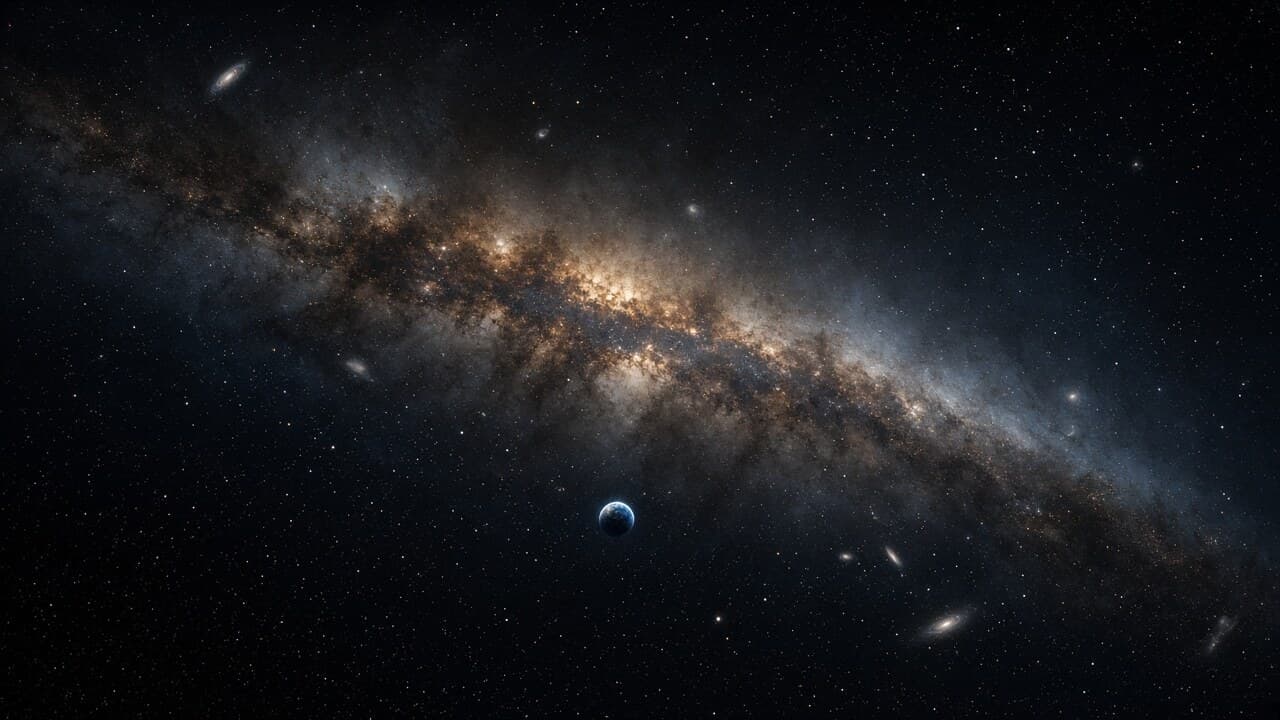
Start with our own galaxy. The Milky Way is a vast spiral galaxy containing hundreds of billions of stars, along with planets, gas, dust, and dark matter. Its stellar disk spans roughly 100,000 light-years, although the galaxy's broader stellar and dark matter components extend farther.
A light-year is the distance light travels in one year: about 9.46 trillion kilometres. Even travelling at light speed, a journey across the Milky Way would take around 100,000 years if measured across its approximate stellar disk. A real spacecraft would need considerably longer under known propulsion technology.
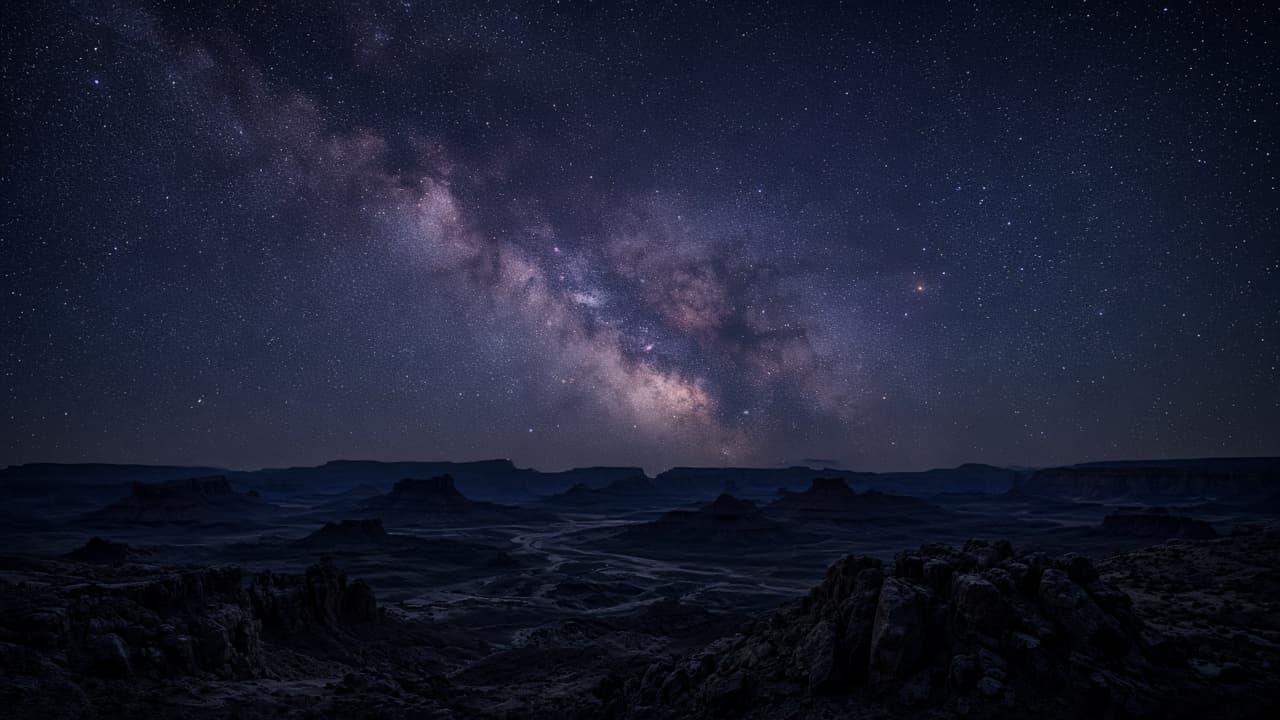
Now look beyond the Milky Way. Our galaxy belongs to the Local Group, a collection of galaxies that includes Andromeda, the Triangulum Galaxy, and numerous smaller companions. These galaxies are held together by gravity.
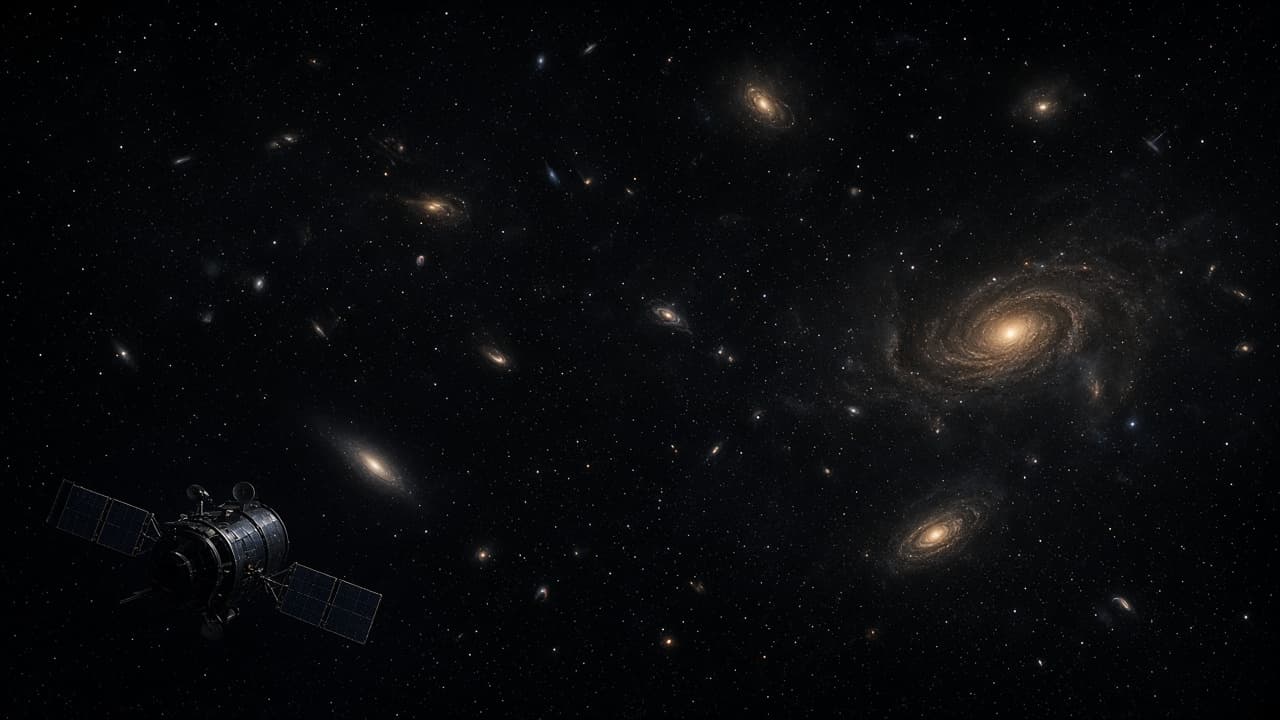
Beyond the Local Group lies an immense cosmic web of galaxy groups, clusters, filaments, and vast voids. The observable universe contains an extraordinary number of galaxies, although estimates depend on galaxy populations and the methods used to count them.
At first, this seems like an engineering challenge. Build faster spacecraft, create better life-support systems, and allow civilizations to travel for thousands or millions of years. Surely a sufficiently advanced species could eventually reach any galaxy it wanted?
Not necessarily. Distance is only part of the problem. On the largest scales, the expansion of the universe changes the relationship between distant places over time. Some destinations are not simply difficult to reach; under standard cosmological models, they may be permanently beyond our causal reach.
To understand why these limits exist, we first need to understand something that sounds almost impossible: the space between galaxies can expand in a way that no ordinary rocket can overcome.
When astronomers observe distant galaxies, they find that most are receding from us as part of the large-scale expansion of the universe. In general, the farther away a galaxy is, the faster its distance from us increases because of that expansion.
This does not mean Earth occupies the centre of the universe. Observers in other sufficiently distant galaxies would also see most galaxies moving away from them. On large scales, the expansion occurs throughout space rather than from one special central point.
The discovery that the expansion of the universe is accelerating transformed cosmology. Instead of gravity steadily slowing the expansion, observations showed that the expansion rate has evolved in a way consistent with a late period of acceleration.
Scientists use the term dark energy for whatever is responsible for this observed acceleration within the standard cosmological model. The simplest model treats it as a cosmological constant, but its physical nature remains unknown.
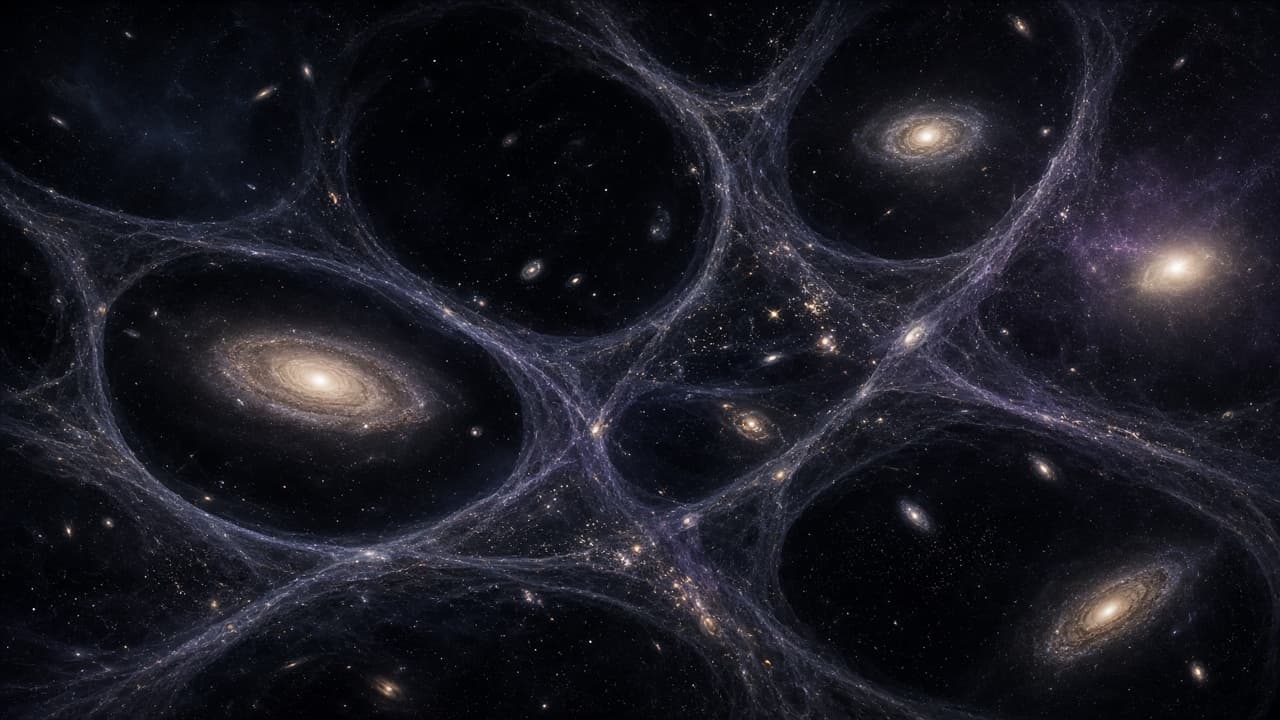
Think of two galaxies separated by an enormous amount of space. If they are not gravitationally bound, the expansion can increase the distance between them. As the universe continues expanding, that separation can grow so rapidly that a light signal travelling from one galaxy may never reach the other.
There is an important distinction here. Objects moving through nearby space cannot locally overtake a light beam in a vacuum. But the rate at which the distance between very distant galaxies increases because space expands can exceed the speed of light without violating special relativity.
A galaxy can therefore recede from us at a rate greater than the speed of light due to cosmic expansion. That fact alone does not tell us whether its light can reach us; the answer depends on the history of the expansion and the galaxy's position relative to the relevant cosmological horizons.
The deeper mystery is dark energy itself. We can measure the universe's expansion history and test models against observations, but we do not yet have a complete explanation for why the acceleration occurs or whether dark energy will remain constant forever.
Imagine drawing an invisible boundary around the region of the universe from which signals emitted today can ever reach Earth. This idea is associated with the cosmological event horizon.
It is not a physical wall, a shell of matter, or a giant cosmic barrier. It is a limit created by the evolution of space and time. If a distant region lies beyond the relevant event horizon, light sent from an event there today may never arrive here, even if we wait indefinitely.
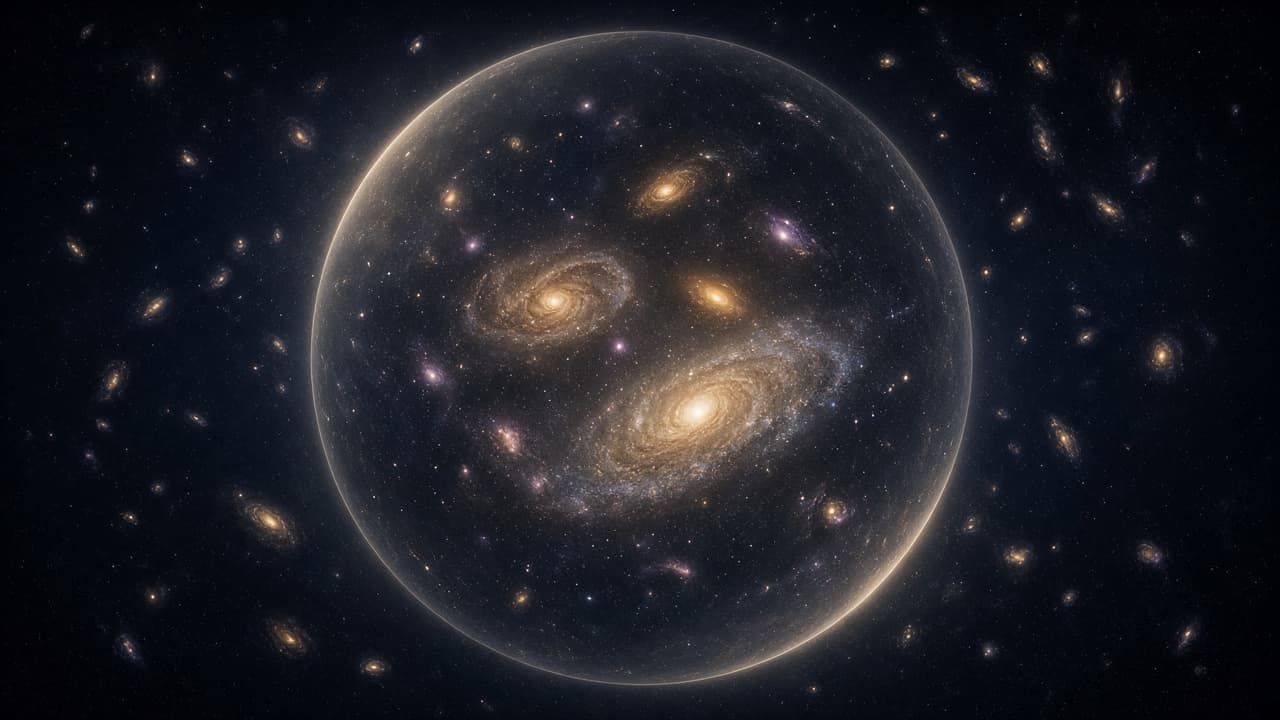
This is where the idea becomes unsettling. The universe has no known physical edge that spacecraft would hit. Instead, the laws of cosmic expansion can impose a limit on what we can influence, visit, or learn about.
The exact boundary changes with time and depends on the cosmological model. In a universe whose accelerated expansion continues in the manner predicted by a cosmological constant, regions outside our gravitationally bound neighbourhood can become permanently inaccessible.
Could a civilisation build a spacecraft that travels at 99.9999% of the speed of light? That would be an extraordinary achievement. But greater speed cannot automatically solve a problem in which the destination is being carried away by the expansion of space faster than the spacecraft can close the gap.
This does not mean every distant galaxy is unreachable. Some nearby galaxies are moving toward us because local gravity dominates the expansion on those scales. The Local Group is gravitationally bound, and its internal future differs from that of distant, unbound galaxy groups.
This is one of the strangest features of cosmology: observing something does not mean we can travel there, and it does not mean we can receive information from it indefinitely.
Light takes time to travel. When a telescope detects a distant galaxy, it records light that may have travelled for billions of years. We see the galaxy as it was when that light began its journey—not as it is at this exact moment.
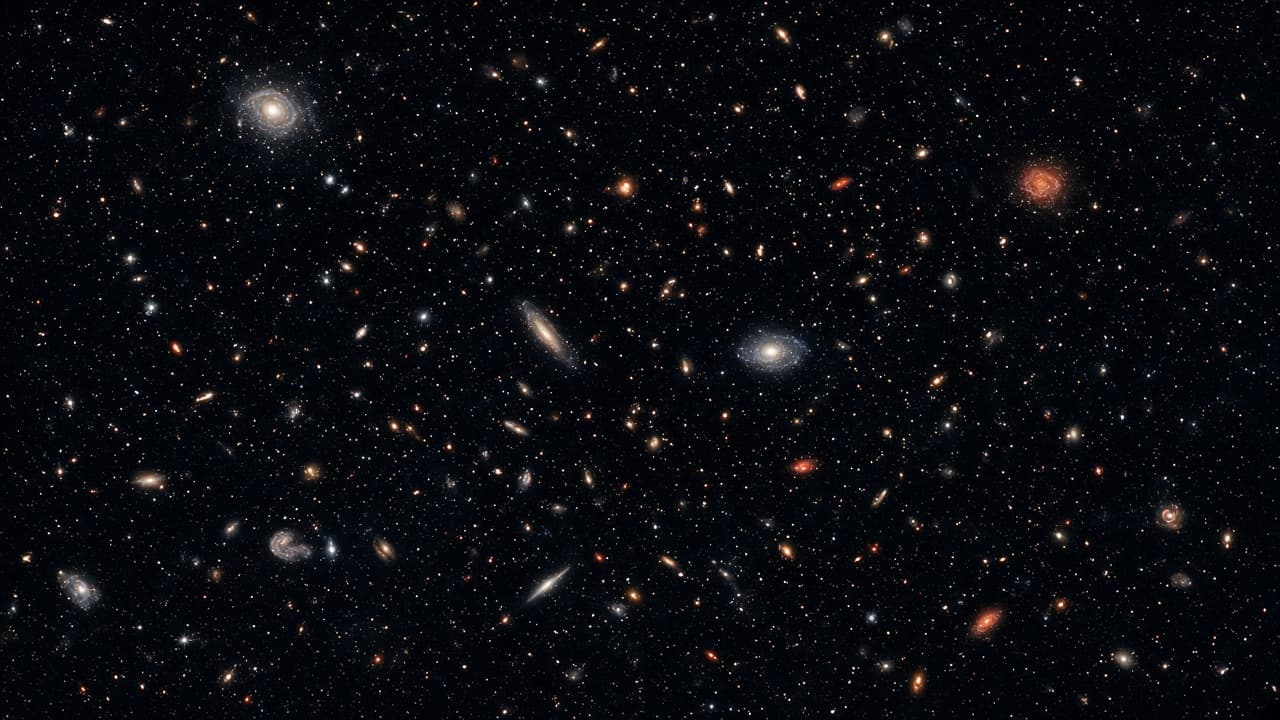
During the time that light was travelling toward us, the universe continued to expand. The galaxy that emitted the light may now be much farther away than it was when the light began its journey.
In some cases, the galaxy's present distance can be so great that a signal emitted from it today will never reach us under the standard accelerating-expansion model—even though its ancient light is arriving at our telescopes right now.
It is like receiving an old letter from a place with which communication has since become impossible. The message is genuine, but it tells you about an earlier moment. You cannot assume that sending a reply today will reach the original sender.
Astronomers can continue studying the light that reaches us, including how it has been stretched to longer wavelengths by cosmic expansion. But the amount of information available from extremely distant regions is not unlimited.
This distinction also explains why the observable universe can continue to grow as additional ancient light reaches us, even while the region from which future signals can reach us is limited.
Suppose humanity survives long enough to master fusion propulsion, build self-sustaining habitats, and send generations of explorers beyond the Solar System. Could our descendants eventually establish colonies throughout the Local Group?
The distances would still be immense. Andromeda is about 2.5 million light-years away. Even a hypothetical spacecraft travelling at light speed would require roughly 2.5 million years to cross that distance in a simplified calculation that ignores the complications of an expanding universe and the motion of the destination.
Known physics does not permit a spacecraft carrying people to reach the speed of light. Faster-than-light travel through ordinary space has not been demonstrated, and proposals involving wormholes or warp drives remain speculative, with major theoretical and engineering obstacles.
However, the Local Group is a different situation from distant galaxy groups. Its galaxies are gravitationally bound, so they do not simply drift apart with the overall expansion in the same way as widely separated, unbound systems.
A very advanced civilisation might, in principle, explore a large part of its gravitationally bound neighbourhood over enormous periods of time. Whether humans could ever develop the technology, social stability, and resources to achieve this is unknown.
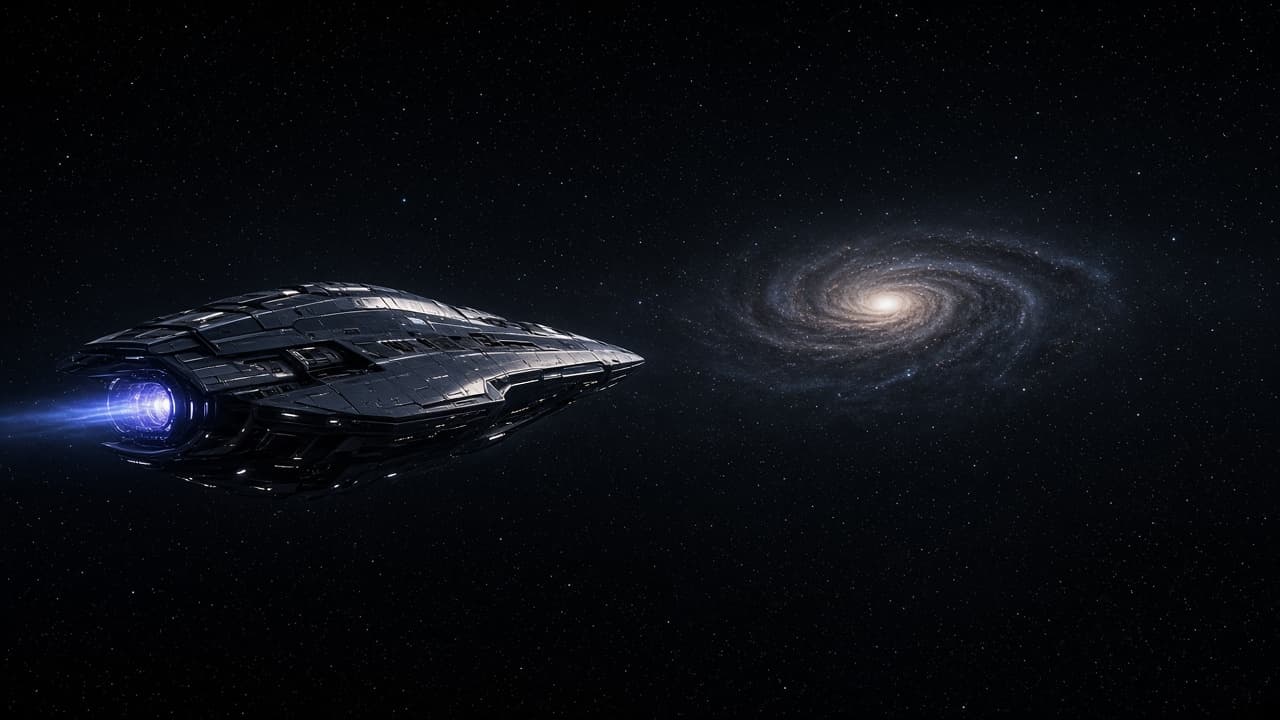
Beyond that neighbourhood, the challenge becomes more severe. Under standard cosmology, there are distant regions from which travel beginning today cannot reach us, even in an idealised scenario where a spacecraft could move at light speed.
The crucial point is not that humanity has already discovered an exact percentage of the universe that it can never reach. Such percentages depend on definitions, assumptions about the expansion history, and what counts as reaching a destination. The robust conclusion is that cosmic expansion creates a genuine limit on intergalactic access.
For decades, astronomers described a future in which the Milky Way and Andromeda would collide and eventually merge into a larger galaxy. This scenario was based on measurements of their relative motion and gravitational interactions.
But a crucial scientific lesson emerged when researchers revisited the prediction using updated observations and modelling. A NASA/ESA Hubble-related study published in 2025 found that the merger is not as certain as earlier accounts suggested. The study reported roughly even odds of a Milky Way–Andromeda collision within the next 10 billion years, with the Large Magellanic Cloud and other uncertainties affecting the outcome.
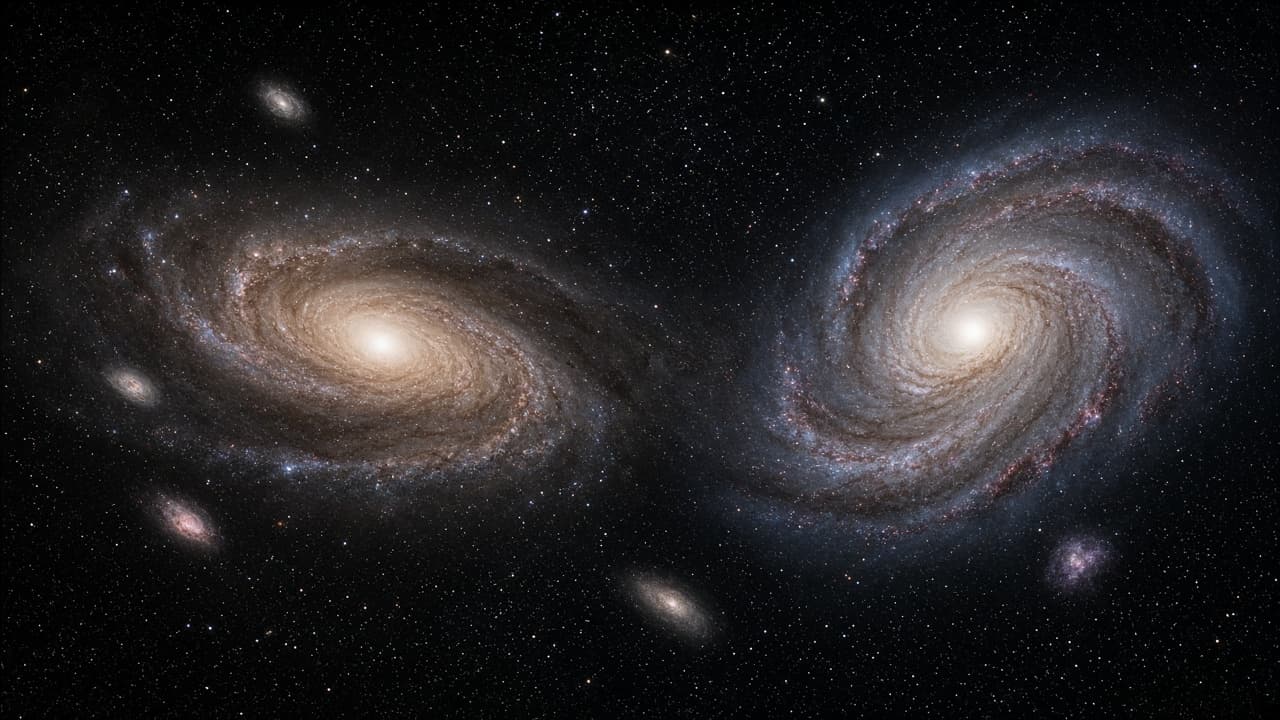
A close encounter or eventual merger remains a plausible outcome, but it should not be described as a guaranteed event on a precise timetable. The prediction illustrates how astronomy uses models to explore possible futures—and how new measurements can change the probabilities.
If a merger eventually occurs, it would unfold over hundreds of millions or billions of years. Individual stars are so widely separated that direct star-on-star collisions would be unlikely, although gravitational interactions would reshape the galaxies and their stellar orbits.
The far future of the Local Group is therefore a story still being refined. Its gravitationally bound galaxies will continue interacting, while the broader universe expands around them. The precise final arrangement depends on the complex gravitational dynamics of the system.
Now imagine astronomers living in the distant future, long after humanity's present era. They live in a galaxy whose stars have evolved and whose night sky bears little resemblance to ours. What would they see when they looked beyond their home?
If accelerated expansion continues over the long term, galaxies that are not gravitationally bound to our local region will become increasingly distant. Their light will be stretched to longer wavelengths and grow fainter. Eventually, much of the evidence we now use to map the large-scale universe could become inaccessible to future observers.
Today, scientists can study the cosmic microwave background, the afterglow of the early universe released when it became transparent roughly 380,000 years after the Big Bang. This radiation provides a crucial record of the universe's early conditions.
In the far future, cosmic expansion will stretch this radiation to ever longer wavelengths and lower energies. Detecting and interpreting it could become increasingly difficult. Other galaxies may also become too faint or too distant to provide useful evidence of cosmic expansion.
Would future astronomers necessarily conclude that their galaxy was the entire universe? Not necessarily. That is an illustrative possibility, not a guaranteed prediction. The evidence available to them would depend on the instruments they develop, the physical state of the universe, and the cosmological clues that remain observable.
Still, this scenario exposes a remarkable fact: our era may offer access to evidence about cosmic history that future observers will find far more difficult to obtain. We can see distant galaxies, measure their redshifts, study the cosmic microwave background, and reconstruct an expanding universe from multiple independent observations.
The universe does not have to change its underlying history for the evidence of that history to become harder to observe. The changing availability of information alone could make future astronomy a very different discipline.
It is tempting to interpret our access to cosmic history as proof that humanity occupies a special place in the universe. Science does not require that conclusion. The same expansion that will hide distant galaxies from later observers is what allows us to see them now: we live at a time when the afterglow of the early universe is still measurable and when many galaxies remain visible.
That is a fact about timing, not a claim that Earth is the centre of anything. Any civilisation that arose at a similar cosmic epoch, in a similar gravitationally bound neighbourhood, would have a comparable window. The special thing is the era, not the species.
If dark energy continues to behave like a cosmological constant, the long-term picture is a Local Group that remains bound while the rest of the observable cosmos fades. If dark energy evolves, the future could be different. Those are open questions. The limit already in force is not: under the standard model, there are places we can still photograph that we can never visit.
Humanity may one day cross oceans of interstellar space. It may never cross the cosmic event horizon. The horizon is not a wall. It is a date after which a destination stops being a destination.
The universe has a point of no return, but it is not the edge of existence. It is a limit on communication and travel created by accelerating expansion. Most of the galaxies in a deep-field image are not invitations. They are records.
What remains reachable, in the only sense that physics currently supports, is the gravitationally bound neighbourhood we already inhabit: the Milky Way, its satellites, and the rest of the Local Group. That is still a frontier large enough to occupy any civilisation we can imagine.
The rest of the cosmos is not lost. It is simply not ours to enter. We can still read its ancient light. We should, while the letters keep arriving.