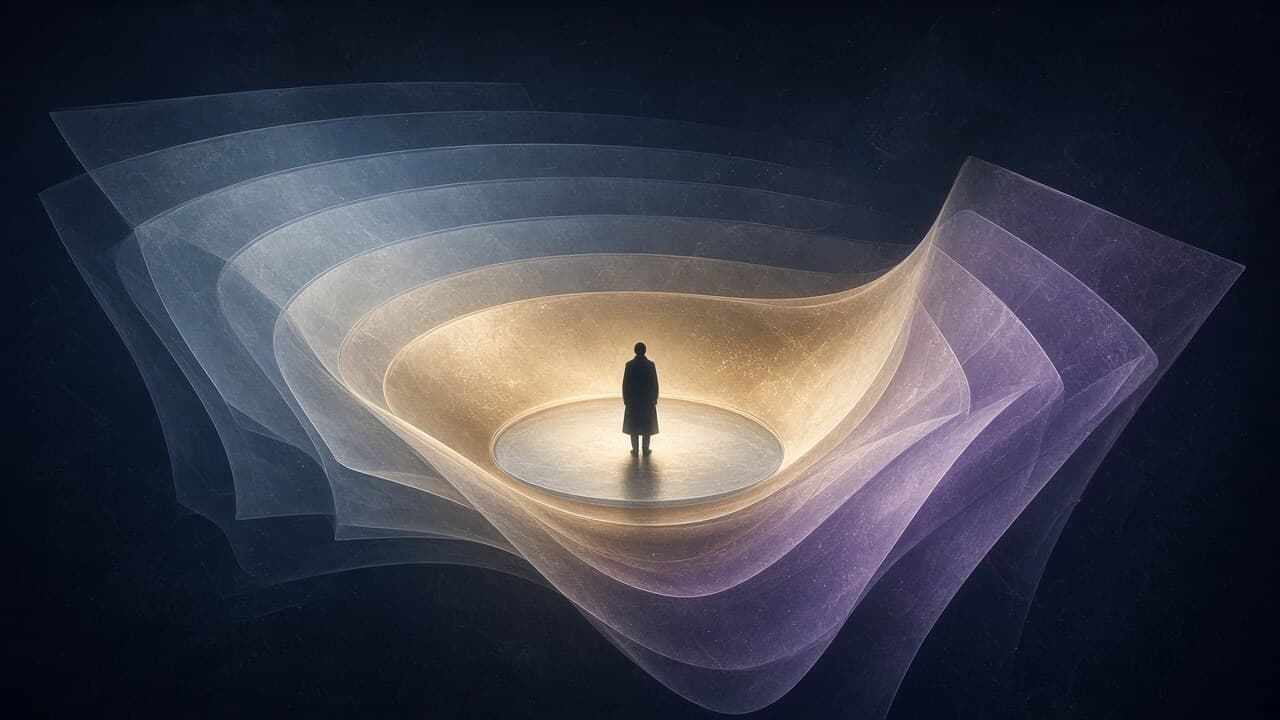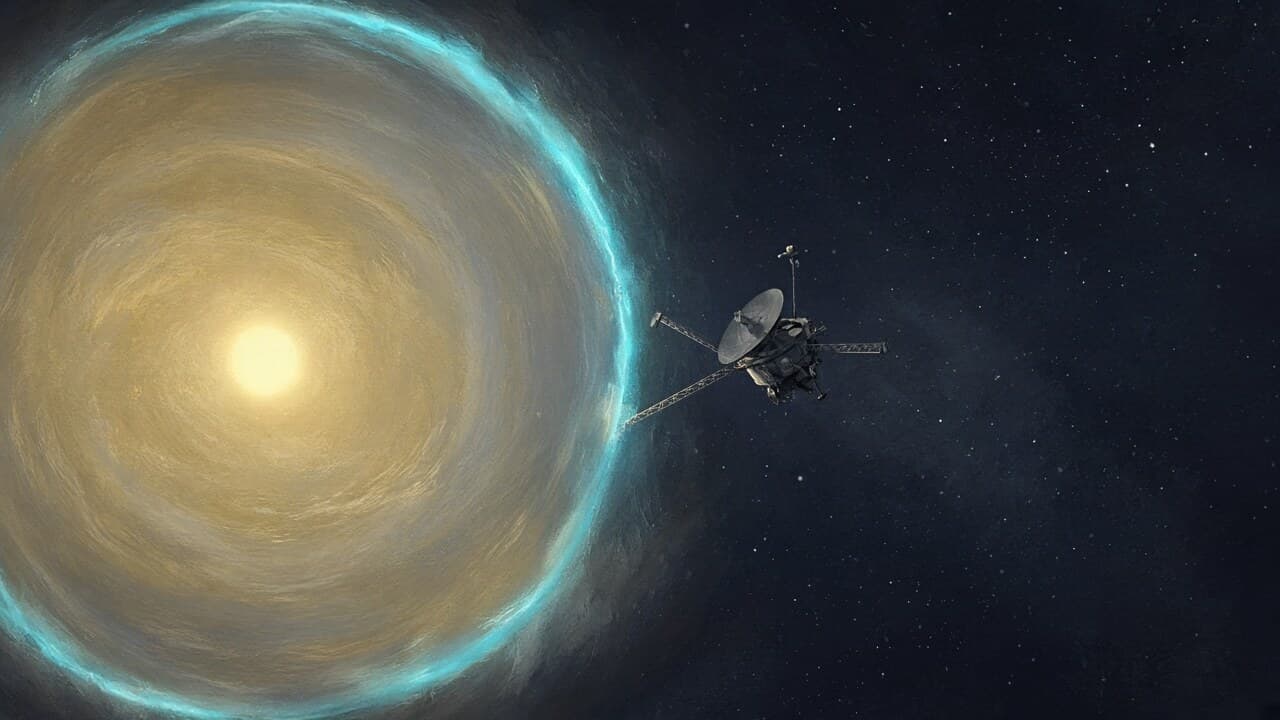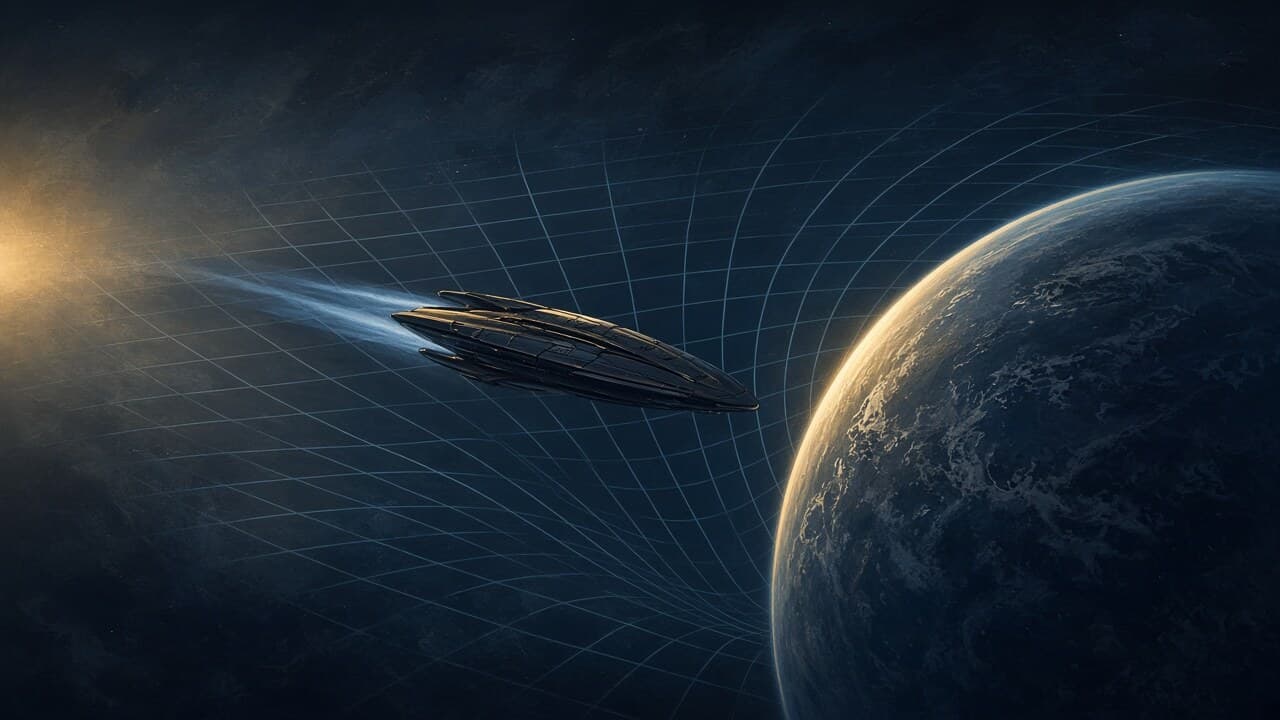
What if time travel has already been achieved—but only by fractions of a second?
Imagine placing two identical clocks next to each other. You synchronize them perfectly, separate them, and bring them together again. You might expect them to show exactly the same time.
But what if one clock spent the day on an airplane while the other stayed on the ground? Or one was placed slightly higher than the other? According to Einstein's relativity, they should not experience exactly the same amount of elapsed time.
Scientists have actually performed these experiments. The differences are extraordinarily small, but modern atomic clocks are precise enough to measure them.
This leads to a much bigger question: if humans can already manipulate the amount of time that passes for an object simply by changing its speed or gravitational environment, how far could we take the idea?
For most of human history, time seemed universal. A second was a second, whether you were standing on a mountain, sailing across an ocean or sitting inside a room.
Einstein's theories of relativity changed that picture. Special relativity showed that motion affects the passage of time, while general relativity showed that gravity affects it as well.
- Time dilation
- Time dilation is the difference in elapsed time measured by observers whose relative motion or gravitational environments differ. It is a prediction of relativity that has been experimentally confirmed.
The important part is that this is not merely a philosophical idea. Scientists have repeatedly measured these effects using increasingly precise clocks.
In 1971, physicists Joseph Hafele and Richard Keating carried atomic clocks aboard commercial aircraft traveling around Earth. They flew clocks eastward and westward and later compared them with reference clocks that had remained on the ground.
The clocks did not agree perfectly when they were reunited. Their differences were consistent with the effects predicted by relativity, including the influence of the aircraft's speed and Earth's rotation and gravitational field.
It was a remarkable experiment because the setup was almost absurdly ordinary: take clocks on airplanes, fly around the planet and compare them afterward.
1971
Hafele–Keating experiment
NIST

The strange part is that you do not need an airplane or a spacecraft to observe gravitational time dilation.
In 2010, NIST researchers compared two extremely precise atomic clocks separated vertically by only about 33 centimeters. The clock positioned higher up ticked slightly faster because it experienced a slightly different gravitational potential.
That means the passage of time at your head is technically different from the passage of time at your feet. The difference is far too small for your body to notice, but precision clocks can detect it.
33 cm
Height difference in a NIST experiment
NIST
Over a 79-year lifetime, the difference measured at that scale would amount to only around 90 billionths of a second. Tiny—but real.
The experiment became even more extraordinary when researchers pushed the measurement to a much smaller scale.
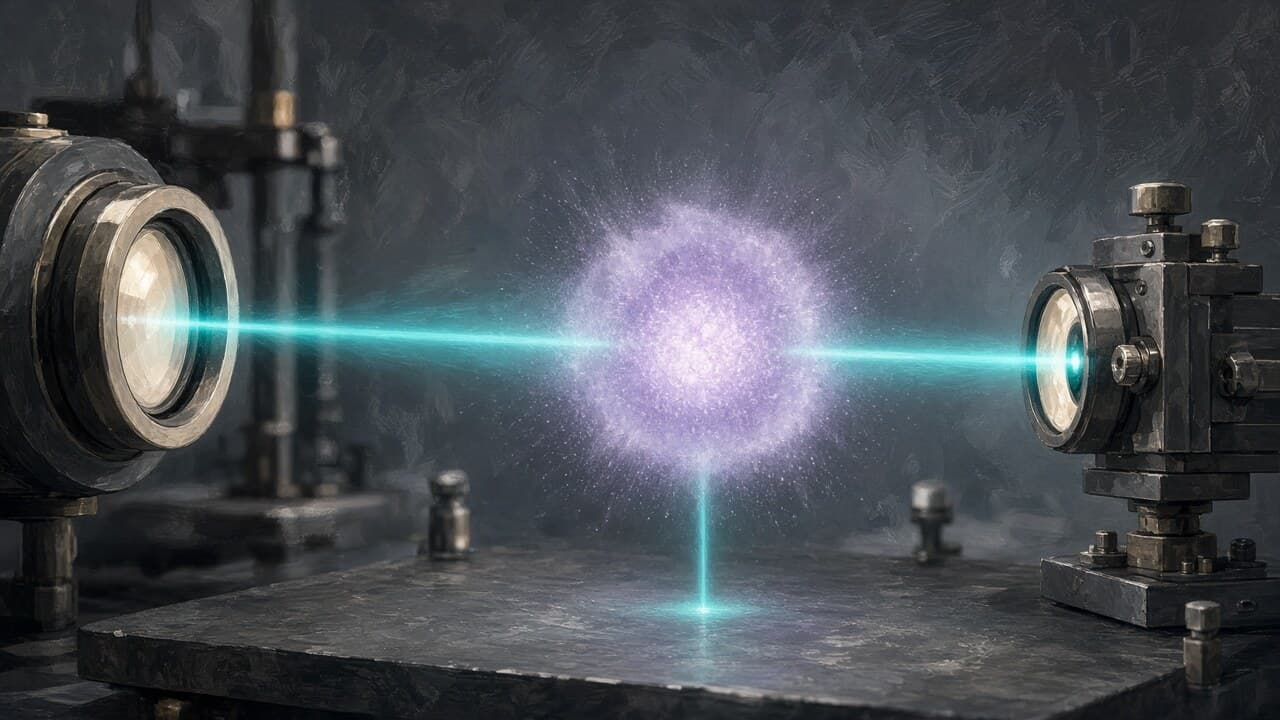
JILA researchers, working with NIST and the University of Colorado Boulder, measured gravitational time dilation across a cloud of ultracold strontium atoms. In the experiment, regions separated by roughly a millimeter experienced slightly different gravitational potentials and therefore slightly different clock rates.
The measured frequency difference was around 10^-19. That number is almost impossible to imagine, yet modern optical-clock technology can detect effects at this scale.
Gravity is only half of the story. Special relativity predicts that the faster an object moves relative to another observer, the slower its clock appears to run from that observer's perspective.
At everyday speeds, the effect is too small to notice. At speeds approaching the speed of light, however, the difference becomes dramatic.
This is the foundation of the famous twin scenario. Imagine one twin staying on Earth while another travels through space at an extremely high speed and eventually returns. Depending on the journey, the traveling twin can have experienced less elapsed time than the twin who stayed behind.
| Effect | What Changes | Result |
|---|---|---|
| Motion | Relative velocity | A moving clock accumulates less elapsed time relative to an appropriate stationary observer. |
| Gravity | Gravitational potential | A clock deeper in a gravitational field ticks more slowly relative to a clock farther away. |
One of the most surprising applications of relativity is something many people use every day: GPS.
Navigation satellites carry extremely precise clocks. Because the satellites move rapidly and orbit at a different gravitational potential from clocks on Earth's surface, relativity affects their clock rates.
GPS systems must account for these relativistic effects. Without the corrections, the timing used to calculate positions would drift enough to make the navigation system unusable for precise positioning.
In a very specific scientific sense, yes—but not in the science-fiction sense.
People and objects moving at different speeds or existing in different gravitational environments can accumulate slightly different amounts of elapsed time. Experiments with clocks have demonstrated this repeatedly.
But nobody has stepped into a machine, entered the year 2126 and returned home.
The distinction is crucial. Relativistic time travel into the future is not a violation of known physics. Dramatic human time travel would simply require conditions far beyond what current spacecraft can achieve.
Now the thought experiment becomes much more interesting.
Suppose humanity eventually develops a spacecraft capable of traveling extremely close to the speed of light. The crew could experience a relatively short journey while much more time passes for people who remain on Earth.
A Relativistic Journey Into Earth's Future
Accelerate
A spacecraft accelerates to a speed extremely close to the speed of light.
Travel
Because of relativistic time dilation, less proper time passes for the travelers than for observers on Earth.
Return
The spacecraft eventually slows down and returns to Earth.
Compare Clocks
The crew and people on Earth can have experienced different amounts of elapsed time.
From the travelers' perspective, their own clocks behave normally. Their hearts, thoughts and onboard clocks all feel normal to them. The difference appears when their elapsed time is compared with the time experienced by people who followed a different path through spacetime.
Einstein's general relativity predicts that stronger gravity produces stronger gravitational time dilation. This makes extreme objects such as neutron stars and black holes fascinating when discussing the future of time travel.
Near a sufficiently massive compact object, an observer far away could see clocks in a strong gravitational field running extremely slowly relative to their own clocks.
The next generation of time experiments is unlikely to involve a giant machine labeled TIME MACHINE. Instead, scientists are building clocks so precise that tiny differences in gravity, motion and spacetime become measurable.
- More precise optical clocks.
- Clock comparisons over increasingly small height differences.
- Space-based precision clocks.
- Relativistic measurements for mapping Earth's gravitational field.
- Tests of relativity under increasingly extreme conditions.
- Experiments exploring connections between gravity and quantum mechanics.
- Searches for tiny deviations that could reveal physics beyond current theories.
NIST and JILA researchers have specifically pointed to improved optical clocks as potential tools for exploring the relationship between quantum mechanics and gravity. These experiments could eventually probe physics that current theories do not completely unify.
This is where the science becomes much more speculative.
General relativity contains mathematical solutions involving unusual spacetime structures, including closed timelike curves and theoretical wormhole scenarios. Some physicists have explored whether such structures could permit paths through spacetime that return to an earlier event.
But mathematical possibility is not the same as physical engineering. We have no demonstrated method for creating, stabilizing or traversing a wormhole, and there are major unresolved issues involving energy requirements, quantum effects and causality.
The famous grandfather paradox illustrates the problem. If someone traveled into the past and changed an event that prevented their own existence, how could the traveler have existed to make the change?
From Einstein to Atomic Clocks
1905
Special Relativity
Einstein publishes special relativity, changing the relationship between space, time and motion.
1915
General Relativity
Einstein's theory connects gravity with the geometry of spacetime and predicts gravitational effects on clocks.
1950s
Atomic Clocks
Practical atomic clocks make extremely precise time measurements possible.
1971
Hafele–Keating
Atomic clocks are flown around Earth, providing a direct test involving motion, gravity and Earth's rotation.
2010
33-Centimeter Experiment
NIST researchers measure gravitational time dilation between atomic clocks separated by about one foot.
2022
Millimeter-Scale Time Dilation
JILA researchers measure gravitational time dilation across a millimeter-scale atomic sample.
Future
Even More Precise Clocks
Researchers are developing clocks capable of probing gravity, Earth science and potentially the relationship between quantum mechanics and gravity.
If the goal is dramatic forward time travel rather than fractions of a second, the technological requirements become enormous.
- A spacecraft capable of reaching an extremely high fraction of the speed of light.
- A propulsion system capable of accelerating and decelerating enormous masses safely.
- Protection against radiation and collisions with interstellar particles.
- A way to keep humans alive during potentially long missions.
- An energy source far beyond the capabilities of today's spacecraft.
- Navigation accurate enough to control a relativistic trajectory.
The laws of physics may allow the time-dilation effect, but engineering is a completely different problem.
| Idea | Scientific Status | Evidence |
|---|---|---|
| Time dilation from speed | Established physics | Repeated experimental evidence |
| Gravitational time dilation | Established physics | Measured with atomic clocks |
| Large-scale forward time travel | Allowed in principle by relativity | Requires extreme conditions not currently practical for humans |
| Using a black hole as a time machine | Highly speculative as an engineering concept | Based on relativistic effects and theoretical scenarios |
| Traveling into the past | Speculative | No experimental demonstration |
It is tempting to focus on the possibility of building a time machine. But the experiments already performed tell us something more fundamental.
Time is not simply a universal background clock ticking at the same rate everywhere. The amount of elapsed time depends on the path an observer takes through spacetime, including their motion and gravitational environment.
Atomic clocks have transformed this strange prediction into something measurable. They have effectively turned time itself into a scientific instrument for detecting gravity and changes in Earth's gravitational landscape.
And as these clocks become more precise, scientists can ask increasingly ambitious questions.
For centuries, humans imagined time as something universal and untouchable. Then Einstein proposed that time could depend on motion and gravity. More than a century later, scientists are measuring those effects with clocks so precise that differences across a millimeter can become visible.
We have not built a machine that lets someone jump from 2026 to 3026. But physics has already shown that different observers can experience different amounts of elapsed time.
The future question is therefore not simply whether time travel is possible. It is how far humanity can push the physical effects we already know are real.
Could future spacecraft turn months of travel for astronauts into decades passing on Earth? Could increasingly precise clocks reveal something deeper about gravity and quantum mechanics? Could a theory beyond Einstein eventually change what we think is possible?
We do not know yet. And that may be the most exciting part.
What this reading clarifies — and what it cannot
What works
- Based on experimentally tested physics rather than purely fictional time-machine concepts.
- Connects famous relativity experiments with technologies such as GPS.
- Shows how atomic clocks allow scientists to measure extremely small differences in elapsed time.
- Explores realistic future possibilities while clearly separating them from speculation.
What doesn't
- Large-scale human time travel remains technologically far beyond current capabilities.
- Backward time travel has no experimental demonstration.
- Extreme relativistic travel would create enormous propulsion, energy, radiation and life-support challenges.
- Some theoretical time-travel concepts depend on physical conditions that may not be achievable.