Imagine discovering an object travelling through our Solar System that was not born here. It did not originate near the Sun. It was not one of the familiar asteroids orbiting between Mars and Jupiter. It had travelled through the enormous darkness between stars before briefly passing through our cosmic neighbourhood.
Now imagine that this object looks strangely elongated, spins in an unusual way, and appears to accelerate slightly without displaying the familiar signs of a comet.
That is exactly the kind of mystery astronomers encountered in October 2017. The object was named 1I/2017 U1, better known as Oumuamua.
It was the first confirmed interstellar object ever observed passing through our Solar System. Its discovery opened an entirely new window into the possibility of material travelling between planetary systems.
But Oumuamua became famous for more than its origin. Its unusual appearance and unexpected motion inspired scientific debates, competing explanations and even speculation that humanity might have encountered an artificial object built by an extraterrestrial civilisation.
Was it an asteroid? A comet unlike anything we had seen? A fragment of an alien planet? Or something artificial?
The real story is more interesting than any single answer. Here is what we know, what scientists have proposed, and what remains unresolved.
On October 19, 2017, astronomers using the Pan-STARRS1 telescope in Hawaii detected a faint moving object in the sky. Pan-STARRS1 was designed to survey the sky and identify objects, including asteroids that might approach Earth.
At first, the object looked like another small body passing through the Solar System. But its orbit quickly revealed something extraordinary.
It was travelling too fast to be gravitationally bound to the Sun. Its path was hyperbolic rather than the closed elliptical orbit followed by planets and ordinary long-period comets. In simple terms, the Sun was not going to capture it. The object was passing through and would continue back into interstellar space.
Astronomers calculated that it had already passed closest to the Sun on September 9, 2017, before its discovery. It had also passed relatively close to Earth on October 14, only five days before it was detected.
The discovery was announced on October 25, 2017, after observations confirmed its unusual trajectory.
The name Oumuamua comes from Hawaiian and is commonly translated as a messenger from afar arriving first. It was a fitting name for an object that had travelled from beyond our Solar System.
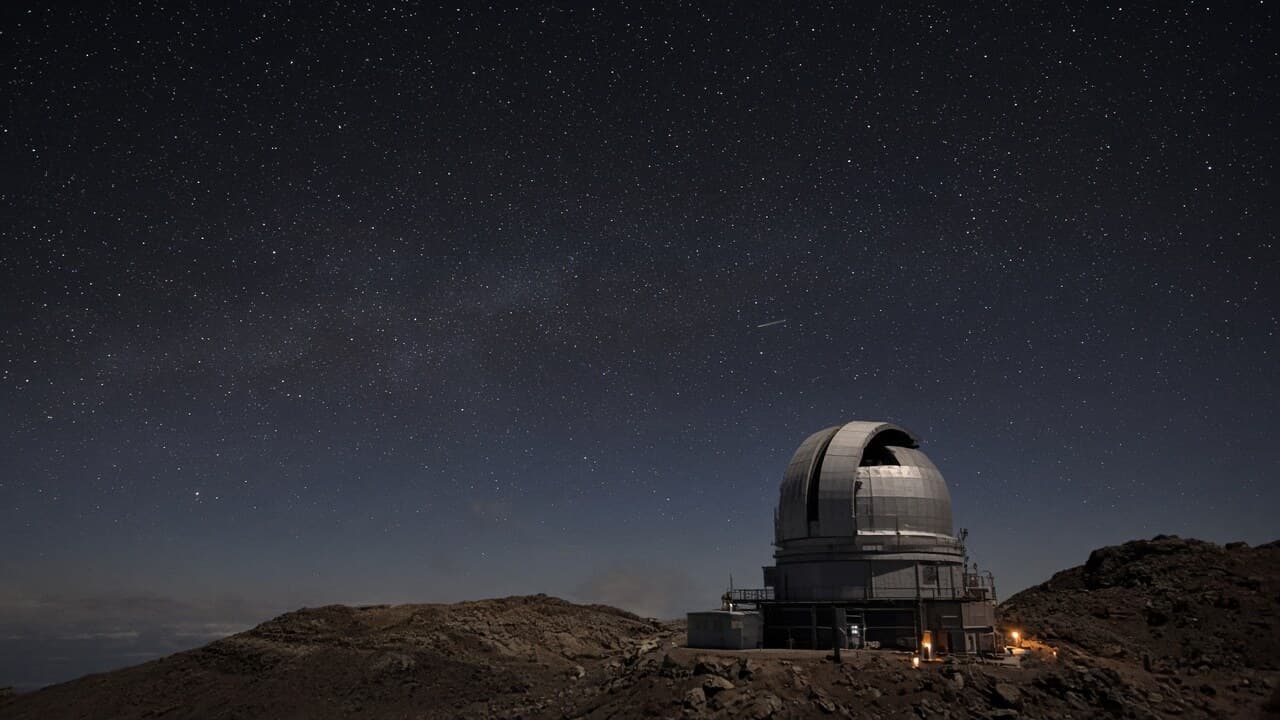
The first challenge was that Oumuamua was incredibly faint and small in telescope images. Even powerful observatories could not resolve its surface into a detailed photograph. Astronomers saw a tiny point of light, not a clear picture of a strange-shaped object.
Instead, researchers studied how its brightness changed over time. This technique, known as light-curve analysis, can reveal information about the rotation and shape of a distant object.
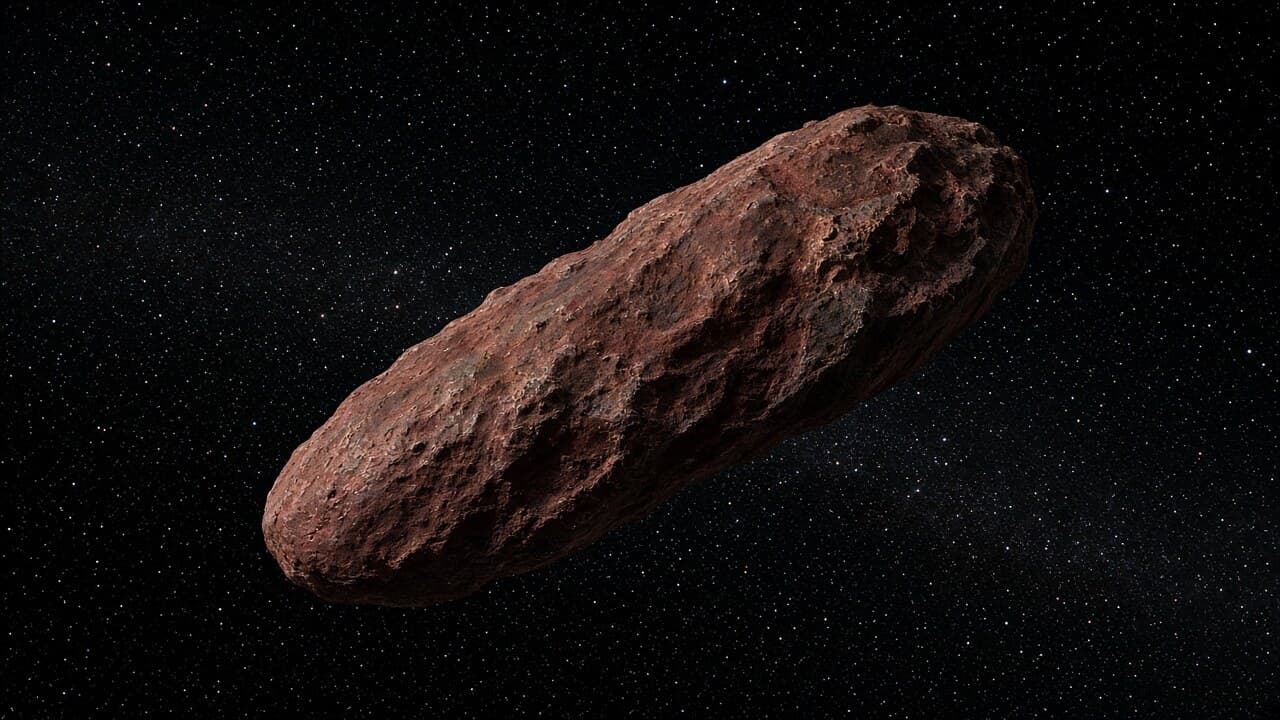
Oumuamua's brightness changed dramatically. At some points it appeared much brighter than at others, with variations by roughly an order of magnitude in early observations.
One explanation was that it had an extremely elongated shape. If a long object rotates, it presents different amounts of reflective surface towards Earth. When its broad side faces us, it can appear brighter. When its narrow end faces us, it can become much fainter.
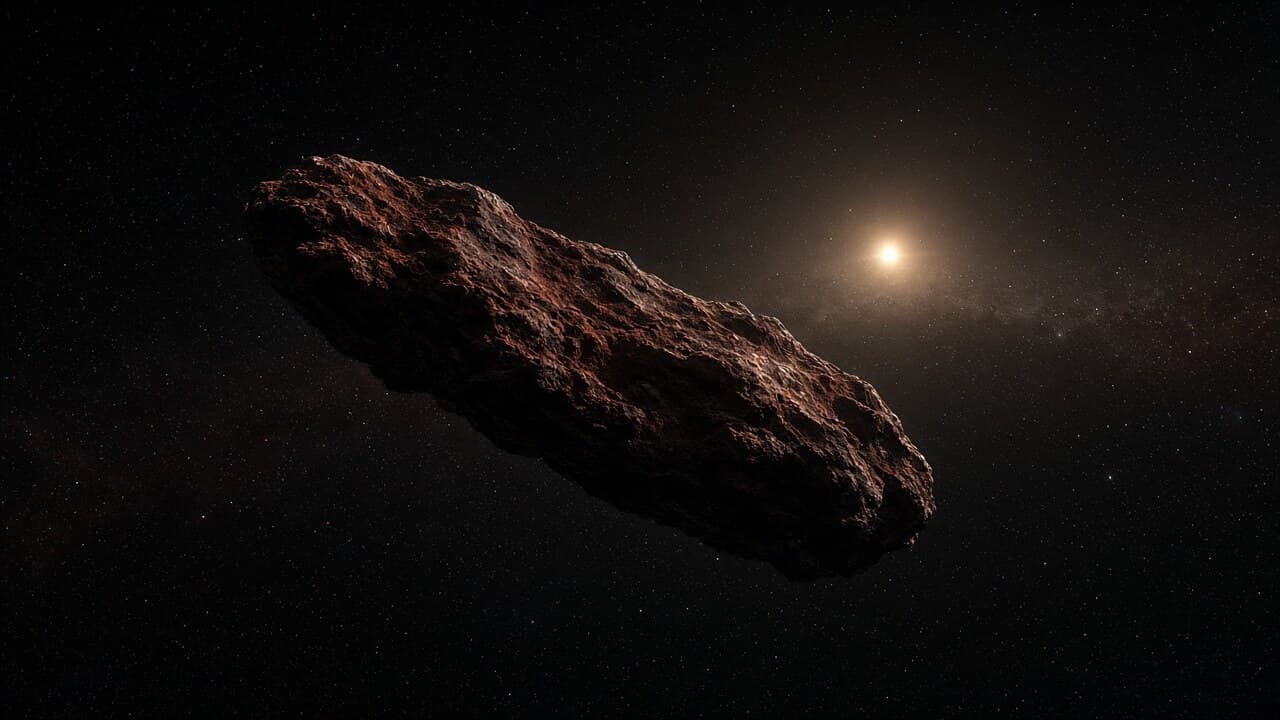
Early estimates suggested an aspect ratio approaching ten to one. Later analyses explored different shapes and rotational models, with some studies finding a lower minimum ratio. The exact dimensions and shape remain uncertain because astronomers never obtained a resolved image.
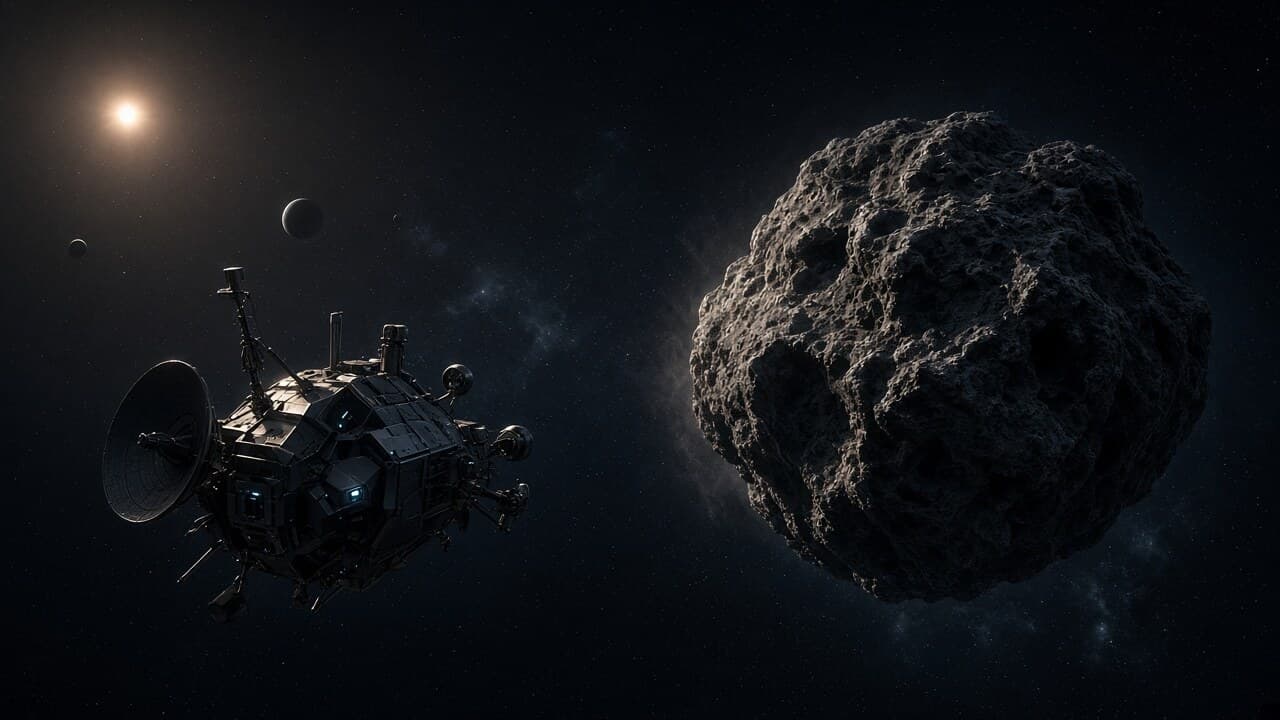
This is where many illustrations become misleading. The famous cigar-shaped image is an artist's interpretation, not an actual photograph. Some researchers have also explored flatter, pancake-like shapes or more complex irregular bodies.
Whatever its precise geometry, its changing brightness made one thing clear: Oumuamua was unusual.
The strange brightness pattern revealed another surprise. Oumuamua was not simply rotating like a spinning football or a planet turning around a stable axis.
Its motion was tumbling. This means its orientation changed in a more complicated way, involving rotation around more than one axis.
Observations suggested a characteristic rotation timescale of roughly 7 to 8 hours, although the tumbling motion means there is no single simple rotation period that explains every brightness change.
Why was it tumbling? There are several possibilities. It could have experienced gravitational disturbances or collisions in its original planetary system. Forces associated with material escaping from its surface could also have altered its rotation.
Imagine a rock that has been travelling through interstellar space for millions or even billions of years, possibly experiencing collisions and other disturbances. Its rotation could tell us something about its violent history.
The important point is that the tumbling behaviour is unusual, but it does not require an artificial explanation.
Its shape and rotation were strange enough. But another observation made the object even more interesting.
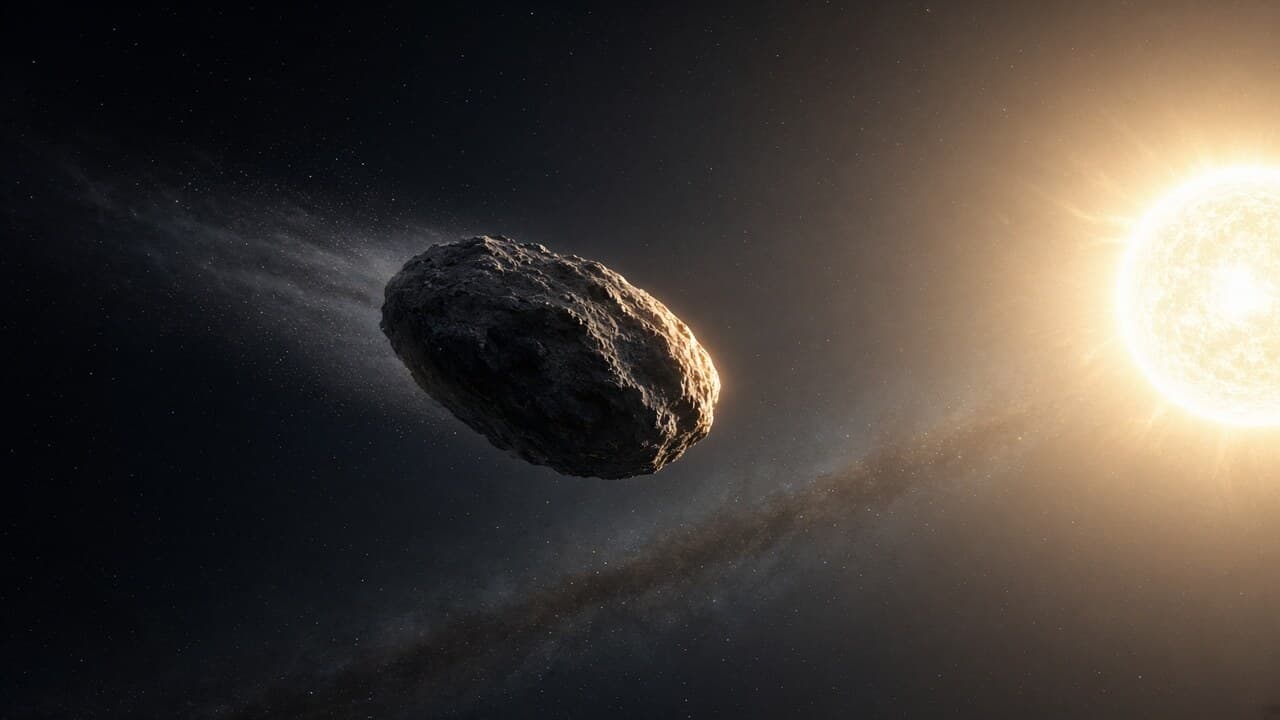
When astronomers calculated Oumuamua's path using the gravitational influence of the Sun and planets, they found a small discrepancy. Its measured trajectory showed a slight additional acceleration that could not be explained by gravity alone.
This was called non-gravitational acceleration. The effect was tiny compared with the Sun's gravitational pull, but it was measurable in the object's trajectory.
For ordinary comets, this kind of behaviour is not particularly shocking. When a comet approaches the Sun, its ice warms and turns directly into gas. This process is called sublimation. Escaping gas can act like a small rocket engine, pushing the comet in the opposite direction.
The problem was that Oumuamua did not look like a typical active comet.
Astronomers searched for the familiar cloud of gas and dust called a coma, as well as a visible dust tail. They did not detect the obvious cometary activity that might have explained the acceleration.
This created the central puzzle: how could an object experience a comet-like push without displaying the usual visible signs of a comet?
The absence of a visible coma did not prove that no gas was escaping. A weak or unusual form of outgassing could be difficult to detect. But researchers needed to explain both the acceleration and the missing visible activity.
When an object behaves in an unexpected way, people naturally begin exploring unusual explanations. Oumuamua quickly became the subject of a much more extraordinary possibility: what if it was not a natural object at all?
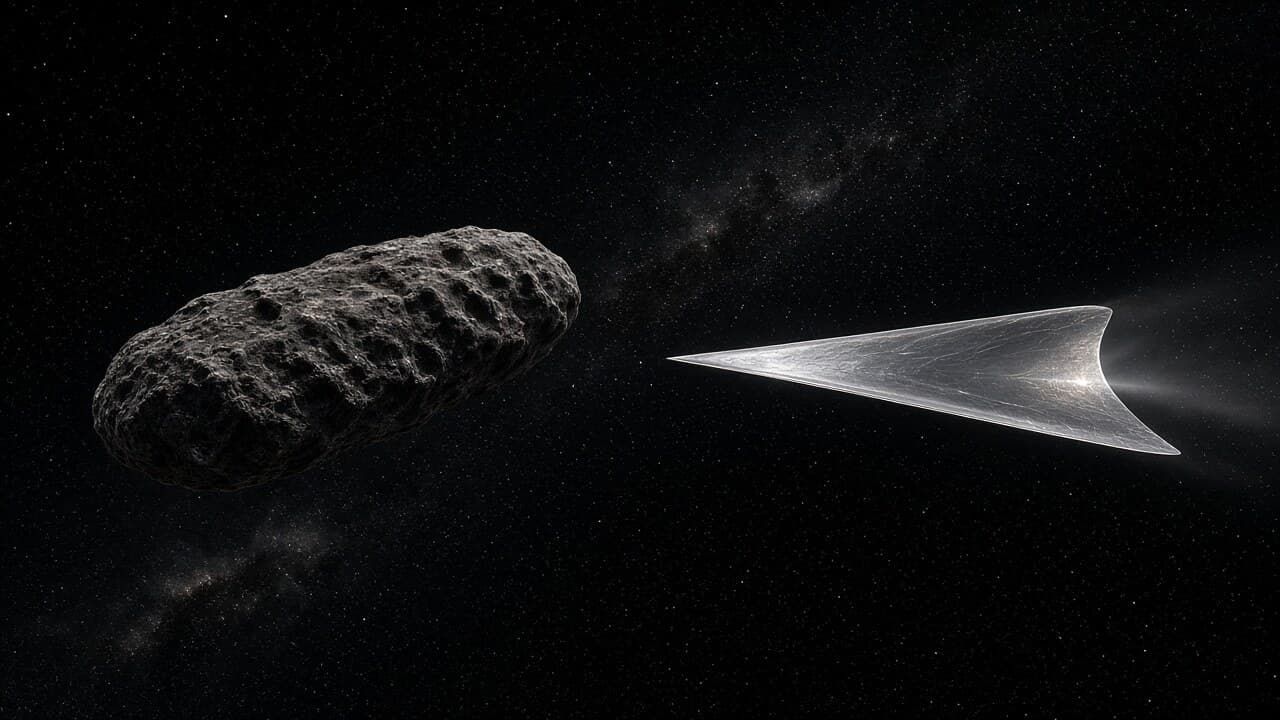
In 2018, astrophysicist Avi Loeb and researcher Shmuel Bialy published a paper examining whether solar radiation pressure could explain Oumuamua's unusual acceleration. They considered the possibility that the object might have an extremely thin structure, allowing sunlight to push it more effectively than it would push a normal asteroid.
This led to speculation that Oumuamua could resemble a light sail: a thin reflective structure that uses radiation pressure from sunlight or another light source for propulsion.
Light sails are not purely science fiction. Scientists and engineers have investigated them as a possible propulsion technology for future spacecraft. Photons carry momentum, so light can exert a small force on a reflective surface. Projects such as Breakthrough Starshot have explored the idea of using powerful lasers to accelerate tiny light-sail spacecraft.
But there is a huge difference between showing that light pressure can move a thin object and demonstrating that Oumuamua was an engineered sail.
The artificial-object proposal is speculative. No direct evidence has established that Oumuamua was manufactured, controlled or sent by an extraterrestrial civilisation.
It remains an interesting hypothesis to examine, but an unusual observation is not automatically evidence of alien technology.
If Oumuamua were an artificial spacecraft, could it be transmitting signals?
Researchers associated with the Breakthrough Listen initiative and other radio astronomy efforts turned their attention towards the object. The idea was straightforward: search for radio emissions that might indicate artificial technology.
The Allen Telescope Array also conducted radio observations between November 23 and December 5, 2017, across frequencies from 1 to 10 gigahertz.
The searches found no evidence of artificial radio transmissions from Oumuamua within the sensitivities and frequency ranges of the observations.
This does not prove that an object could not be artificial. A silent spacecraft, a non-radio technology or a transmitter outside the observed frequency range would not necessarily be detected. But it is important evidence: there was no positive radio signal supporting the alien-probe interpretation.
The scientific position therefore remains cautious. The object was extraordinary, but no technological signature was discovered.
Scientists have explored several natural explanations. None should be presented as a final, universally accepted answer. Each attempts to explain a different combination of the object's observed properties.
The simplest broad explanation for non-gravitational acceleration is outgassing. A comet does not need to display a spectacular dust tail to release gas. Some volatile materials can escape with little visible dust.
The difficulty is identifying which material could produce the observed acceleration while remaining consistent with the lack of a detectable coma and the object's other properties.
This is why researchers have investigated unusual ices and gases rather than assuming Oumuamua behaved like a familiar Solar System comet.
In 2023, Jennifer Bergner and Darryl Seligman proposed a particularly interesting explanation in Nature.
Their model suggests that Oumuamua may have started as an icy body containing water ice. During its long journey through interstellar space, energetic radiation could have altered the ice and produced molecular hydrogen trapped within it.
As the object warmed while travelling through the inner Solar System, some of this hydrogen could have been released. Escaping hydrogen could provide a small push, helping explain the observed non-gravitational acceleration without requiring a large visible dust cloud.
This is an important scientific proposal because it attempts to connect the object's unusual motion with a natural physical process.
However, it is a proposed explanation, not a direct measurement of hydrogen escaping from Oumuamua. The object was already too distant and faint for scientists to collect the kind of detailed follow-up data that would settle the question.
Another proposal suggested that Oumuamua could be a fragment of nitrogen-rich ice, perhaps originating from a Pluto-like world in another planetary system.
The idea was that a collision could eject nitrogen-ice fragments into interstellar space. Nitrogen ice could gradually evaporate near the Sun and potentially produce an acceleration without the same amount of visible dust expected from an ordinary comet.
This model generated significant scientific discussion. Researchers have debated whether enough such material could be produced and ejected to make this explanation plausible.
It is an example of how scientists use an unusual object to test ideas about planetary formation and the material that may exist around other stars.
Light carries momentum. When photons strike an object, they exert a small force. This effect is called radiation pressure.
For an ordinary thick asteroid, the effect is generally very small. But for an object with an extremely high surface-area-to-mass ratio, the force can become more important.
This is why the light-sail explanation attracted attention. A thin object could respond more strongly to sunlight than a conventional rock.
The challenge is that the physical structure required by some versions of this explanation is difficult to reconcile with the available observations and natural formation scenarios. The radiation-pressure idea does not, by itself, establish an artificial origin.
One of the most fascinating aspects of Oumuamua is that it came from outside our Solar System, but astronomers could not identify its exact parent star.
Its incoming trajectory pointed broadly towards the direction of the constellation Lyra. However, that does not mean it definitely came from a star currently located in Lyra.
Stars move through the Milky Way. An object travelling between stars can spend an enormous amount of time in interstellar space. By the time it reaches us, the star system from which it originated may have moved far from its earlier position.
Astronomers have investigated possible stellar origins using the motions of nearby stars, but no parent system has been conclusively identified.
The object may have been ejected from a planetary system during the early stages of planet formation. Young systems can be gravitationally chaotic. Large planets can scatter smaller bodies, sending asteroids and icy fragments into interstellar space.
Our own Solar System likely ejected enormous quantities of leftover material during its formation. Other planetary systems should be capable of doing something similar.
In that sense, Oumuamua may be a messenger from another planetary system, carrying clues about how planets and small bodies form around distant stars.
Oumuamua was detected only after it had already passed its closest point to the Sun. By the time astronomers realised what they were looking at, the object was moving away and becoming fainter.
This created a major observational problem. Astronomers had only a short period in which to collect measurements using the world's most powerful telescopes.
An object travelling between stars does not announce its arrival. It may be small, faint and moving quickly against the background of distant stars. Unless a telescope happens to observe the right part of the sky at the right time, the visitor can pass unnoticed.
Oumuamua therefore revealed something important about our observational capabilities: the Solar System may be visited by interstellar objects more often than our discoveries suggest.
The first detection was followed by another landmark discovery in 2019: 2I/Borisov, the first confirmed interstellar comet. Unlike Oumuamua, Borisov displayed a clear coma and behaved much more like a familiar comet.
These discoveries demonstrated that Oumuamua was not necessarily a once-in-history event. Interstellar visitors are real astronomical objects, and better surveys may find more of them.
Oumuamua is no longer anywhere near Earth. It passed through the inner Solar System and continued on an outbound hyperbolic trajectory.
It is travelling away from the Sun and will not return on a normal orbit. It is now far too distant and faint for the kind of detailed observations that were possible during its brief visit.
This is one of the most frustrating parts of the story. Scientists could not send a spacecraft to investigate it, and telescopes could not obtain a detailed surface image before it disappeared into the darkness.
The observations we collected during that short window are all we have to reconstruct its journey and physical properties.
Oumuamua also changed how astronomers think about future space missions. If interstellar objects are passing through our Solar System, could we build a spacecraft capable of intercepting one?
The biggest challenge is speed. Interstellar objects can move extremely quickly, and discovering one after it has passed the Sun leaves very little time to plan a mission.
A successful intercept would require early detection, rapid mission planning and a spacecraft capable of reaching a target on a difficult trajectory.
The European Space Agency's Comet Interceptor mission illustrates a related strategy. It is designed to wait in space until a suitable comet is discovered, then travel to study it. The mission is primarily aimed at a dynamically new comet, not specifically at catching an interstellar object, but its approach demonstrates the value of preparing spacecraft before a target is known.
Future sky surveys, including the Vera C. Rubin Observatory's Legacy Survey of Space and Time, are expected to improve the discovery of small Solar System bodies. Better early detection could give scientists more time to study unusual visitors and potentially plan missions.
Imagine discovering the next Oumuamua months or years before it reaches the inner Solar System. Instead of watching it disappear, humanity might finally have the opportunity to send a spacecraft close enough to examine it.
The Oumuamua story is a useful reminder that science does not always produce immediate, complete answers. We can separate the evidence into two categories.
- Oumuamua was discovered on October 19, 2017, by the Pan-STARRS1 survey telescope in Hawaii.
- Its orbit was hyperbolic, showing that it came from outside our Solar System.
- Its brightness varied dramatically, indicating an unusual shape, rotation or combination of both.
- It was in a tumbling rotational state rather than simple rotation around one stable axis.
- It displayed a small non-gravitational acceleration during its passage.
- No obvious dust coma or tail was detected in the observations.
- Radio searches did not find evidence of artificial transmissions within their observational limits.
- Its exact three-dimensional shape and dimensions.
- Its precise chemical and mineral composition.
- The detailed mechanism responsible for its non-gravitational acceleration.
- Its exact parent star system.
- The full history of its journey through interstellar space.
- Whether any proposed natural model explains every observation completely.
This distinction is essential. A mystery is not proof of an extraordinary explanation. It is an invitation to collect better evidence.
Oumuamua is often presented as a story about a possible alien spacecraft. That is certainly the most attention-grabbing angle, but I think it misses the bigger scientific opportunity.
For the first time, humanity had detected a natural object that had travelled from another star system and entered our cosmic neighbourhood. We were not simply looking at another asteroid formed around the Sun. We were observing a piece of material from somewhere beyond our planetary family.
Consider what that means. Planetary systems may create enormous numbers of smaller bodies. Some are thrown out during gravitational encounters. Others may be released when planets collide or when young systems evolve. Over millions or billions of years, these fragments can travel through the Milky Way.
Oumuamua could be one of those fragments. If so, it is a natural sample from another planetary system, delivered to us without a spacecraft or a human mission.
The real limitation was our timing. We discovered it late, observed it for a short period and could not resolve its surface. Many of the questions that made it famous became difficult to answer because we did not have enough data.
The alien-probe hypothesis deserves to be discussed because it was proposed in scientific literature. But the available observations do not establish an artificial origin. The fact that an object is unusual does not mean it is engineered.
I find the natural possibility just as extraordinary. Somewhere in the Milky Way, a planetary system may have formed a small object that was later ejected into interstellar space. It travelled through darkness for an immense period of time, crossed paths with our Solar System, and was observed by a species that had only recently developed the technology to detect it.
That is already an incredible story.
Perhaps the next interstellar visitor will arrive with enough warning for us to send a spacecraft. Perhaps we will finally see the surface of an object born around another star. And perhaps the next discovery will answer questions that Oumuamua left behind.
Oumuamua entered our Solar System as a faint point of light and left behind one of the most fascinating astronomical mysteries of the modern era.
It was the first confirmed interstellar object observed passing through our planetary neighbourhood. Its unusual brightness variations, tumbling motion and non-gravitational acceleration challenged astronomers to rethink what kinds of objects might travel between stars.
Theories ranging from unusual cometary activity to hydrogen-rich ice, nitrogen ice and even artificial light sails have been proposed. But no confirmed evidence has shown that Oumuamua was an alien spacecraft.
The most important lesson may be that our Solar System is not isolated. Material from other stars can travel across the galaxy and eventually pass through our cosmic neighbourhood.
Oumuamua is gone. We may never know exactly what it looked like, where it came from or what gave it that unexpected push.
But somewhere out there, another visitor may already be on its way.
Continue with does the universe have an edge, is space-time an illusion, and the Fermi paradox.
Oumuamua FAQ
What is Oumuamua?
Was Oumuamua an alien spacecraft?
Why was Oumuamua so unusual?
How fast was Oumuamua travelling?
What does Oumuamua mean?
Why did Oumuamua accelerate?
Did scientists detect radio signals from Oumuamua?
Where is Oumuamua now?
Was Oumuamua the only interstellar object discovered?
Could another interstellar object visit our Solar System?
What the evidence establishes — and what remains open
What works
- Confirms Oumuamua as the first observed interstellar visitor through its hyperbolic orbit.
- Separates documented anomalies (brightness, tumbling, acceleration) from alien-probe speculation.
- Treats the 2023 hydrogen model as a published proposal, not a direct measurement.
What doesn't
- Exact shape, composition and acceleration mechanism remain uncertain.
- No parent star system has been conclusively identified.
- No confirmed evidence establishes an artificial origin.