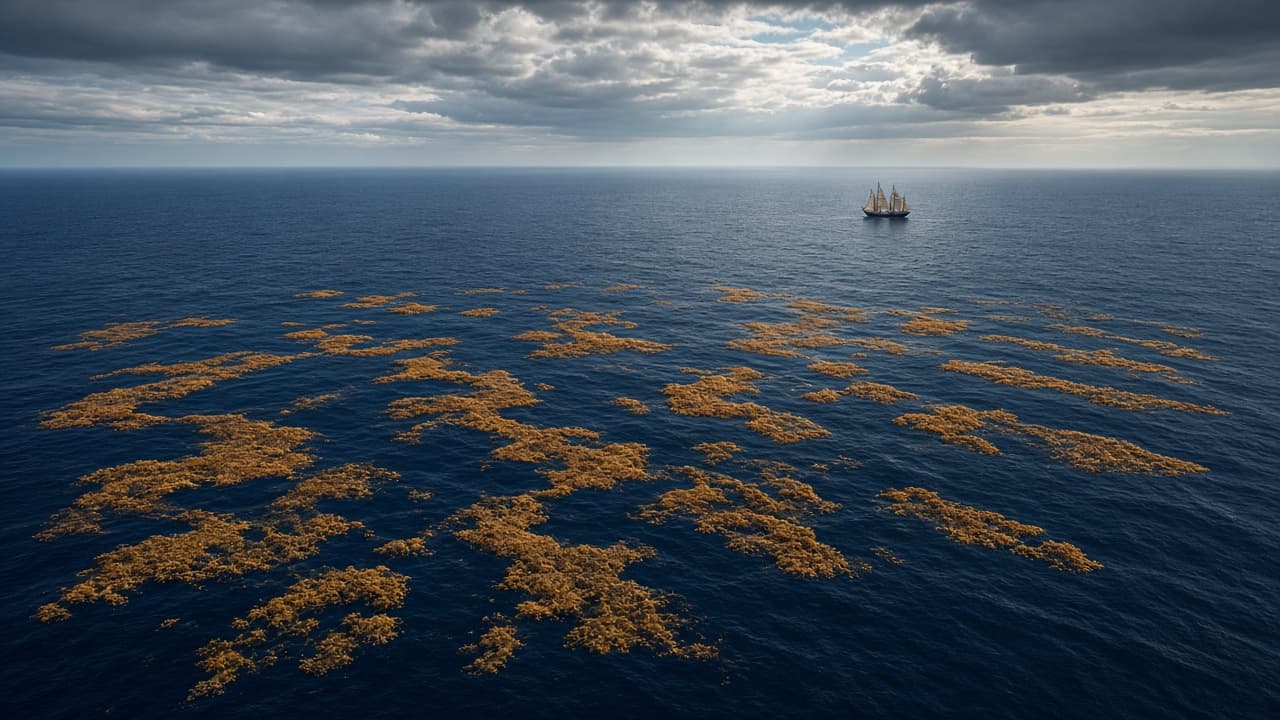
Imagine standing on the deck of a sailing ship in the middle of the Atlantic Ocean. There is no land in sight. The wind has almost disappeared. Beneath the ship, the deep blue water stretches into the distance, but the surface is covered with strange golden-brown vegetation that resembles a floating meadow. You lower a measuring line into the ocean, hoping to find a shallow seabed nearby. The line keeps descending, but the bottom never comes.
For sailors who encountered these waters centuries ago, the scene could feel deeply unsettling. Why was the ocean covered in vegetation? Was land hidden beneath it? Could the floating plants trap a ship far from civilization? And how could a sea exist without a single coastline?
This was the world of the Sargasso Sea—a real region of the North Atlantic that inspired maritime stories long before the Bermuda Triangle became famous. Its strange appearance, unpredictable sailing conditions, and unusual ecology helped turn it into one of the ocean's most intriguing places.
But the truth is even more fascinating than the legends. The Sargasso Sea is not a supernatural trap or a forgotten ocean. It is an extraordinary ecosystem shaped by currents, winds, drifting algae, and the migrations of animals across thousands of kilometres.
The Sargasso Sea lies within the North Atlantic Ocean, broadly around the region east of the Caribbean and near Bermuda. Unlike almost every other named sea, it has no land-defined coastline. Its boundaries are formed by major ocean currents that circulate around the North Atlantic subtropical gyre.
The Gulf Stream forms its western boundary, while the North Atlantic Current, Canary Current, and North Atlantic Equatorial Current help define its other sides. These currents do not create a perfectly fixed border. The boundaries shift with changing ocean conditions, so the Sargasso Sea is better understood as a dynamic ocean region than as a lake with precise edges.
The surrounding currents help concentrate floating Sargassum algae in the region. As a result, the sea has a distinctive appearance and ecology that set it apart from much of the open Atlantic.
Its exact size depends on how researchers define its shifting boundaries. Some descriptions place it at roughly two million square miles, while other conservation and scientific assessments use different study areas. Those figures should not be mistaken for the measurements of a permanently enclosed sea.
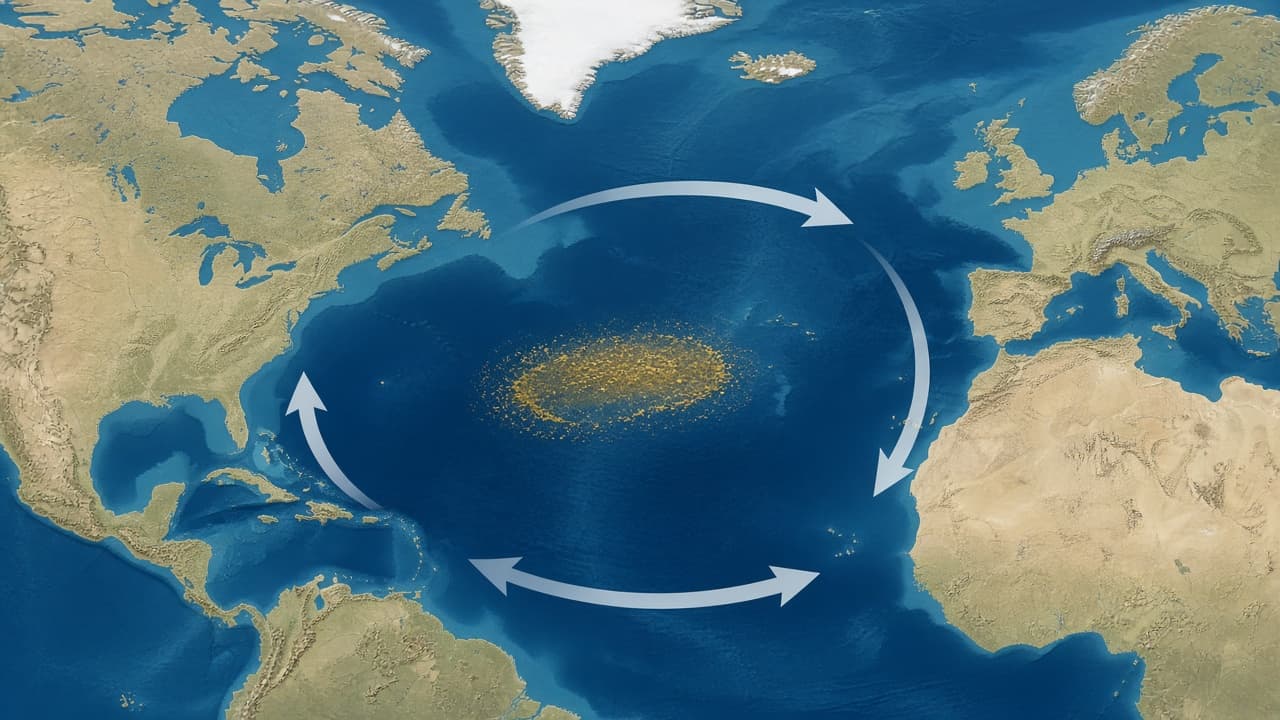
The Sargasso Sea takes its name from Sargassum, a genus of brown algae that floats at the ocean's surface. Instead of needing to remain attached to the seabed, the open-ocean species found here can float and reproduce while drifting through the water.
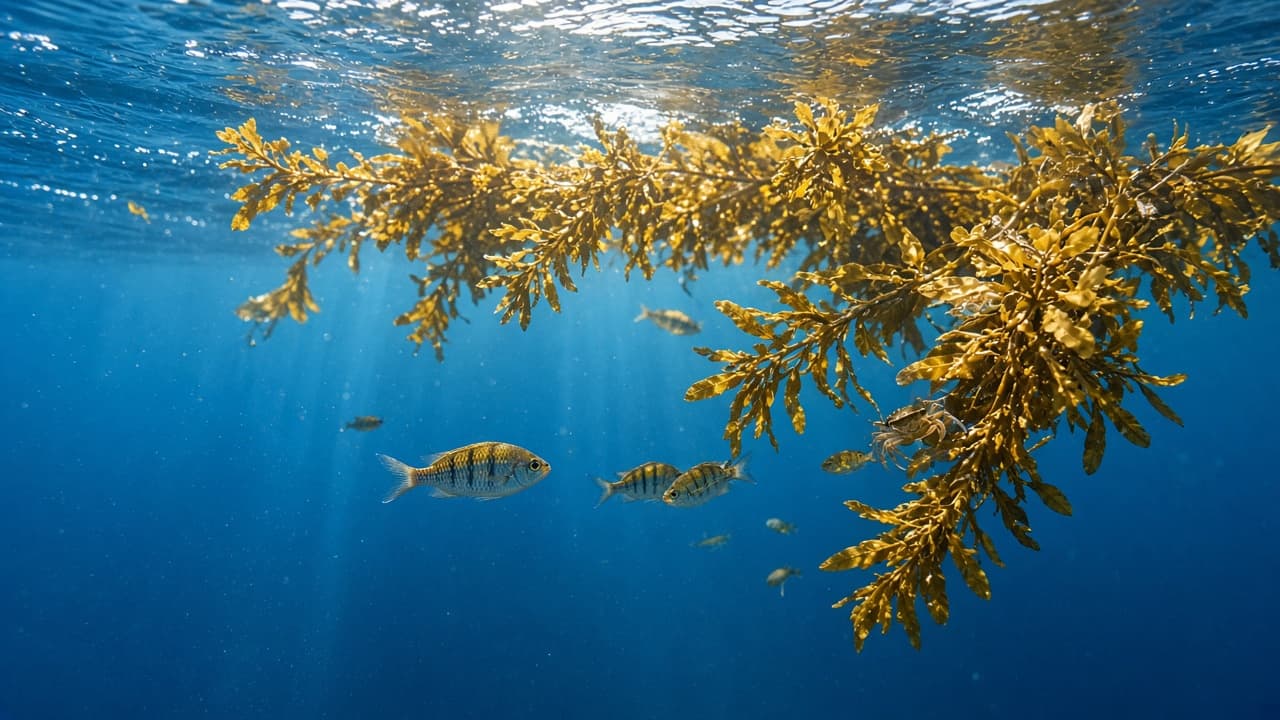
Look closely at a piece of Sargassum and you will notice small, rounded structures along its branches. These air-filled bladders help the algae remain buoyant. The seaweed gathers into clumps, ribbons, and sometimes enormous floating rafts that move with currents and winds.
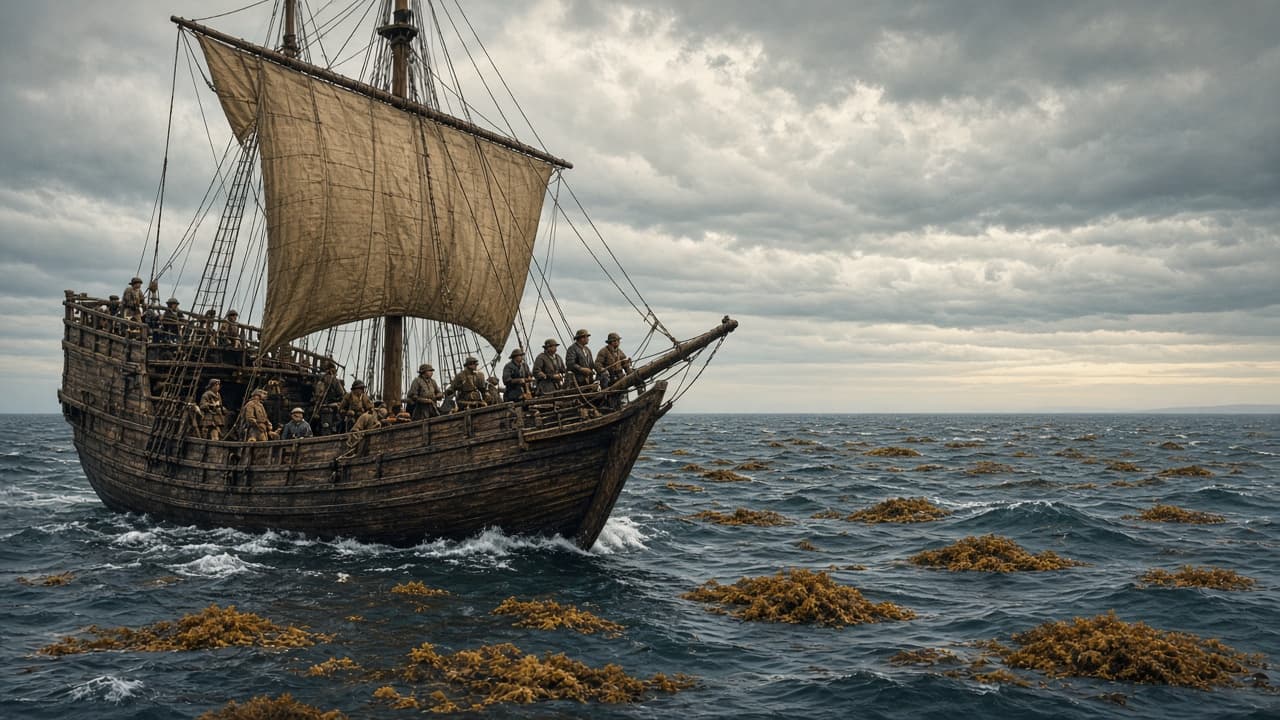
To a sailor unfamiliar with this ecosystem, the sight could look like a field of plants growing over hidden land. Some historical accounts describe fears that the weed signalled shallow water or could hold vessels in place. The imagery of ships trapped in an endless sea of vegetation became part of the Sargasso Sea's reputation.
Yet the popular image of the entire sea being covered by an impenetrable carpet of seaweed is misleading. Sargassum occurs in floating patches and rafts, not as a solid blanket across every part of the region. The amount and distribution of seaweed vary.
Sargassum can interfere with equipment or foul parts of a vessel under certain circumstances, but the idea that it routinely swallowed ships or made escape impossible is not supported by modern ocean science. The greater historical danger often came from the sailing conditions themselves.
For centuries, sailing ships depended on the wind. Without it, a vessel could lose its ability to make meaningful progress, no matter how experienced its crew might be.
Parts of the Sargasso Sea lie within the broad region historically associated with the horse latitudes, where high-pressure systems can produce weak winds and extended periods of calm. For a modern ship with an engine, calm conditions may be inconvenient. For a sailing vessel carrying limited water and food, they could become a serious emergency.
A ship might drift slowly for days while its supplies diminished. Heat, thirst, illness, and uncertainty could turn an ordinary delay into a frightening experience. From the deck, the surrounding seaweed could appear to be the cause of the problem, even when the real obstacle was the lack of wind.
The popular explanation that sailors slaughtered horses because ships became trapped in the Sargasso Sea is part of the region's historical lore, but it should not be treated as a universal or fully documented account of what happened on every voyage. The broader point is better established: windless conditions were dangerous for vessels that relied entirely on sails.
The Sargasso Sea was already part of sailors' experience before modern oceanography gave it a scientific explanation. Christopher Columbus's 1492 voyage across the Atlantic is associated with one of the earliest widely cited written European accounts of encountering extensive floating Sargassum.
Imagine what the sight might have meant to a crew travelling into unfamiliar waters. They had no satellite images, modern navigation systems, or detailed ocean-current maps. A wide field of unfamiliar vegetation could raise an obvious question: what lay beneath the surface?
Floating plants can suggest proximity to land, but in the Sargasso Sea the algae can live and reproduce in the open ocean. The discovery challenged assumptions about where marine vegetation could survive.
Stories of sailors fearing the weed helped build the sea's reputation as an uncanny place. However, the historical record does not justify claiming that Columbus discovered a supernatural ocean or that his crew faced a confirmed threat of being permanently trapped by seaweed.
The real historical significance is subtler: the Sargasso Sea is an example of how unfamiliar natural phenomena can become legends when people encounter them before they understand them.
The Sargasso Sea and the Bermuda Triangle are often mentioned together in books, documentaries, and online discussions about unexplained ocean mysteries. Their reputations overlap partly because both are associated with the western and central North Atlantic, and Bermuda is close to the Sargasso Sea.
However, they are not the same thing. The Sargasso Sea is a recognized oceanographic region characterized by its circulating currents and floating Sargassum. The Bermuda Triangle is a popular name for a loosely defined area of the Atlantic, often described using Bermuda, Florida, and Puerto Rico as its approximate points.
The Bermuda Triangle became especially famous through twentieth-century stories about ships and aircraft that disappeared under supposedly mysterious circumstances. Some accounts mixed genuine losses with speculation, errors, incomplete records, or dramatic retellings.
The US National Oceanic and Atmospheric Administration notes that there is no evidence that mysterious disappearances occur more frequently in the Bermuda Triangle than in other large, heavily travelled regions of the ocean. It also points to more ordinary hazards, including tropical storms, the Gulf Stream, navigational challenges, and human error.
This does not mean every historical shipwreck has been solved. It means that an unresolved incident is not, by itself, evidence of a paranormal force. The Sargasso Sea's genuine mysteries should not be confused with every legend associated with the Bermuda Triangle.
Perhaps the most surprising thing about the Sargasso Sea is that its floating vegetation is not a threat to life. It is a habitat that supports it.
The tangled branches of Sargassum create shelter and feeding areas for fish, crabs, shrimp, and other small marine animals. Some species are specially adapted to blend into the weed, helping them hide from predators or ambush prey. Young sea turtles can also use Sargassum mats as places to find food and shelter.
Larger animals depend on the wider ecosystem, too. The Sargasso Sea serves as a migratory corridor for marine wildlife, including whales, sharks, and other species. It also provides important habitat for commercially valuable fish.
The seaweed's role extends beyond the surface. When Sargassum loses its buoyancy and sinks, some of its organic material reaches deeper waters, where it can contribute to deep-sea food webs and the movement of carbon through the ocean.
This creates a remarkable ecological contrast. What once appeared to some sailors to be a lifeless trap is actually a complex habitat supporting animals at different stages of their lives.
Among the Sargasso Sea's most remarkable inhabitants are eels whose life cycles cross entire ocean regions. European and American eels are associated with spawning in the Sargasso Sea, although many details of their migrations and reproductive lives have historically been difficult to observe directly.
Young eels travel from their oceanic spawning grounds toward freshwater and coastal habitats in Europe and North America. After growing for years, mature eels migrate back toward the Atlantic breeding region. Their life cycle connects distant rivers, coastal waters, and the open ocean.
This journey raises extraordinary biological questions. How do eels navigate such long distances? What environmental cues guide their migration? How do changing ocean conditions affect their survival?
Researchers have made significant progress in understanding eel biology, but the open ocean makes some parts of the story difficult to observe. Scientists must combine tracking, sampling, oceanographic data, and studies of eel development to piece together the journey.
The Sargasso Sea is especially important because it is recognized as the spawning area for European and American eels, two species facing conservation concerns. Protecting the open ocean where they reproduce is one part of protecting animals whose lives also depend on rivers, estuaries, and coastal environments.
The Sargasso Sea may look calm from above, but the water beneath it is not an empty blue void. The region contains a wide range of depths, underwater landscapes, changing water masses, and marine communities.
In parts of the Sargasso Sea, the seafloor lies thousands of metres below the surface. Deep-ocean environments can contain seamounts, abyssal plains, and habitats shaped by darkness, pressure, temperature, and the slow delivery of food from above.
Oceanographers study the movement of water, nutrients, plankton, and carbon through the region. They also investigate how eddies and fronts influence marine productivity. These moving features can alter local conditions, transporting water and organisms across different parts of the ocean.
The Sargasso Sea is not a single unexplored hole in the ocean, and scientists have studied it for generations. Nevertheless, the open sea is vast, and its changing ecosystems remain difficult to observe continuously. Each expedition and long-term monitoring programme can add information that helps researchers understand how the region works.
The most exciting unknowns are not necessarily hidden monsters or lost civilizations. They are questions about how the ocean circulates, how marine species survive across immense distances, and how an ecosystem can influence the wider planet.
The Sargasso Sea may appear remote, but it is not isolated from human activity. Shipping, fishing pressure, plastic pollution, and climate change all create challenges for this open-ocean ecosystem.
Because circulating currents can concentrate floating material, the same physical processes that help gather Sargassum can also influence the movement and accumulation of pollutants. Plastic and other debris can enter marine food webs or threaten animals that mistake floating material for food.
Climate change can also affect ocean temperatures, circulation patterns, and marine ecosystems. The precise consequences vary by species and process, which is why continued monitoring is important rather than assuming a single outcome for the entire region.
International cooperation matters because the Sargasso Sea lies largely in the high seas, beyond any one country's ordinary territorial waters. Conservation efforts therefore involve scientific institutions, governments, and international organizations working to improve knowledge and coordinate protection.
Protecting this ecosystem is not just about saving a strange patch of floating seaweed. It is about preserving a nursery for marine life, a migratory region for ocean animals, and a part of the Atlantic that helps us understand how life and water move across the planet.
The Sargasso Sea captures something powerful about human curiosity. It is both familiar and alien: ordinary seawater shaped into an unusual landscape by invisible forces, filled with living organisms that follow journeys we cannot easily see.
For early sailors, the seaweed and calm weather could seem like signs that the ocean was hiding something. Today, we can explain much of what they observed through ocean circulation, atmospheric conditions, and marine biology. Yet explanation has not made the place any less extraordinary.
A sea without shores challenges the way we imagine geography. A floating forest challenges the idea that marine ecosystems must grow from the seabed. Eels travelling across the Atlantic challenge our sense of how far an animal can journey during its life.
And a vast ocean region that is still being monitored and investigated reminds us that understanding the planet is an ongoing project. We have mapped much of the world, but maps alone do not tell us everything about how its systems function.
The Sargasso Sea does not need supernatural explanations to earn its reputation. Its drifting golden seaweed, shifting boundaries, historic sailing challenges, remarkable wildlife, and deep-ocean environment make it one of the most distinctive regions of the Atlantic.
The stories of ships trapped in weed and mysterious disappearances helped turn it into a maritime legend. But the evidence points toward a more interesting truth: many of the experiences that seemed inexplicable to earlier sailors arose from natural processes that they could not yet fully understand.
The sea still holds questions worth investigating—from the long-distance migrations of eels to the effects of changing currents and pollution. These are not failures of science. They are invitations to explore.
Perhaps that is the greatest mystery of all. Even on a planet we have studied for centuries, nature can create places so unusual that they force us to rethink what we thought we knew.
The Sargasso Sea has no shores, but it has boundaries. It has no solid forest floor, but it shelters life. And while its legends may never disappear entirely, its real story is still being written by the ocean itself.