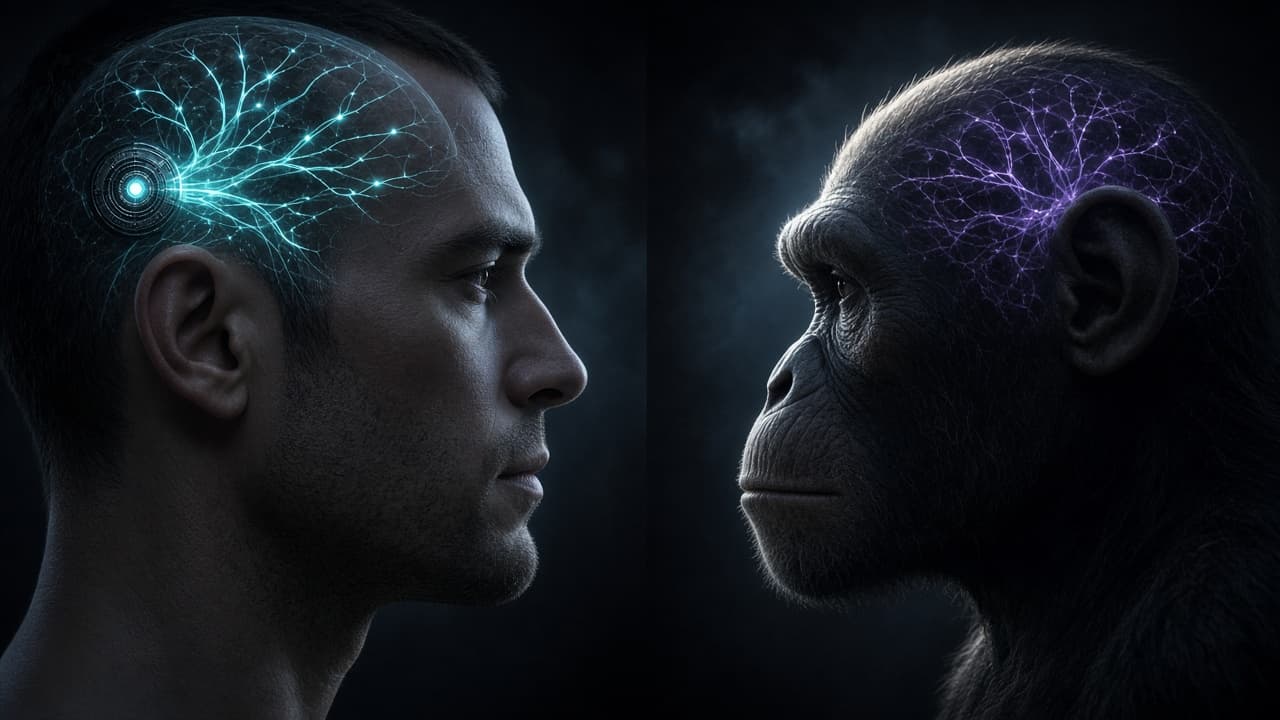
In Planet of the Apes, a laboratory treatment does something no brain chip has ever done. It does not help a paralyzed person move a cursor. It changes what a mind is capable of.
Elon Musk's Neuralink is often described as if it were heading in the same direction: a coin-sized implant, threads in the cortex, a wireless link to a computer, and a longer-term claim that humans will need a high-bandwidth connection to artificial intelligence. The images are easy to mash together. The science is not.
A brain-computer interface can, in the right patient, decode intended movement from motor cortex. That is a genuine, carefully studied medical technology. It is also a narrow one. It does not upload a personality, raise IQ, or turn a chimpanzee into Caesar.
The useful question is therefore not 'Has science fiction arrived?' It is: what can these implants actually do, what have human trials shown, and how far is that from the intelligence-enhancing experiment in Planet of the Apes?
Neuralink is a company building an implantable brain-computer interface. The public-facing system is a sealed implant placed in the skull, with ultra-thin electrode threads inserted into brain tissue by a surgical robot. The implant records electrical activity from neurons, processes the signal on the device, and sends it wirelessly to software that can move a cursor, click, or control another digital interface.
That description already separates Neuralink from most consumer gadgets. It is not a headband. It is not a consumer EEG toy. It is neurosurgery plus electronics plus machine-learning decoding. The first intended users are people with severe paralysis who have lost the ability to use their hands to operate a computer or phone.
- Brain-computer interface
- A system that records neural activity and translates it into a command for a computer, prosthetic or other device, without using muscles as the output path.
- Also known as: BCI, brain-machine interface
Musk has also talked about later uses: restoring vision, treating psychiatric conditions, and eventually a high-bandwidth link between human brains and AI. Those remain goals, not demonstrated products. The gap between a working cursor and 'symbiosis with AI' is the gap this article is about.
Popular coverage often says a chip 'reads your thoughts.' That is the wrong picture. In the motor-cortex implants used by Neuralink and by earlier academic systems, the useful signal is closer to this: the person imagines or attempts a movement, populations of neurons fire in a pattern associated with that intention, and a decoder maps the pattern onto a two-dimensional cursor or a click.
The implant does not have a transcript of inner speech sitting in memory. It has voltage traces. Researchers train a model on those traces while the participant tries to move. Over hours and days the mapping can become reliable enough to browse the web, play a game, or type with an on-screen keyboard.
What the implant is doing
- Electrodes sit in or near motor cortex and pick up local electrical activity.
- On-implant electronics amplify, digitize and compress the signal.
- A decoder—trained with the participant—turns that activity into cursor motion, clicks or similar commands.
- The person gets visual feedback and learns, with the model, to produce cleaner control.
That loop is impressive. It is also specific. Change the task from 'move a cursor left' to 'increase general intelligence' and there is no equivalent map. Intelligence is not a single motor command sitting in one cortical patch.
Neuralink has moved from animal work into human trials. In January 2024 the company said its first human participant had received an implant. That person, Noland Arbaugh, later appeared in public demonstrations using the device to control a computer after a spinal cord injury. Neuralink has since described additional participants in its PRIME study and related protocols.
The early results matter, and they should be stated without the marketing haze. People who could not use their hands have used an implant to move a cursor, play games, and browse. That is a functional gain. It is also the kind of gain BrainGate and other academic groups had already shown, over many years, with different hardware.
The first implant also showed a real engineering problem: some electrode threads retracted from the brain, which reduced the number of usable signals. Neuralink described algorithm changes that recovered a useful level of control. That episode is more informative than a launch video. It shows that the interface is a living piece of hardware inside living tissue, and that tissue moves.
If you strip away the science-fiction frame, the current capability is assistive technology for people with severe motor impairment.
- Control an on-screen cursor without using hands.
- Click, select and navigate software after a period of calibration.
- Play simple games or use standard computer applications as the decoder improves.
- Do this wirelessly, without a cable bolted through the skull of the kind used in some earlier research systems.
Those are not small things if you cannot move your arms. They are also not a new species of mind. The person using the implant is the same person, with the same memories, the same language, the same intelligence, and a new output channel.
A Neuralink implant does not make someone smarter. It does not download skills. It does not let you inhabit someone else's memories. It does not give a surgeon a complete map of a person's beliefs. And it does not, by itself, create the kind of cognitive leap Planet of the Apes uses as its origin story.
There is research on stimulating the brain as well as recording from it. Deep-brain stimulation already treats some movement and psychiatric disorders. Experimental work has tried to support memory or mood. None of that is a consumer intelligence upgrade, and none of it is a reliable recipe for turning a non-human primate into a strategist.
In the reboot that begins with Rise of the Planet of the Apes, the fictional drug ALZ-112 is a gene-therapy treatment aimed at Alzheimer's disease. In the story, it repairs and enhances cognition. When it is given to apes, they become dramatically more intelligent. Later versions of the virus spread. The plot is about a biological change to the brain's developmental and cognitive machinery, not about a wireless implant that talks to a laptop.
| Question | Planet of the Apes (reboot) | Neuralink-style BCI |
|---|---|---|
| What is the intervention? | A viral gene-therapy drug that alters cognition | An implant that records neural activity and sends it to a computer |
| Who is changed? | Apes, then a wider population in the fiction | Individual human patients in a clinical study |
| What improves? | General intelligence, language, social strategy—in the story | The ability to control a digital interface without hands |
| Is the change heritable or contagious? | The fiction treats later versions as spreading | No. The hardware is in one skull. |
| Has this been demonstrated? | No. It is a film. | Limited, real human trials for assistive control |
The comparison is still useful, because it names the fear underneath the headlines: that someone will use a brain technology not to restore a lost function, but to create a new kind of mind—and that they will do it first in animals, or without consent, or faster than society can respond.
Neuralink and many academic BCI groups have trained non-human primates to use implants to move cursors or robotic arms. Those experiments are ethically contested, and they are scientifically ordinary in this field: motor cortex is mapped in similar ways across primates, so a monkey study can test hardware before a human trial.
What those studies do not show is an ape that has become a person. The animal is performing a learned control task. It has not acquired human language, political organization, or the narrative intelligence of Caesar. Treating a research macaque with a Utah array or a Neuralink thread as a step toward Planet of the Apes confuses a laboratory control task with a species-level cognitive transformation.
If the story is 'humans have begun implanting computers in brains,' that story is older than Neuralink. BrainGate researchers have published years of work in which people with paralysis used implanted arrays to type, control robotic arms, and communicate. Synchron has developed a stent-like sensor that reaches the brain through blood vessels, avoiding an open-skull implant. Other companies and labs are testing speech decoders that try to reconstruct intended words from cortical activity.
Neuralink's distinctive claims are engineering ones: more channels, thinner threads, a robot that inserts them, a fully implanted wireless package, and a plan to scale. Whether those claims become a reliable medical device is an empirical question. It is not settled by a livestream.
Any implant that enters the brain carries surgical risk: bleeding, infection, seizure, damage to nearby tissue. Once it is in, the device can fail, migrate, or lose signal as scar tissue forms. Batteries, radios and firmware become medical problems. Removing or replacing an implant is another surgery.
There are also questions that are not captured on a hospital consent form. Who stores the neural data? What happens if a company folds? Can a decoder be used to infer more than the user intended to share? A motor cursor is a limited channel. A future speech decoder would be a more intimate one.
- Infection, hemorrhage and other surgical complications.
- Loss of signal as electrodes move or the brain encapsulates them.
- Device failure, software bugs, and the need for revision surgery.
- Privacy of neural data, and the commercial incentives around it.
- Unequal access if the technology ever leaves a trial setting.
Musk has said that a high-bandwidth brain interface might be necessary if humans are to keep up with artificial intelligence. That sentence is doing a lot of work. It assumes AI capabilities will outrun unaided humans, that a useful interface would be an implant rather than a screen or an earpiece, and that 'keeping up' is a well-defined engineering target.
A more grounded version is this: if a person can already control a computer with an implant, then that computer can run any software, including an AI assistant. The implant is the mouse. The intelligence, if any extra intelligence appears, is in the model on the other side of the link—not in a rewritten cortex.
That is still a serious future. It is also a different future from Planet of the Apes. One path is a medical device that lets a paralyzed person use ChatGPT with their mind the way they would use it with a finger. The other is a biological rewrite of cognition. Only one of those is in human trials.
If the question means 'Are scientists putting devices into living brains and reading signals that control machines?' then yes. That work is real, it includes Neuralink, and it includes people who have used an implant in daily life.
If the question means 'Are we about to create a new intelligent species with a chip, or upgrade human minds the way ALZ-112 upgrades apes in the film?' then no. That would require a different science: developmental neuroscience, gene therapy, or some other way of changing how a brain learns and reasons, with evidence that the change is safe. A motor BCI is not that science.
A more honest distance scale
Where we are
Small human trials of implants that decode intended movement or, in other labs, attempted speech.
A nearby next step
More reliable hardware, more patients, better decoders, and perhaps stimulation as well as recording.
A farther step
A durable medical product that a hospital can implant, maintain and explain without a livestream.
The movie
A treatment that rewrites general intelligence in another species. That is not on Neuralink's published clinical path.
It is easy to laugh at the comparison and stop there. That would miss the part of the film that is not about apes. Planet of the Apes is also a story about a laboratory that treats a mind as a test article, a company that wants a miracle drug, and a society that does not notice the consequences until they are already loose.
Brain implants will not need to create talking chimpanzees to raise those issues. They only need to sit inside a person, work well enough to matter, and belong to a company with incentives that are not identical to the patient's. The closer the decoder gets to speech and intention, the more those incentives matter.
That is a better frame than a movie poster. Neuralink is not Caesar. It is a high-profile attempt to industrialize a technology academic labs have been inching forward for decades. The question worth keeping is not whether we are living in the film. It is whether the people inside the trial, and the public watching it, can tell the difference between a restored hand and a rewritten mind.
Frequently asked questions
What is Elon Musk's brain chip?
Has Neuralink been implanted in humans?
Can Neuralink increase intelligence?
Is Neuralink the same as the Planet of the Apes experiment?
Have monkeys been used in this research?
Are there other brain chips besides Neuralink?
Could a brain chip connect a person to AI?
Brain chips are no longer science fiction. People have used them. Neuralink has put that fact on a stage, with a brand and a founder that make the story travel farther than a journal paper ever will.
What those people have used the chips for is still modest in the only sense that matters here: they have gained a way to act on a screen. They have not become a new kind of human, and no ape has become a new kind of person.
If you want a comparison with Planet of the Apes, keep the laboratory, the ambition, and the risk that a company will oversell a medical device as destiny. Leave the talking apes in the cinema. The real experiment is already strange enough without them.